External Thread Machining Guide: ISO/UNC/NPT Depth & Passes
External thread machining parameters control the cutting depth in thread turning or thread milling. Different standards (ISO, metric, UNC, BSPT, NPT, ACME) need suitable pass counts and depth distribution. This guide covers cutting depth and a degressive-infeed strategy for external threads to lower tool wear, avoid chatter and chipping, and improve thread surface quality and accuracy.
1. What Are External Thread Parameters
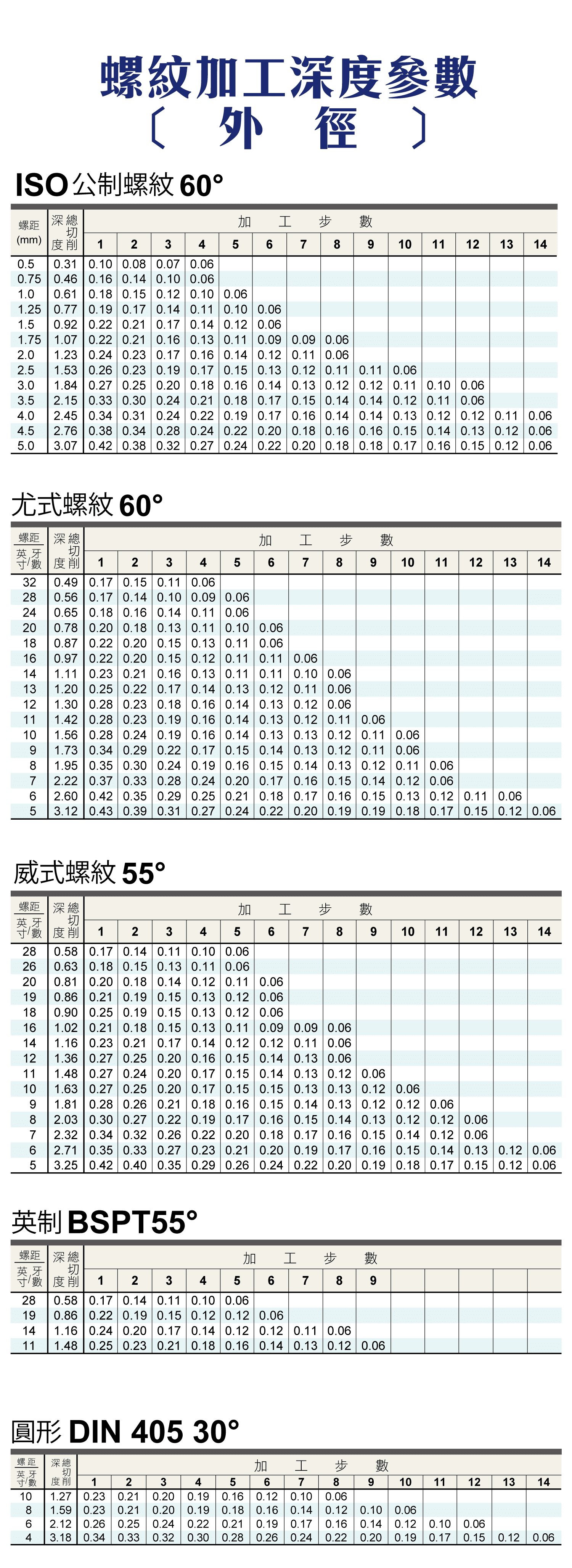
External thread parameters are the depth per pass and the number of passes, used mainly in CNC thread turning, thread milling and pre-rolling control.
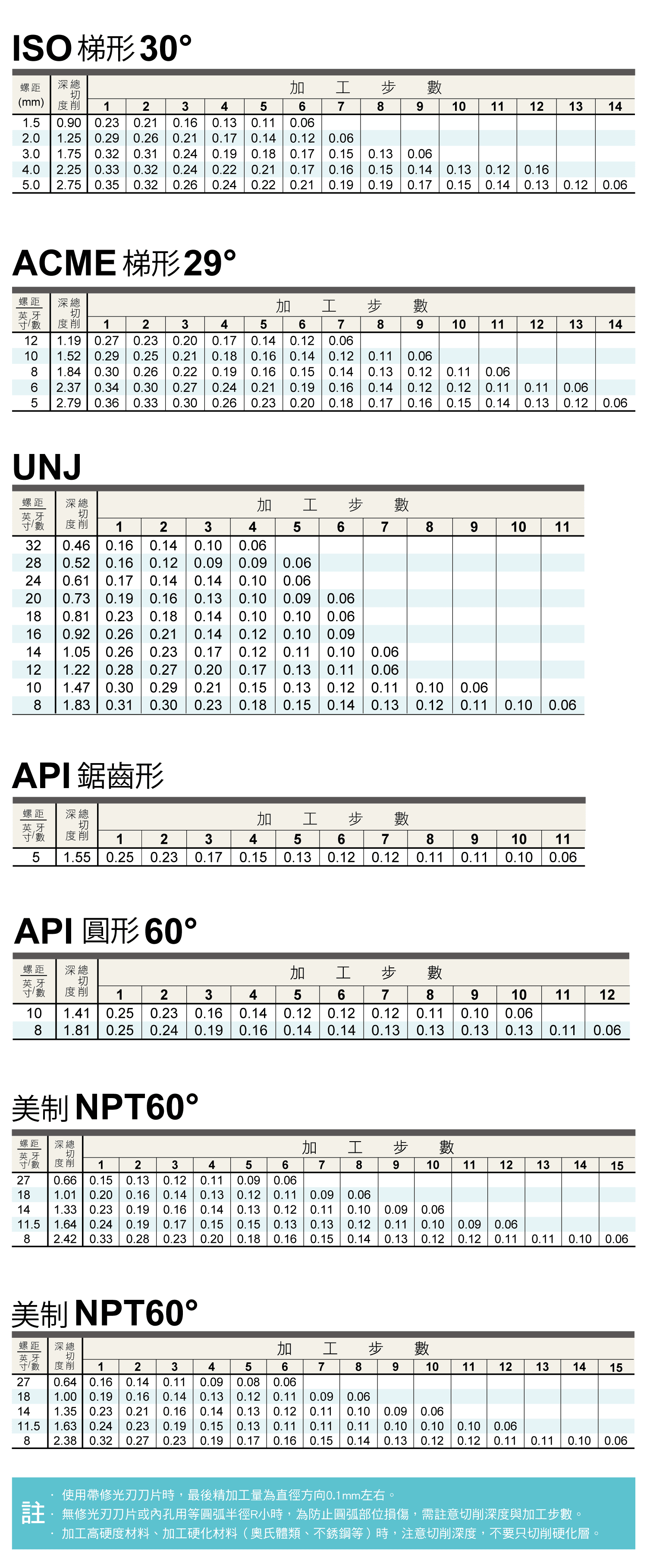
2. Common Thread Types and Applications
Different standards have different flank angles and uses, so machining strategy differs too:
| Thread type | Angle | Application / notes |
|---|---|---|
| ISO metric | 60° | Most common (M series), general machinery/molds; 6–12 passes suggested |
| UNC / UNJ (inch) | 60° | Inch TPI; auto/aerospace; UNJ has a root radius for fatigue strength |
| BSPT pipe thread | 55° | Inch taper thread for pipe sealing; cut conservatively to avoid thin threads |
| NPT / NPTF | 60° | Inch taper thread, high sealing; precise depth control |
| ACME trapezoidal | 29° | Power transmission (lead screws); large removal, multi-pass layering |
| DIN 405 round thread | 30° | Food and firefighting pipework (round form, easy to clean and to connect/disconnect repeatedly) |
3. External Infeed Strategy (Degressive)
Use a degressive infeed: take more material in the first passes, then step down, and finish with a small spring/finish pass to lower tool load and avoid chatter and chipping.
| Stage | Distribution | Typical ratio (reference) |
|---|---|---|
| Pass 1–2 | Remove most material (deeper) | Early: 25–35% |
| Middle passes | Steady decrease | Mid: 15–20% |
| Later passes | Converge | Late: <10% |
| Final 1–2 passes | Finish (~0.06 mm) | Fixed small cut |
These ratios are a reference strategy; actual depth and pass count depend on pitch, material and tool — see the Turning Machining Formulas.
4. Practical Points
| Point | Note |
|---|---|
| Final finish pass | ~0.06 mm suggested, improves finish and thread form |
| Avoid chatter | External work chatters more; reduce the last few passes' cut |
| Hard materials | SUS, titanium: cut depth 30–50% lower, more passes |
| Large-diameter threads | High load; add passes to avoid tool breakage |
5. CNC Thread Turning vs Thread Milling (External)
External threads can be turned or milled, each with trade-offs in stability, accuracy and use:
| Item | Thread turning | Thread milling |
|---|---|---|
| Method | Single-point forming | Multi-pass milling |
| Stability | Lower | High |
| Accuracy | Medium | High |
| Best for | Volume production | High-value parts |
6. Machining Notes
Don't skip the finish pass; small-diameter threads need more passes; watch bottom interference with tools lacking a wiper; avoid one deep cut in hard materials; and use coolant with a steady feed. For tolerance-grade selection, see the External Thread Tolerance Guide.
FAQ
Q: How many passes for an external thread?
It depends on pitch, material and thread type. For ISO metric 60°, 6–12 passes are common; hard materials, large diameters or coarse pitches need more. Use degressive infeed, deep-to-shallow, and keep a small finish pass.
Q: What is degressive infeed?
Degressive infeed reduces each pass's cut step by step: passes 1–2 cut deeper to remove most material, the middle steps down, later passes converge, and the last 1–2 finish at about 0.06 mm. It spreads tool load, avoids chatter and chipping, and improves thread form.
Q: What to watch when threading stainless or titanium?
For hard materials (SUS, titanium), lower the cut depth by 30–50% and add passes to reduce load and chipping risk, with coolant and a steady feed. Look up actual speeds by material in the formulas guide.
Q: Thread turning or thread milling?
Thread turning is single-point forming, efficient for volume production but medium in stability and accuracy; thread milling is multi-pass with high stability and accuracy, good for high-value parts, large diameters or hard materials. Choose by volume and accuracy needs.
Last updated: 2026-07-24
For the full reading guide on this topic, see Thread Machining: A Complete Reading Guide.