Thread Machining Troubleshooting Guide: CNC Turning Fixes
Common thread-machining problems include poor thread form, surface damage, fast tool wear and chipping, usually tied to cutting-depth setup, tool mounting, cutting conditions and chip evacuation. This guide organizes common defects, root-cause analysis and fixes to help CNC operators clear problems quickly and improve stability and tool life.
1. Five Common Problems and Fixes
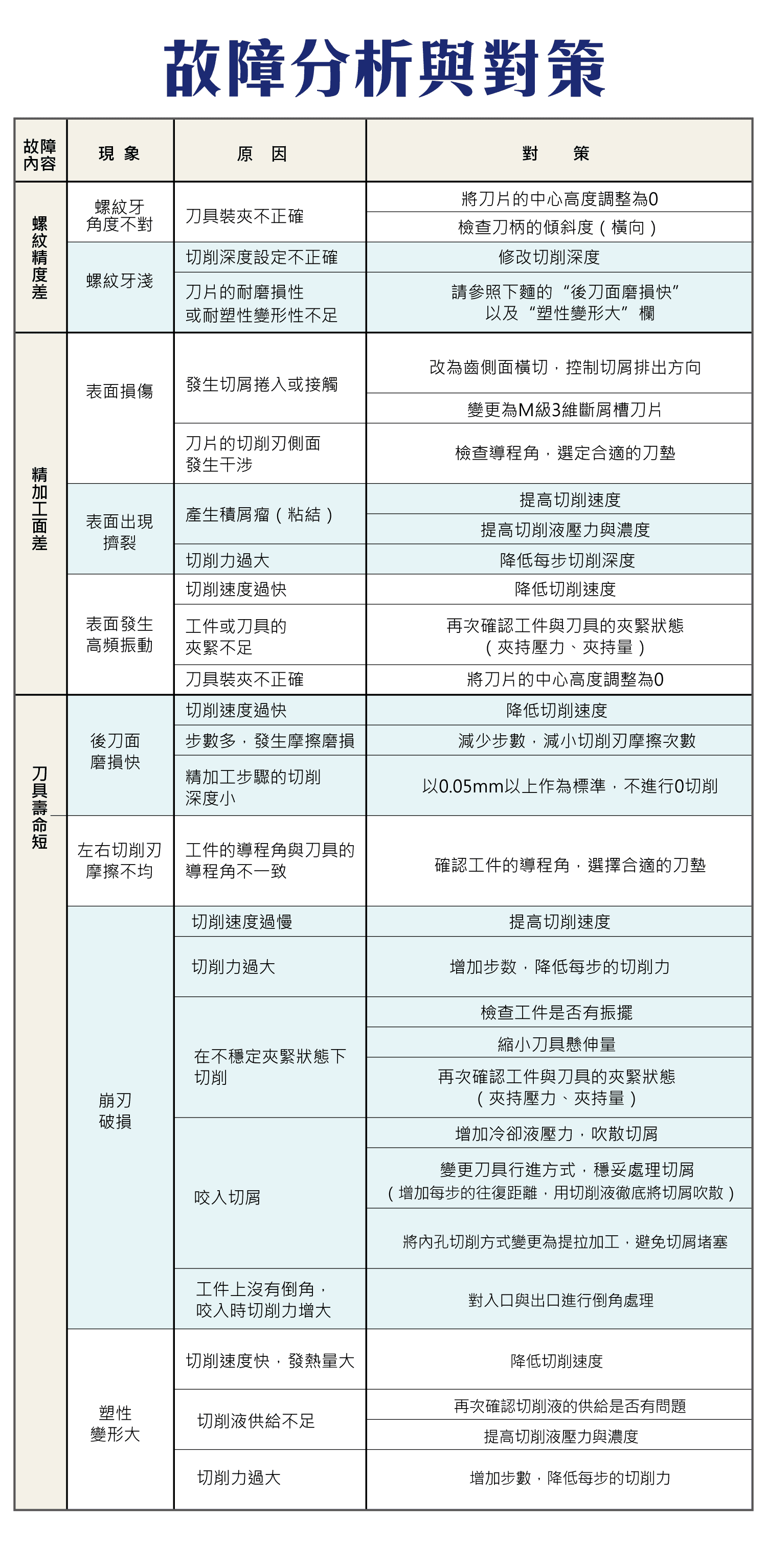
The table summarizes five common thread-machining defects, root causes and fixes:
| Problem | Main cause | Fix |
|---|---|---|
| Poor thread accuracy (form error): wrong angle, too shallow or undersized | Tool center-height error, wrong depth setup, insufficient wear resistance or plastic deformation | Set center height correct (center = 0), check shank tilt, fix depth, use wear-resistant grade/coating |
| Surface damage / poor roughness: scratches, rough | Chip tangling or re-cutting, poor evacuation | Change infeed (e.g. flank), use a chipbreaker insert, improve cooling and evacuation |
| Poor finished surface: tearing, burrs | Built-up edge, excessive cutting force | Raise speed, increase coolant concentration/pressure, lower depth per pass |
| Fast tool wear: flank wear | Too high speed, too many passes (friction), too small a finish cut | Reduce speed, cut passes, keep a sensible finish allowance (≥0.05 mm) |
| Chipping and tool breakage | Excessive force, unstable clamping, chip packing, plunging in with no chamfer | Lower per-pass cut, check clamping, add cooling/air, split passes, chamfer first |
2. Form & Accuracy (Problem 1)
A wrong thread angle or shallow form is usually tied to tool center-height error, shank tilt or depth setup. Always set the tip center height to the workpiece center (center = 0) first, then fix depth and wear resistance. Center-height error is one of the most common root causes of form defects.
3. Surface & Finish (Problems 2, 3)
Scratches and roughness mostly come from chip tangling, re-cutting or poor evacuation; tearing and burrs usually from built-up edge and high force. Fixes: switch to flank cutting and a chipbreaker insert, improve cooling/evacuation, and suppress BUE with "high speed, low per-pass cut". For chip-control detail, see the Turning Chip Control Guide.
4. Wear & Chipping (Problems 4, 5)
Fast flank wear often comes from too high a speed, too many passes, or too small a finish allowance (rubbing in the hardened layer); chipping mostly from too large a per-pass cut, unstable clamping, chip packing or plunging in without a chamfer. For wear-pattern reading, see the Tool Wear Guide.
5. Practical Key Tips
| Aspect | Key tip |
|---|---|
| Depth strategy | Avoid zero-cut passes; keep a finish pass of ≥0.05 mm |
| Condition optimization | High speed / low cut reduces BUE; low speed / big cut invites chipping |
| Evacuation control | Internal threading has long, low-rigidity tool overhang and vibrates easily with chip-buildup issues; external threading has relatively better evacuation and rigidity |
For depth distribution and infeed methods, see the CNC Thread Cutting Depth Guide and Thread Infeed Methods Explained; for actual speed and feed by material, see the Turning Machining Formulas.
FAQ
Q: What if the thread angle is wrong?
The most common root cause is tip center-height error. First set the tip center height equal to the workpiece center (center = 0), then check shank tilt and depth setup, and confirm the insert is wear-resistant with no plastic deformation.
Q: How do I fix tearing and burrs on the thread?
Tearing and burrs mostly come from built-up edge and high cutting force. Raise the speed above the BUE range, increase coolant concentration and pressure, lower the per-pass depth, and switch to flank cutting with a chipbreaker insert if needed.
Q: Why does too small a finish allowance wear faster?
With too small a finish cut, the edge tends to rub in the already-hardened surface layer rather than truly cut, building friction and speeding flank wear. Keep a sensible finish allowance (≥0.05 mm) and moderately reduce the pass count.
Q: How do I prevent thread insert chipping?
Chipping mostly comes from too large a per-pass cut, unstable clamping, chip packing or plunging in without a chamfer. Lower the per-pass cut, split passes, chamfer first, check clamping stability, and add cooling/air to prevent chip packing.
For the full reading guides on this topic, see Thread Machining: A Complete Reading Guide, Tool Life and Wear: A Complete Reading Guide and Chip Control: A Complete Reading Guide.