
How Fast Can an Abrasive Run: Same Sheet of Abrasive, Seven Times the Limit
Abrasives that mount on the same hand tool carry maximum speeds from 11 to 80 m/s — a seven-fold spread. This article ranks the common types, explains why peripheral speed and rotational speed are two limits that must both be met, why the limit is not a working value, and which types carry conditions no other type has.
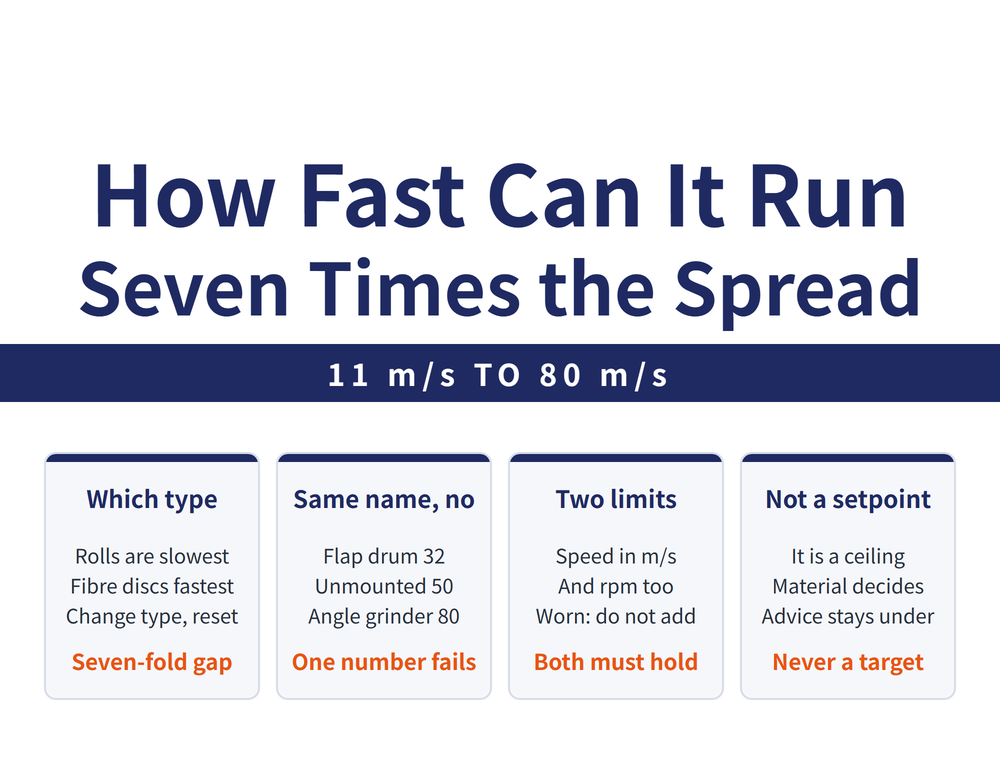
1. The same sheet of abrasive does not carry the same limit
Bonded wheels and their safe operating speed are familiar ground. Coated abrasives and flap tools spread much wider than most people expect: the slowest sits at 11 m/s, the fastest at 80 m/s.
🔴 The cost runs both ways: run the slow type at the fast speed and it can burst; run the fast type at the slow speed and the efficiency is simply thrown away. And the usual shop-floor habit is one machine, one speed setting, with the abrasive changed and the setting left alone.
For strength and safety factors on the bonded side, see Why Grinding Wheels Burst: Strength, Unbalance and the Checks Before Mounting.
2. Maximum permitted speed by type
Ranked slowest to fastest — the order itself is the first thing to look at when choosing:
| Type | Maximum permitted speed |
|---|---|
| Cartridge rolls, abrasive cones | 11 m/s |
| Self-adhesive abrasive discs | 20 m/s |
| Abrasive caps | 25 m/s |
| Abrasive spiral bands | 30 m/s |
| Hook and loop discs, flap drums | 32 m/s |
| Grinding discs | 35 m/s |
| Small-diameter quick-change systems, unmounted flap wheels | 50 m/s |
| Fibre discs, quick-change disc systems, flap wheels for angle grinders | 80 m/s |
⚠ The table above comes from one maker's tool manual. Its purpose is to show how far the types differ, not to state an industry rule. What your own tool can run is whatever its own marking says — the same type from another maker can differ.
3. One name, three forms, three limits
Flap tools are where this goes wrong most often. They come in three mounting forms, and the speed limit is not the same number:
| Form | Limit |
|---|---|
| Flap drum | 32 m/s |
| Unmounted flap wheel | 50 m/s |
| Flap wheel for angle grinders | 80 m/s |
🔴 Remember only "flap wheel, 50" and both of the other two are wrong — one wasteful, one over speed. Sharing a name does not make them the same tool; what matters is how it is mounted.
4. Peripheral speed and rotational speed are two limits, not one
A product usually carries two numbers: a maximum peripheral speed (m/s) and a maximum rotational speed (rpm). Neither may be exceeded, and diameter links them:
v = π × D × n ÷ 60000
(D = tool diameter in mm, n = rpm, v = m/s)
📌 One consequence of that relation is widely misread: as the abrasive wears down, the same rpm gives a lower peripheral speed, and efficiency drops with it. That is part of why coated abrasives feel duller with use — but it is not a licence to raise the rpm to compensate. The marked maximum rotational speed still applies.
🔴 Passing the arithmetic is not the same as being allowed. If the calculated peripheral speed is inside the limit but the marked rpm is exceeded, it is still a no. The two limits sit side by side; it is not a choice of one.
5. The limit is a ceiling, not a working value
A maximum permitted speed answers "how fast is too fast", not "how fast should I run". The working speed still depends on the material, the abrasive type and the finish required.
📌 Even the maker declines to give a universal figure: applications and drive tools vary too widely, so recommended cutting speeds are reference values only — and a recommended value must itself stay under the maximum permitted speed.
For reading the spec fields on coated abrasives, see Reading Coated Abrasive Specs: Grain, Grit, Coating, Bond and Backing. For centrifugal force on shank-mounted tools, see Mounted Points and Flap Wheels: Selection and Safe Use.
6. Conditions that belong to one type only
Beyond speed, several types carry their own rule, and the one that gets missed is usually the one that causes the accident:
| Type | Extra condition | Why |
|---|---|---|
| Grinding discs | Ring test before mounting | A crack shatters outright at speed |
| Abrasive spiral bands | Must not overhang the rubber drum holder | The overhang is unsupported and throws off |
| Hook and loop discs | Mount centred; use a backing pad | Off-centre means unbalance and vibration |
| Unmounted flap wheels | Use a proper clamping flange; above the optimum speed, contact pressure must be reduced markedly | At high speed, pressure is the main cause of failure |
| Quick-change discs, hook and loop discs, cartridge rolls and cones | 🔴 Not permitted for wet grinding | Bond and backing lose strength with water |
🔑 "No wet grinding" is the one most often missed, because wet working is normal practice with bonded wheels; move to coated abrasives and it becomes a prohibition. For markings and storage, see Abrasives Have an Expiry Date Too: Markings, Stock Rotation and Storage.
7. Frequently Asked Questions (FAQ)
Q: Does the machine speed need resetting when the abrasive changes?
Yes. Maximum permitted speeds across common types run from 11 to 80 m/s, a seven-fold spread. One speed applied to every type will over-speed the slow ones and waste the fast ones. Change the abrasive, then read the speed and rpm marked on that abrasive.
Q: If the peripheral speed is within limits, can the rpm go slightly over?
No. The two are parallel limits and both must be met. The marked maximum rotational speed may never be exceeded, even where the calculated peripheral speed is still inside its own limit.
Q: The abrasive has worn down. Can the rpm be raised to recover efficiency?
No. A smaller diameter does give a lower peripheral speed at the same rpm, and efficiency does fall, but the marked maximum rpm is still the ceiling. Fit a new tool, or choose a type rated for a higher speed, rather than winding the speed up.
Q: So what is the limit for a flap wheel?
It depends on how it is mounted. Flap drums, unmounted flap wheels and flap wheels for angle grinders carry three different figures, and remembering only one of them will be wrong on the other two. Go by the marking on the tool in your hand.
This article is part of Deburring and Surface Finishing: The Complete Guide - Which Tool, Which Material, and What to Do in Volume; that guide shows how the whole topic fits together.
Published: 2026-09-24 | Last updated: 2026-10-24









