
Why Grinding Wheels Burst: Strength, Unbalance and the Checks Before Mounting
A bursting wheel is one of the few grinding-shop accidents that hurts people, and it is almost never decided at the moment it happens. Selection, storage and the pre-mount checks each move the odds. This covers, in order: what strength and the safety factor mean, which selection choices weaken a wheel, how the unbalance limit is calculated, how abrasives should be stored, and the ten operating rules plus what a wheel guard must be made of.
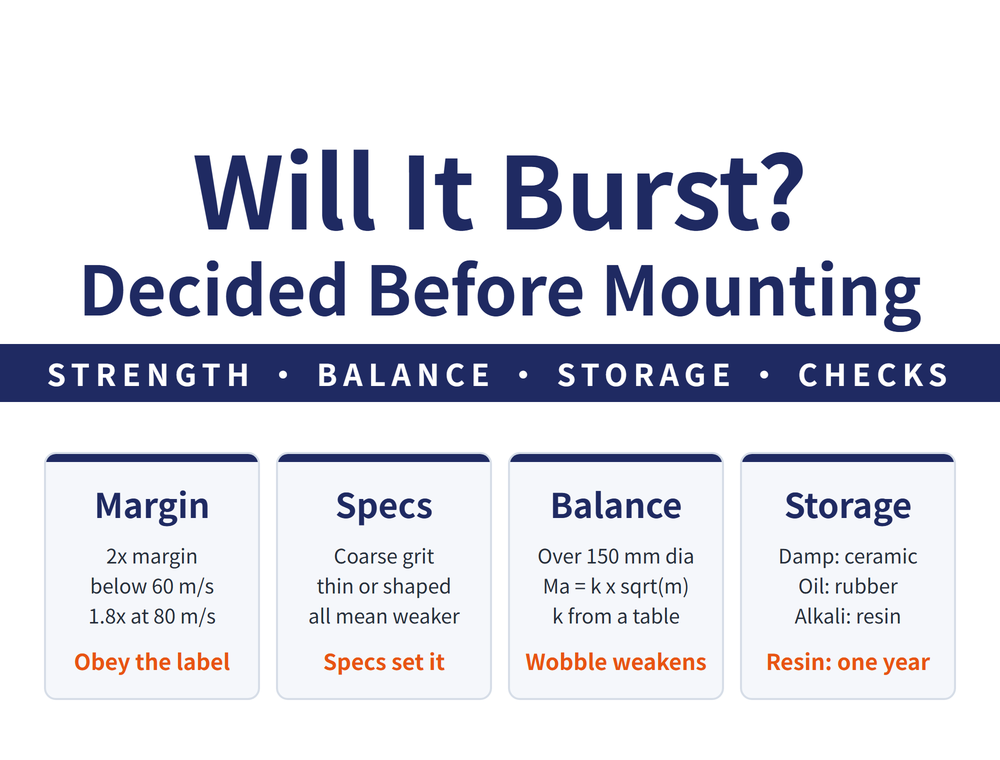
1. What wheel strength means: burst speed against working speed
Wheel strength is the wheel's ability to resist its own centrifugal force at speed and not break apart. It is not judged by feel. The rule is that burst speed must stay a set multiple above working speed, and that multiple is the safety factor fs.
| Maximum working speed vs | Safety factor fs |
|---|---|
| ≤ 60 m/s | 2 |
| 80 m/s | 1.8 |
There is a second one, the factory test factor fc: the test speed before shipping is vc = vs × fc. For working speeds between 35 and 80 m/s, fc is 1.6, slightly below the safety factor.
Reference values compiled from technical sources; go by the wheel marking and your supplier's specification. The faster the wheel, the thinner the margin — which is why high-speed grinding cannot inherit ordinary-wheel habits.
How to read the maximum speed in the last field of the marking is covered in Reading a Grinding Wheel Marking. Never run a wheel above the maximum working speed printed on it — this is the one rule in wheel safety with no room to negotiate.
2. Strength is already decided when you pick the specification
Strength is often treated as a quality attribute fixed at the factory. In fact every selection choice moves it. The table shows which direction makes a wheel weaker or stronger:
| Factor | Weaker | Stronger |
|---|---|---|
| Grit size | Coarse | Fine |
| Grade (hardness) | Soft | Hard |
| Structure | Open | Dense |
| Bond type | Vitrified | Organic (resin, rubber) |
| Bore-to-OD ratio | Large | Small |
| Thickness | Thin | Thick |
| Shape | Shaped | Straight |
| Unbalance | Large | Small |
| Reinforcement | None | Present |
The bond row is the one most often misread. It says a vitrified-bond wheel has lower burst strength than an organic-bond one. It does not say vitrified material is soft. The same applies to grade: "soft means weaker" refers to the wheel grade, not to how hard the abrasive grain is.
Put another way: choosing fine grit and a hard grade for surface quality also buys you strength; choosing coarse grit and an open structure for free cutting spends it. Nobody usually points this trade-off out, but it is always running. How grit and grade are chosen is covered in Choosing Grinding Wheel Grit, Grade, Bond and Structure.
3. Unbalance has a ceiling, and it can be calculated
Unbalance is not only about shake — it pulls strength down directly. For wheels above 150 mm outside diameter there is an empirical limit for the maximum permissible unbalance Ma:
Ma = k × √m
m = wheel mass in grams; k = an empirical coefficient read from a table by grinding method, machine, wheel diameter and speed.
The table below takes the four rows for precision grinding on a machine (surface, cylindrical, tool and centreless machines, straight wheels and their variants):
| Wheel diameter D (mm) | k (vs ≤ 40 m/s) | k (40 < vs ≤ 63) | k (63 < vs ≤ 100) |
|---|---|---|---|
| ≤ 305 | 0.25 | 0.20 | 0.16 |
| 305–610 | 0.32 | 0.25 | 0.20 |
| 610–1100 | 0.40 | 0.32 | 0.25 |
| > 1100 | 0.50 | 0.40 | 0.32 |
Reference values. This table gives only the machine precision-grinding block; hand-held rough grinding, heavy-duty snagging and cut-off work use a larger k.
The consequence of unbalance is a chain, not a single symptom: centrifugal force → vibration → poorer surface, faster machine wear, wheel damage → equipment and personal injury. And the main sources of unbalance are exactly what section 2 listed: uneven structure and geometric defects. Strength, unbalance and selection are three faces of one thing.
⚠ "A quantified limit above 150 mm OD" and "balance anything above 125 mm diameter" are two different statements: the first asks how much unbalance is permitted, the second asks whether balancing is required at all. They come from different sources and do not replace each other. How balancing is done and checked by amplitude is covered in Mounting and Balancing a Grinding Wheel: Fit, Flanges, Two-Stage Balance and Amplitude Check.
4. Before it reaches the machine: storage weakens wheels
When a customer reports that "this batch cracks more easily", storage is the most overlooked cause. And the three bond types are vulnerable to completely different things:
| Bond | Keep away from | Consequence |
|---|---|---|
| Vitrified | Damp, freezing | Loses strength and cutting ability |
| Rubber | Oil | Same |
| Resin | Alkali | Same |
Four more rules: (1) keep the store dry, room temperature not below 5 °C; (2) stand large or thick wheels upright and slightly tilted; stack thin and small ones flat, not too high, with a flat steel plate above and below to prevent distortion or cracking; (3) sort by specification and label the location so nobody picks the wrong one; (4) for long-distance transport, pack in wooden crates or wicker baskets with soft material between wheels.
Organic-bond wheels (resin and rubber) should not be stored longer than one year. Anything past that should be strength-tested before use, and a wheel that has been re-made must pass a fresh spin test first. That batch sitting at the back of the store is not "still new because nobody used it".
Cut-off wheels and grinding discs also carry an expiry date set by the standard; for which markings to check at goods-in and how to run stock first in first out, see Abrasives Have an Expiry Date Too: Markings, Stock Rotation and Storage.
5. At the machine: ten rules you cannot skip
| When | What to do |
|---|---|
| Before start-up | Check that every lever and button sits in the right position and that all machine movements are normal |
| First run of a new wheel | Idle 2–3 minutes to confirm it runs true, dress the periphery and both faces flat, take it off with the flanges, then static balance it again |
| Where to stand | Never stand in the plane of wheel rotation; never lean on the machine |
| Before grinding | Confirm the part is located and clamped securely; set and lock the stops; make sure the wheel cannot hit the chuck, jaws or tailstock |
| Infeed and retract | Feed in only once both part and wheel are running normally, and never feed in abruptly; always retract before stopping |
| People | Two people must not operate one grinder at the same time |
| Measuring | Never measure a rotating part; never touch a running wheel by hand, or wipe a rotating part with cotton waste |
| Personal protection | Close-fitting clothing and a mask against dust and coolant mist; long hair under a cap; safety glasses when dressing the wheel |
| Before shutdown | Shut off the coolant supply first and let the wheel run dry for 1–2 minutes to throw off absorbed fluid |
The last one gets skipped most often. A wheel that stops while soaked lets the fluid settle to the bottom, and what you start next time is an off-centre wheel.
6. If it does burst: the guard has to hold
The first five sections exist to stop it bursting; protection has to assume it will. A wheel guard catches fragments at the moment of failure, so both material and construction are specified:
| Item | Requirement |
|---|---|
| Material | Welded steel plate or cast steel; aluminium alloy castings are acceptable for small wheels. Cast iron is too weak and must not be used |
| Wall thickness | Graded by wheel diameter, width and speed. Larger wheels or higher speeds need thicker walls plus a reinforcing ring; cast steel needs more thickness than plate |
| Opening | Keep the opening as small as the work allows, so fewer fragments can escape through it |
| Inner wall | An energy-absorbing liner reduces impact |
Actual wall thicknesses depend on wheel specification and speed. Follow the machine manufacturer's specification and the occupational safety regulations in force where you are; no specific dimensions are given here.
7. Frequently Asked Questions (FAQ)
Q: We have wheels that sat in the store for two years. Can we still use them?
Organic-bond wheels, meaning resin and rubber, should not be stored beyond one year. Anything older needs a strength test before use. Unused does not mean new — the bond degrades with time and environment.
Q: Is a fine-grit, hard-grade wheel safer?
In terms of burst strength the direction is right: fine grit, harder grade and denser structure all give more strength. But specification must follow the job. Strength is a side effect, not a reason to pick the wrong wheel.
Q: Why let the wheel run dry for a minute or two before stopping?
Shutting off the coolant and running dry throws off the fluid the wheel has absorbed. If it stays in the wheel it settles to the bottom, creating an off-centre wheel that shakes on the next start and loses strength.
Q: Can a wheel guard be made of cast iron?
No. Cast iron is not strong enough to contain fragments at the moment of burst. Use welded steel plate or cast steel; aluminium alloy castings are acceptable for smaller wheels.
This article belongs to the line covered in Grinding Wheels and Machines: The Complete Guide - Reading the Wheel, Mounting It, Dressing It, and Tracing Defects, which shows where to start and where to go next.
Published: 2026-09-17|Updated: 2026-10-24









