
Abrasives Have an Expiry Date Too: Markings, Stock Rotation and Storage
Cut-off wheels and grinding discs carry an expiry date, and it is written into the standard rather than offered as advice. This article covers which markings to check at goods-in, why only one family of bonds expires, how to run stock first in first out, and the three environmental factors that actually damage them in storage.
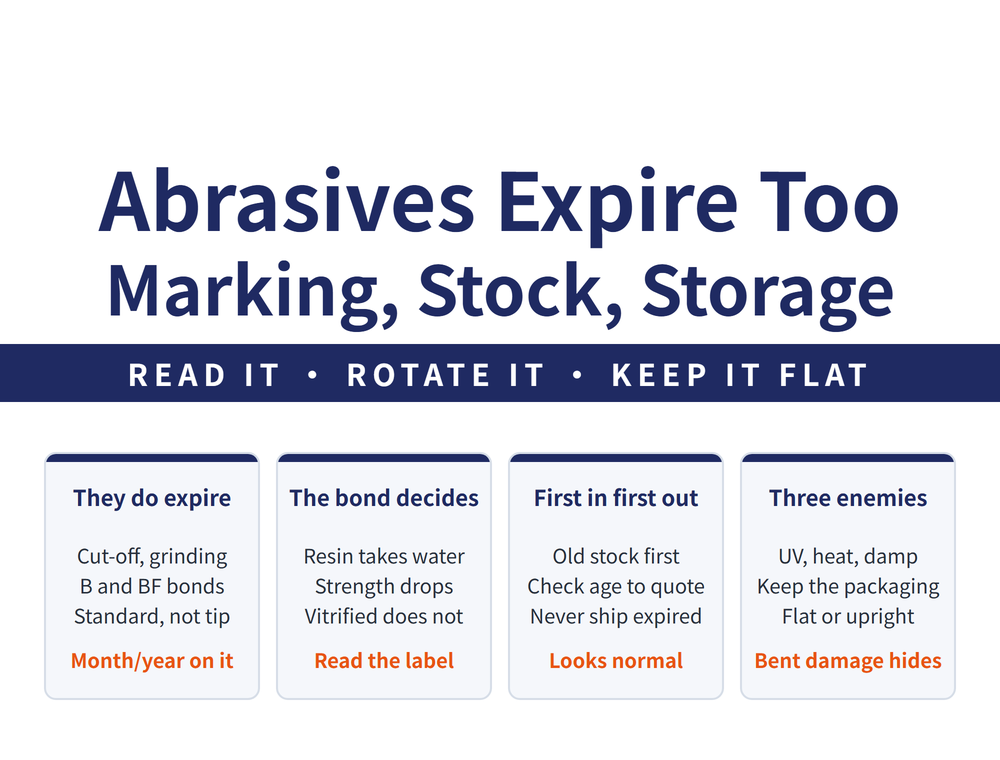
1. Start with the part fewest people know: they expire
Products for hand-held grinding whose bond type is B or BF — in other words the everyday cut-off wheels and grinding discs — must not be used after the marked expiry date, under EN 12413.
🔴 That is a requirement of the standard, not a maker's recommendation. The date is marked as month/year (04/2026, for example), and the bond type is always on the label; both pieces of information sit on the same label.
📌 Why only that family expires: these resinoid bonds absorb moisture and age over time, and once strength has fallen there is a burst risk at speed. Vitrified-bond products do not share the problem and carry no expiry date — the difference is the bond, not what the product looks like.
2. What to check on the marking at goods-in
With the expiry date included, incoming inspection comes down to four items:
| Check | Criterion |
|---|---|
| Safety standard number | EN 12413 for bonded, EN 13743 for coated, EN 13236 for diamond and CBN |
| oSa mark | Membership mark of the abrasives safety organisation, whose testing requirements exceed those EN thresholds |
| Bond type | B or BF is the family that expires, so read the date next |
| Expiry date | Month/year format; do not accept or ship anything past it |
🔴 And one rule with no exceptions: a tool whose marking cannot be clearly identified must never be used. If it cannot be read, do not gamble on it — this goes straight into the goods-in criteria.
For reading the code fields, see Reading Grinding Wheel Markings: Grain, Grit, Grade, Structure and Bond. For coated specs, see Reading Coated Abrasive Specs: Grain, Grit, Coating, Bond and Backing.
3. Which standard covers what
The three numbers are not versions of each other; they cover different things:
| Standard | Scope |
|---|---|
| EN 12413 | Bonded: reinforced wheels, cut-off wheels, cup wheels, grinding wheels |
| EN 13743 | Coated: flap discs, abrasive discs on a backing |
| EN 13236 | Superabrasives: diamond and CBN tools |
📌 oSa is not a standard but an organisation: leading makers joined it voluntarily and commit to continuous monitoring of product safety and quality. The mark means the product passed that system, and its testing requirements are set above the EN thresholds.
4. Stock has to be rotated first in first out
Once there is an expiry date, stock is managed differently:
| Practice | What happens without it |
|---|---|
| First in, first out; older stock goes first | A batch nobody can use quietly accumulates at the back |
| Check stock age before quoting | The quote goes out before anyone notices the batch is near its date |
| Expired stock is not shipped | The customer receives something unusable, and unsafe |
🔑 What makes this awkward is that there is no symptom: an expired cut-off wheel looks entirely normal and spins up perfectly well. Only the strength has changed — and strength is verified at the moment it bursts.
5. Storage: three things actually damage it
Time is not the only factor; the environment ages it too. The rules are short:
| Item | Practice |
|---|---|
| Environment | Keep away from UV light, heat and humidity |
| Packaging | Transport and store in the original packaging wherever possible |
| Placement | Flat on a level surface, or upright on a rack |
| Prohibited | 🔴 Never let the tool bend |
📌 "Never bend" is aimed at thin products: once a cut-off wheel or a coated disc has been bent, the internal damage does not show from outside and only reveals itself on the machine. Same principle as the expiry date — what you can see is the appearance; what you cannot see is the strength.
6. Two more gates before it reaches the machine
Marking, stock age and storage all cleared, two things remain. They belong to other articles; this one only points at them:
| Gate | What to look at |
|---|---|
| Pre-mounting checks and clamping | Ring test, bore clearance, the two flange rules, balancing |
| Speed setting | Peripheral speed and rpm, both limits at once |
For the first, see Mounting and Balancing a Grinding Wheel: Clearance, Flanges, Two-Stage Balancing and Amplitude Limits and Why Grinding Wheels Burst: Strength, Unbalance and the Checks Before Mounting. For the second, see How Fast Can an Abrasive Run: Same Sheet of Abrasive, Seven Times the Limit. For choosing a handheld cut-off wheel for the job, and what to do before and after cutting, see Choosing and Using Handheld Cut-Off Wheels: Abrasive, Grade, Reinforcement, and What to Do Before and After Cutting.
7. Frequently Asked Questions (FAQ)
Q: Do cut-off wheels really have an expiry date?
Yes. Products for hand-held grinding with a B or BF bond must not be used after the marked expiry date under EN 12413, and the date appears on the label in month/year form. It is a requirement of the standard, not a maker's recommendation.
Q: Why do some abrasives have no expiry date?
The bond decides it. Resinoid bonds absorb moisture and age, losing strength and creating a burst risk at speed; vitrified bonds do not behave that way. To tell whether the one in your hand expires, read the bond type on the label.
Q: Can you tell an expired cut-off wheel by looking?
No. It looks normal and runs up normally; what has dropped is strength, and strength is only verified when it bursts. This one has to be caught by stock management beforehand, not by visual inspection.
Q: What is the oSa mark, and is it required?
oSa is the abrasives safety organisation, formed voluntarily by leading makers whose members commit to continuous monitoring of safety and quality, with testing requirements above the EN thresholds. The mark means the product passed that system. An EN number plus an oSa mark is the safer purchase, and any tool whose marking cannot be clearly identified must not be used at all.
This article is part of Deburring and Surface Finishing: The Complete Guide - Which Tool, Which Material, and What to Do in Volume; that guide shows how the whole topic fits together.
Published: 2026-09-24 | Last updated: 2026-10-24









