
Reading Aluminium and Titanium Designations: The A.A. Four-Digit System, JIS Codes and ASTM Grades
In the A.A. four-digit system the first digit names the aluminium alloy family — 6061 is Al-Mg-Si, 7075 is Al-Zn, 2024 is Al-Cu — while a titanium ASTM grade is a specification tier, not an alloy name: Grades 1 to 4 are all pure titanium and Grade 5 is Ti-6Al-4V. This article lays out the A.A. series table, the four positions of a JIS aluminium code and the ASTM grade table for plate and bar, and explains why ordering 6061 without a temper specifies no hardness.
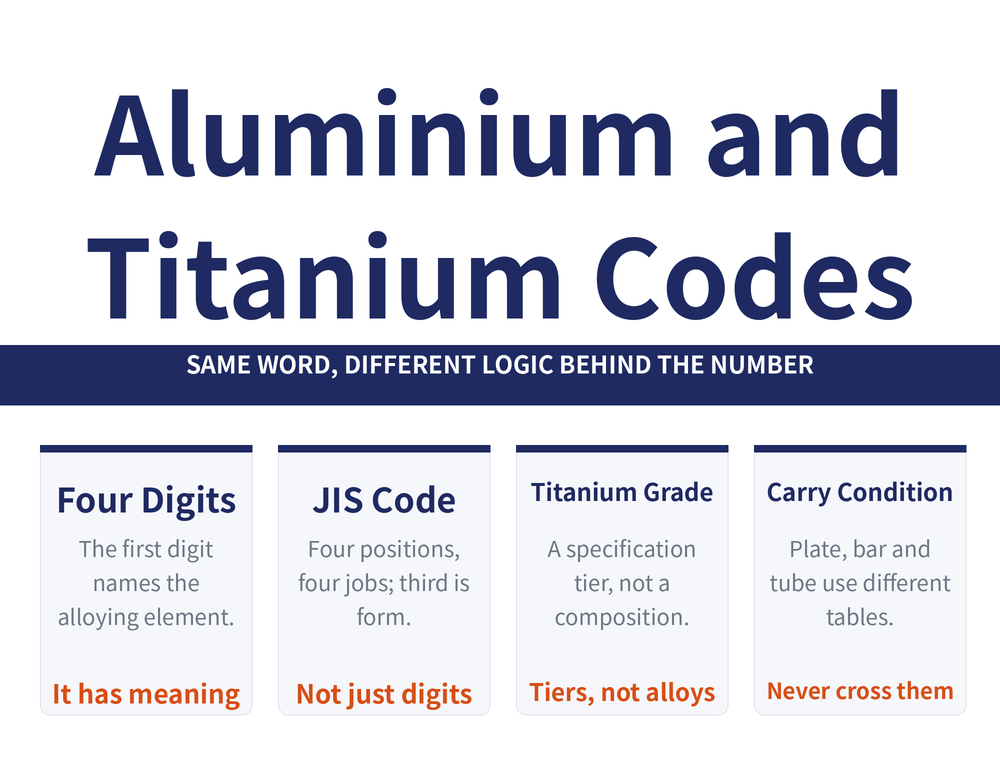
1. Two materials, two different numbering logics
"6061" and "Grade 5" both read as designations on a purchase order, but they answer different questions:
| Material | What the number states |
|---|---|
| Aluminium (A.A. four digit) | The main alloying element — the first digit alone tells you what was added |
| Titanium (ASTM Grade) | A specification tier — composition has to be looked up separately, and the same grade maps to different specification numbers depending on product form |
Carrying one intuition into the other is the common misreading: assuming a higher titanium grade means a more complex alloy (it does not), or reading the aluminium four-digit number as a quality tier (it is not). For the machining side see the ISO N guide for aluminium and non-ferrous metals and the ISO S guide for titanium and superalloys.
2. The A.A. four digit: the first digit is the alloy system
Aluminium has several designation systems in circulation (A.A., Alcoa, JIS, DIN, BS). The two in common use are the A.A. (Aluminum Association) four-digit system and JIS. In the four-digit system the first digit is the alloy family:
| Code | System | Code | System |
|---|---|---|---|
| 1XXX | Pure aluminium (99.00% and above) | 5XXX | Al-Mg |
| 2XXX | Al-Cu | 6XXX | Al-Mg-Si |
| 3XXX | Al-Mn | 7XXX | Al-Zn |
| 4XXX | Al-Si | 8XXX / 9XXX | Other systems / reserved |
So 6061 is Al-Mg-Si, 7075 is Al-Zn and 2024 is Al-Cu. The first digit already gives the composition direction without opening a table.
3. The dividing line that matters most: heat treatable or not
More decisive than the four-digit number is this split: aluminium alloys are either heat treatable or not.
| Class | Which systems | Where the strength comes from |
|---|---|---|
| Heat treatable (precipitation hardenable) | 2XXX, 6XXX, 7XXX (cast: 2XX.X, 3XX.X, 7XX.X) | Suitable heat treatment forms fine precipitates inside the structure — precipitation or age hardening |
| Non heat treatable | The remaining systems | Solid solution strengthening, grain refinement and similar general methods |
Why purchasing should care: the same 6061 can arrive at very different hardness depending on condition. Precipitation strengthening can raise strength by a factor of five to six, and ageing has an over-aged region where the precipitates coarsen and hardness falls again. Specifying "6061" without the temper therefore specifies no hardness at all. General properties worth remembering: density about 2.7g/cm³, roughly one third that of copper or steel by volume, corrosion resistant, a good conductor of heat and electricity, non-magnetic, non-sparking and non-toxic.
4. The JIS aluminium code: four positions, four jobs
A JIS aluminium code is not a plain number. Taking A2P1 as the example:
| Position | What it states |
|---|---|
| First, A | Aluminium |
| Second | Broad class: 1 aluminium, 2 corrosion resistant, 3 high strength, 4 heat resistant |
| Third | Product form: P plate, R strip, E disc, PC clad plate, RC clad strip, T tube, B bar, W wire, S extruded section, V rivet stock, F forging, H foil, TW welded tube, BC conductor |
| Fourth | Type (special 1 and special 2 marked S and O) |
The third position is the one most often overlooked — it states product form, not material. Plate and tube of the same material carry different JIS codes, so quoting a plate code when asking about tube gets the answer that no such specification exists.
5. ASTM grades in titanium: a tier, not an alloy
The easiest misreading in titanium is this: a grade is a specification tier, not an alloy name, and the same grade maps to different specification numbers by product form. For plate, sheet and strip (B265) and round bar (B348):
| Grade | Alloy | Min 0.2% yield MPa (ksi) | Similar AMS |
|---|---|---|---|
| 1 | Pure titanium | 170 (25) | — |
| 2 | Pure titanium | 280 (40) | 4902 |
| 3 | Pure titanium | 380 (55) | 4900 |
| 4 | Pure titanium | 480 (70) | 4901 (B348: 4921) |
| 5 | Ti-6Al-4V | 830 (120) | 4911 (B348: 4928) |
| 6 | Ti-5Al-2.5Sn | 790 (115) | 4910 (B348: 4926) |
| 7 | Ti-0.2Pd | 280 (40) | — |
| 11 | Ti-0.2Pd | 170 (25) | — |
Two points. First, pure titanium spans four grades (1 to 4), differing in strength rather than alloying — yield climbs from 170 to 480 MPa across them. Second, grades 7 and 11 are the same alloy (Ti-0.2Pd) at different strengths, so naming the alloy without the grade is equally incomplete. The table above covers plate, sheet, strip and round bar; tube runs on B337 and B338, where grades such as 9 and 10 appear that are absent from the plate table, so the tables must not be crossed. Values are as given in the ASTM and AMS specifications, are stated minima, and are not measured by this site.
6. Frequently asked questions
Q: Is ordering by "6061" alone enough?
No. The 6XXX series is heat treatable, meaning its strength comes from fine precipitates formed by heat treatment. Precipitation strengthening can change strength by a factor of five to six, and over-ageing coarsens the precipitates so that hardness falls again. The same 6061 can therefore arrive at very different hardness depending on the temper. Specify the condition alongside the designation, or nothing about hardness has been specified and the cutting data cannot be settled either.
Q: Does a higher titanium grade number mean harder and harder to machine?
It cannot be read that way. A grade is a specification tier, not a strength ranking. Grades 1 to 4 are all pure titanium and do climb from 170 to 480 MPa, but grade 5 is Ti-6Al-4V at 830 MPa, grade 6 is Ti-5Al-2.5Sn at 790 MPa, grade 7 returns to 280 MPa and grade 11 sits at 170 MPa. Grades 7 and 11 are even the same alloy, Ti-0.2Pd, at different strengths. Judge machinability from the alloy and the strength, not from the size of the grade number.
Q: Can a plate grade table be used to look up tube?
No. Plate, sheet and strip run on B265, round bar on B348, and seamless and welded tube on B337 and B338, and the associated AMS numbers differ as well — grade 4 maps to 4901 on the plate table but 4921 on the bar table. The tube tables also carry grades such as 9 and 10 that do not appear on the plate table at all. Crossing the tables produces combinations that do not exist, and a supplier will find the mismatch as soon as they check.
Q: How do JIS aluminium codes map to the A.A. four-digit system?
The two are built differently and do not map position by position. The A.A. first digit names the alloy system (1 pure, 2 Al-Cu, 6 Al-Mg-Si, 7 Al-Zn and so on), while the four JIS positions state aluminium, broad class, product form and type, with the third position covering form rather than material. That is why plate and tube of the same material carry different JIS codes. An exact cross-reference between the two systems needs a table from the material supplier; this article does not convert between them.
This article is part of Workpiece Materials: The Complete Guide - Name the Metal First, Then Match the Tool; that guide shows how the whole topic fits together.
Published: 2026-08-30|Last updated: 2026-10-25









