
N-Group Aluminium & Non-Ferrous Machining Guide: Al, Copper, Brass
Aluminium and non-ferrous metals are ISO 513's group N (insert colour: green) — aluminium alloys, copper, brass and bronze. They are generally soft, light, conductive, machine fast and are relatively easy to cut, which is group N's big advantage; but the trouble lies in that softness: they readily form built-up edge (BUE) and stick to the cutting edge. In addition, high-silicon die-cast aluminium has abrasive silicon hard points, and aluminium should not use Al-bearing coatings (strong affinity, sticking). This guide covers the non-ferrous types, their grades and tool-selection direction; for the overview see "ISO Workpiece Material Classification."
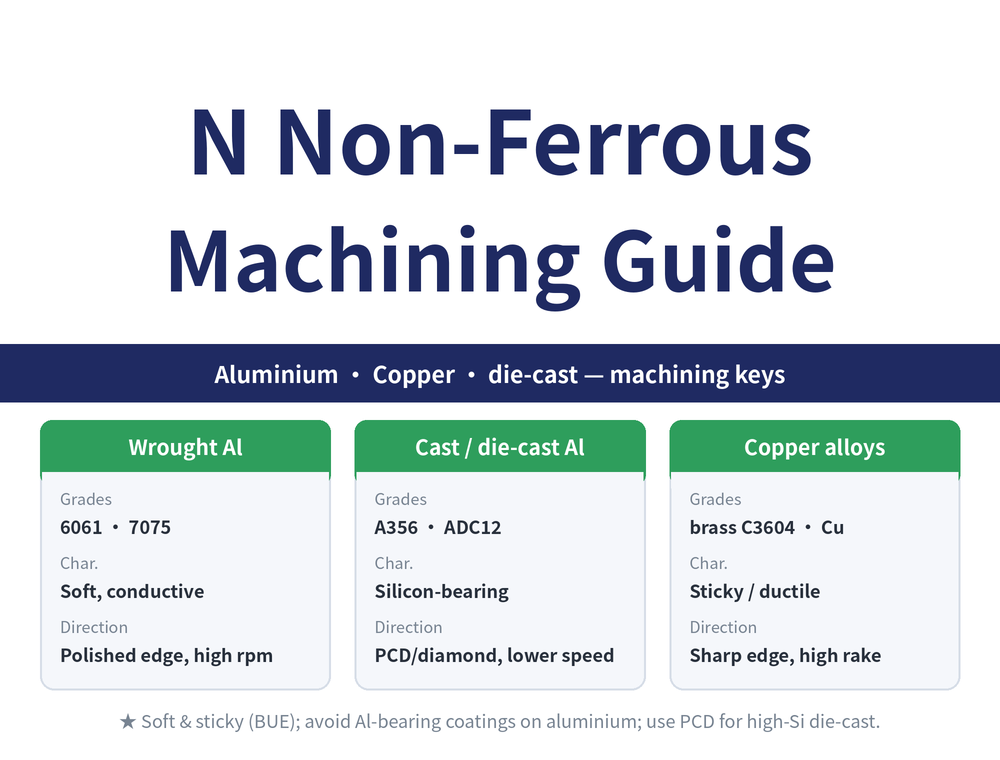
Non-ferrous types and machinability
| Type | Representative grades | Characteristics | Main challenge | Tool / direction |
|---|---|---|---|---|
| Wrought aluminium | 6061, 7075, 2024 | Soft, light, conductive | BUE, sticking, thin-wall distortion | Polished high-rake edge, high rpm, uncoated carbide / diamond |
| Cast / die-cast aluminium | A356, ADC12 | Silicon-bearing, high-volume parts | Silicon hard-point abrasion | PCD / diamond coating, moderately lower speed |
| Brass | C3604 (free-cutting) | Leaded, free-cutting, good chipping | Relatively easy | General carbide, sharp edge |
| Pure / oxygen-free copper | C1100 | Highly ductile, very sticky | Hard to chip, BUE-prone | Sharp edge, high rake, suitable coolant |
| Beryllium copper (BeCu) | C17200 | High strength, high conductivity | Toxic dust | Dust extraction & protection, wear-resistant tool |
In practice aluminium alloys are the most common: wrought aluminium (6061/7075) is soft and sticky — the focus is BUE control; high-silicon die-cast (ADC12) is abrasive, best with PCD/diamond coating. Brass cuts well with good chipping; pure copper is very sticky and hard to chip; beryllium copper dust is toxic and must be controlled.
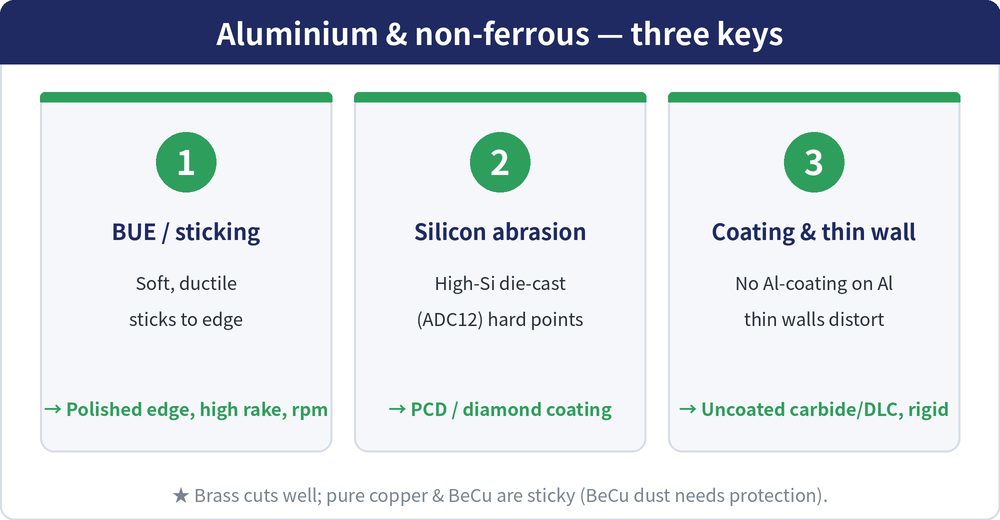
Three machining keys for aluminium & non-ferrous
| Item | Description |
|---|---|
| BUE / sticking | non-ferrous metals are soft and ductile, so chips stick to the edge and form BUE — use a sharp polished edge, high rake and high helix, polished flutes and higher rpm, and flush chips away with coolant or MQL/air as needed. |
| Silicon abrasion in die-cast | high-silicon aluminium (e.g. ADC12) has abrasive silicon hard points — use PCD (polycrystalline diamond) or diamond coating and a moderately lower speed. |
| Coating choice | aluminium should not use Al-bearing PVD coatings (e.g. TiAlN/AlCrN — strong affinity and sticking); use uncoated polished carbide or diamond-family (DLC/PCD) instead. |
| Thin-wall distortion | aluminium parts are often thin-walled, so use a sharp edge to lower cutting force, raise rigidity and take light layered cuts to avoid distortion. |
Tool grade and coating direction
Aluminium alloys mainly use uncoated polished carbide (high rake, high helix, polished flutes); for high-volume or high-silicon die-cast aluminium use PCD/diamond coating; copper and brass use a sharp, high-rake carbide. Avoid Al-bearing coatings on aluminium. For full grade and coating selection, see "Cutting Tool Material Classification."
Key cutting strategy
| Item | Description |
|---|---|
| High rpm, high feed | aluminium suits high-speed machining (HSM) for efficiency and BUE suppression. |
| Edge and chip evacuation | sharp polished edge, large chip space, prevent chip re-welding. |
| Coolant | coolant, MQL or air to flush chips and reduce sticking; balance heat on silicon-bearing die-cast. |
| Protection | materials with toxic dust such as BeCu require dust extraction and protection. For specific vc/fz values, see "End Mill Cutting-Conditions Calculation Guide." |
Turning: why aluminium and copper stick to the tool
Aluminium turns easily at high cutting speed. The trouble is sticking and built-up edge: the melting point is low, so once the temperature rises the chip welds onto the edge.
| Item | What to do |
|---|---|
| What goes wrong | Aluminium welds onto the edge as built-up edge and tears the surface; the silicon in cast Al-Si alloys acts like an abrasive and wears the tool fast |
| Choosing the tool | Large rake and clearance angles with a sharp edge; K-grade carbide for aluminium and copper; ceramic inserts are generally avoided |
| Starting conditions | Cutting speed can run far higher than for steel; take actual values from the tool catalog. For spindle-speed conversion see the formulas article |
| Coolant and chips | Carbide roughing can run without coolant; avoid water-based coolant for finishing and use kerosene or kerosene mixed with machine oil instead |
| Common problems | Aluminium sticking: sharper edge, larger rake. Pure copper chips that will not break: switch to an edge form made for pure copper |
For pure copper and brass edge forms see Turning Copper and Brittle Materials: Washer Tools, Chip-Breaking and Chip-Curling Corrugated Edges; for choosing positive or negative inserts see Insert Angle Guide: Negative, 7° & 11° Positive Inserts; for spindle-speed conversion see Turning Machining Formulas: Speed, Feed & Surface Roughness.
Milling: how many flutes for aluminium, and why polished edges
Aluminium cuts easily and runs at high cutting speed, so it makes a lot of chips per minute. The first limit in aluminium milling is usually chip evacuation, not tool wear. Chips that cannot get out stick back on the edge as built-up edge.
| Item | What to do |
|---|---|
| What goes wrong | Chips pack in the flutes and weld onto the edge as built-up edge, scoring the surface; thin walls get pushed out of shape |
| Choosing the cutter | Two flutes for slotting, high helix, polished flutes; coarse pitch and sharp positive inserts on face mills |
| Starting conditions | Use the aluminium row of the calculation guide; cutting speed can run far higher than for steel; follow the tool catalog |
| Coolant and chips | Coolant, MQL or air blast to clear chips from the cut; for dry milling of wrought aluminium choose a low-friction coating |
| Common problems | Aluminium sticking: sharp polished edge, higher speed. Die-cast parts turn rough after a run: silicon wear, switch to PCD |
For flute count and helix see End Mill Flute Count and Helix Angle: How to Choose; for wrought versus cast aluminium see Dry Milling by Material: Cast Iron, Steel, Aluminium and Stainless Strategies. Speed and feed conversions are in End Mill Cutting Conditions Guide.
Drilling: why aluminium sticks and packs the flutes
Aluminium cuts easily, but two problems grow when drilling: aluminium welding to the edge, and loose, bulky chips packing the hole. Blind holes show it most.
| Item | What to do |
|---|---|
| What goes wrong | Built-up edge blocks chip flow; fine chips pile at the bottom, push the drill off line and enlarge the hole |
| Choosing the drill | Large, polished flutes and a sharp edge, so chips leave as ribbons along the flute |
| Starting conditions | Cutting speed can be much higher than for steel; values vary widely with drill material, so follow the catalog |
| Coolant and chips | Use a fluid with good lubricity against sticking; clear chips out of blind holes promptly |
| Common problems | Sticking: check edge sharpness and flute finish. Oversize hole: check for chips packed at the bottom |
In blind holes you do not want chips broken too fine: they pile at the bottom and push the drill off line. For speed conversions see Drilling Parameters Guide; for point grinds see Drill Point Types by Material and Hole.
Tapping: why aluminium sticks to the tap and the thread comes out small
Aluminium has a low melting point and is soft and sticky, so a cutting tap tends to pick up metal, and the thread can shrink after tapping. The good news is that aluminium, copper and brass are ductile, so most of them can be tapped with a form tap, which makes no chips.
| Item | What to do |
|---|---|
| What goes wrong | Metal welds to the tap, the thread surface comes out rough and undersize after tapping; die-cast parts give fine chips that jam the flutes |
| Choosing the tap | Form taps suit blind holes best: no chips, and the large core resists breaking; with a cutting tap, use a spiral-flute tap in rolled aluminium |
| Starting conditions | The form-tap hole is larger than for a cutting tap, with a tolerance of only about 5% of the pitch; form tapping about 15-35 m/min (typical range) |
| Oil and chips | Use an oil with good anti-friction properties to limit welding; form taps make no chips, and oil-free types exist |
| Common problems | Thread undersize: switch to an oversize-class tap. Burr at the hole mouth after form tapping: chamfer the hole |
Die-cast aluminium takes the low end of the speed range (about 15-25 m/min), and a form tap needs about 2-3 times the torque of a cutting tap. For choosing between the two see Cutting Tap vs Forming Tap; for form-tap hole sizes see Form Tap Drill Size Chart; for high-silicon die castings a nitrided tap is an option, see Tap Surface Treatment Guide.
FAQ
Why does aluminium stick and form built-up edge?
Aluminium is soft and ductile and readily sticks to the edge as built-up edge. Use a sharp polished edge, high rake and high helix, polished flutes and higher rpm, and flush chips with coolant/MQL/air to improve it.
Can I use TiAlN/AlCrN coating for aluminium?
Not recommended. Al-bearing coatings have an affinity for aluminium and tend to stick and build up. Use uncoated polished carbide, or diamond-family (DLC/PCD) tools — for high-silicon die-cast aluminium, PCD is the most wear-resistant.
Why is die-cast aluminium (ADC12) more abrasive?
High-silicon die-cast aluminium contains abrasive silicon hard points. Use PCD (polycrystalline diamond) or diamond-coated tools and a moderately lower speed to greatly extend tool life.
Are copper and brass easy to machine?
Free-cutting brass (e.g. C3604) chips well and machines easily; pure copper is highly ductile, very sticky and hard to chip, needing a sharp, high-rake edge. Beryllium copper is high-strength but its dust is toxic, so use dust extraction and protection.
For the full reading guide on this topic, see Chip Control: A Complete Reading Guide.
This article is part of Workpiece Materials: The Complete Guide - Name the Metal First, Then Match the Tool; that guide shows how the whole topic fits together.
Further reading
Published: 2026-06-24 | Last updated: 2026-10-20









