
Center Drill Guide: A/B/R Center-Hole Angles & Applications
A center drill is a key tool for machining center holes and locating. Common designs are type A, type B and type R center holes. Different center-hole angles (60°, 90°) and structures directly affect stability, locating accuracy and downstream quality; the type-R center hole uses a radiused transition to raise centering stability and reduce rough surface, burrs and distortion. This guide covers the center drill's use, center-hole types and selection rules for precision machining and CNC turning.
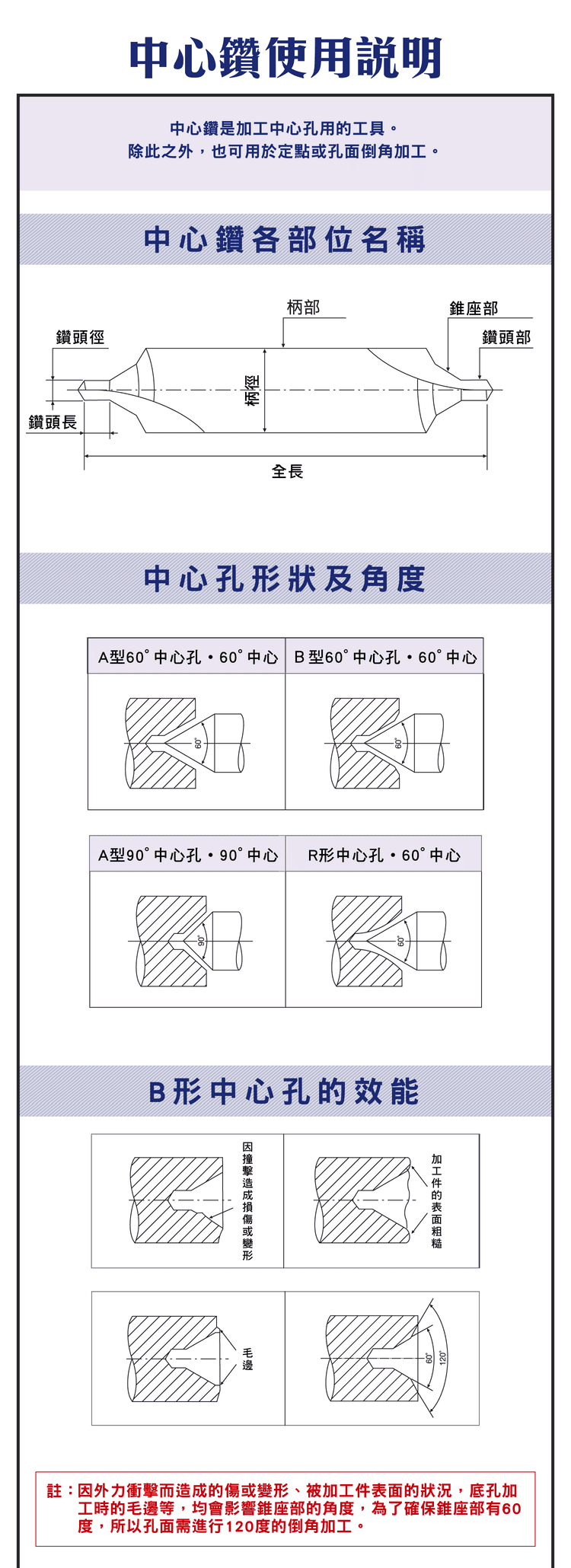
1. Use and Structure
A center drill is mainly used to machine center holes, provide a locating datum and support turning; it can also do spot machining and chamfering. Its main parts are the drill point, the countersink seat and the shank; overall length and shank diameter affect stability, rigidity and accuracy.
2. Center-Hole Types (A / B / R)
| Type | Design | Feature |
|---|---|---|
| Type A | 60° / 90°, basic form | General use |
| Type B | With protecting chamfer (120°) | Improves surface issues, fewer burrs |
| Type R | Radiused transition | Higher centering stability, for precision |
A type-A 90° center hole and the 90° spot drill used to locate a hole before drilling are two different things: the first supports a lathe center, the second keeps the drill from walking as it starts, and the angle rules differ. See Spot Drilling, Center Drilling and Pre-Drilling.
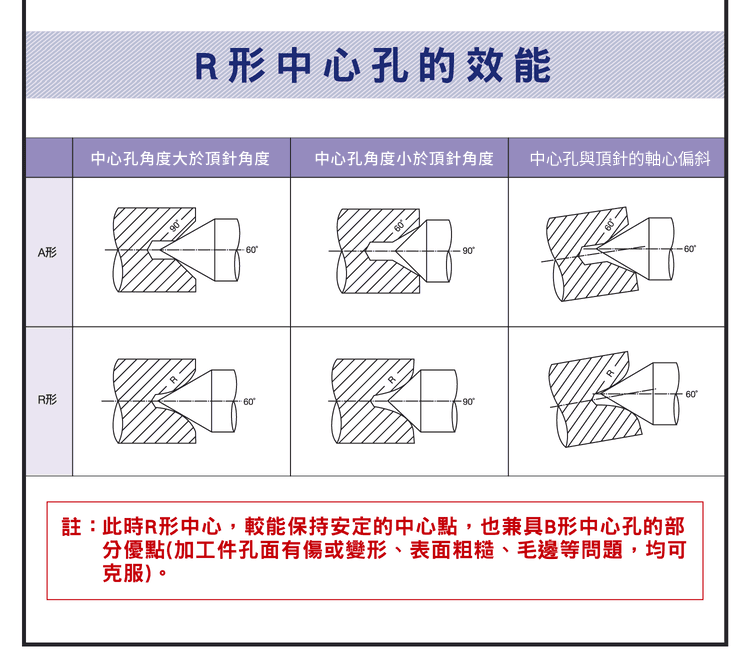
3. Performance of the Type-R Center Hole
With a radiused transition, type R provides stable centering, reduces eccentricity and vibration and improves surface finish — well suited to precision machining, CNC lathe work and high-speed cutting.
4. Effect of Center-Hole Angle
| Situation | Effect |
|---|---|
| Angle too large | Insufficient contact, lower stability |
| Angle too small | Prone to interference |
| Axis offset | Causes machining error |
The type-R design reduces the impact of the above.
5. Type-B Center-Hole Characteristics
The type-B center hole has a protecting chamfer (120°) and suits rough, burred or distorted workpieces, improving quality and the stability of downstream machining. The protecting cone also shields the 60° cone from knocks, so type B is also the choice for high-precision shafts with many operations whose center holes are reused, such as parts ground after heat treatment.
6. Machining Notes
When machining center holes, keep the angle consistent, control cutting conditions and avoid eccentricity; in special cases, add a 120° chamfer to secure the seat contact. For cutting speeds and feeds, see the Center Drill Cutting Parameters.
7. Selection
| Use | Suggested center hole |
|---|---|
| General use | Type A |
| Rough / poor surface | Type B |
| Precision machining | Type R |
FAQ
Q: How do A, B and R center holes differ?
Type A is the 60°/90° basic form; type B adds a 120° protecting chamfer for rough or burred parts; type R uses a radiused transition for the best centering stability, suited to precision work.
Q: How do I choose the center-hole angle?
Center holes are commonly 60° or 90°, matched to the center: too large means insufficient contact and low stability, too small risks interference; add a 120° chamfer when a protecting cone is needed. This applies to center holes for lathe centers; a spot hole before drilling is different, and its angle must be larger than the point angle of the drill that follows (see Spot Drilling, Center Drilling and Pre-Drilling).
Q: Why drill a center hole before turning?
The center hole gives a locating datum and tailstock-center support, raising turning rigidity and reducing runout and vibration — especially important for long parts and precision work.
Q: Is the type-R center hole really better?
For precision and high-speed work, the type-R radiused transition gives more stable centering, less eccentricity and vibration and better surface; it costs more, so type A is fine for general work.
This article is part of Drill Bits: The Complete Guide - Start From Depth-to-Diameter, Then Pick the Drill and Set the Conditions; that guide shows how the whole topic fits together.
Published: 2026-03-24 | Last updated: 2026-10-31









