
Starting the Hole: Spot Drill, Center Drill, Pre-Drill, and the Angle Rule
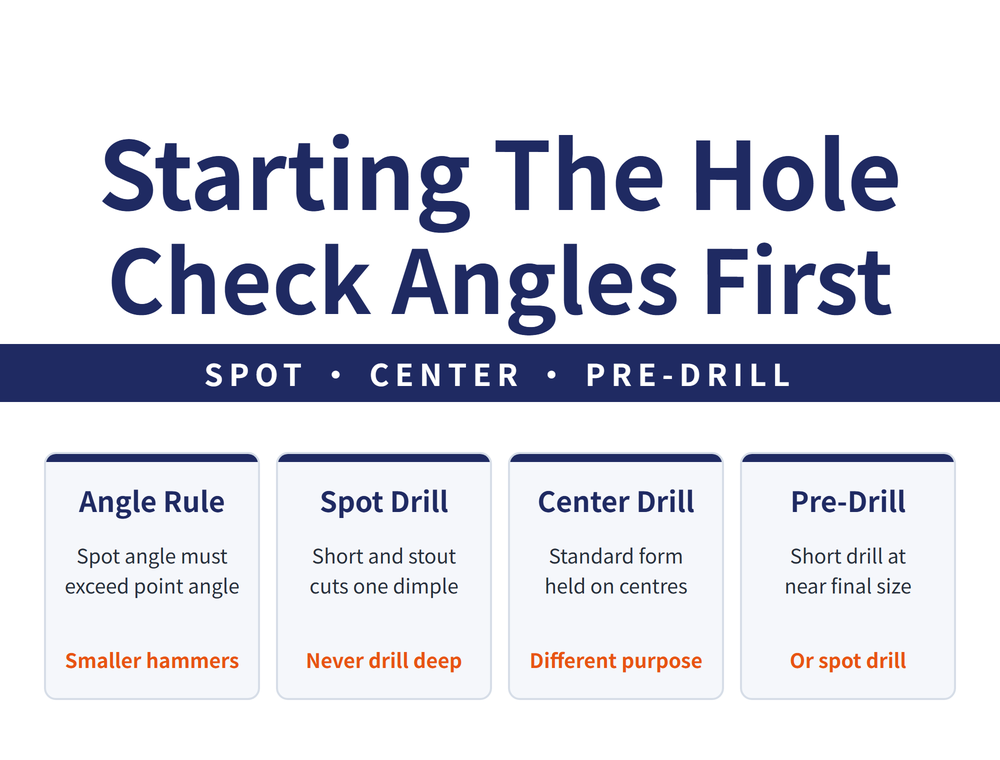
If the spot angle is smaller than the drill point angle, every plunge hammers the cutting edge. This guide separates the three starting methods, gives the three-way angle verdict and its failure mechanism, and explains why a spot drill must not be used as a short drill.
The rule first
The spot angle must be larger than the point angle of the drill that follows. This is a design requirement, not a preference. Two independently sourced manufacturer documents state the same rule, which makes it more reliable than any single vendor claim.
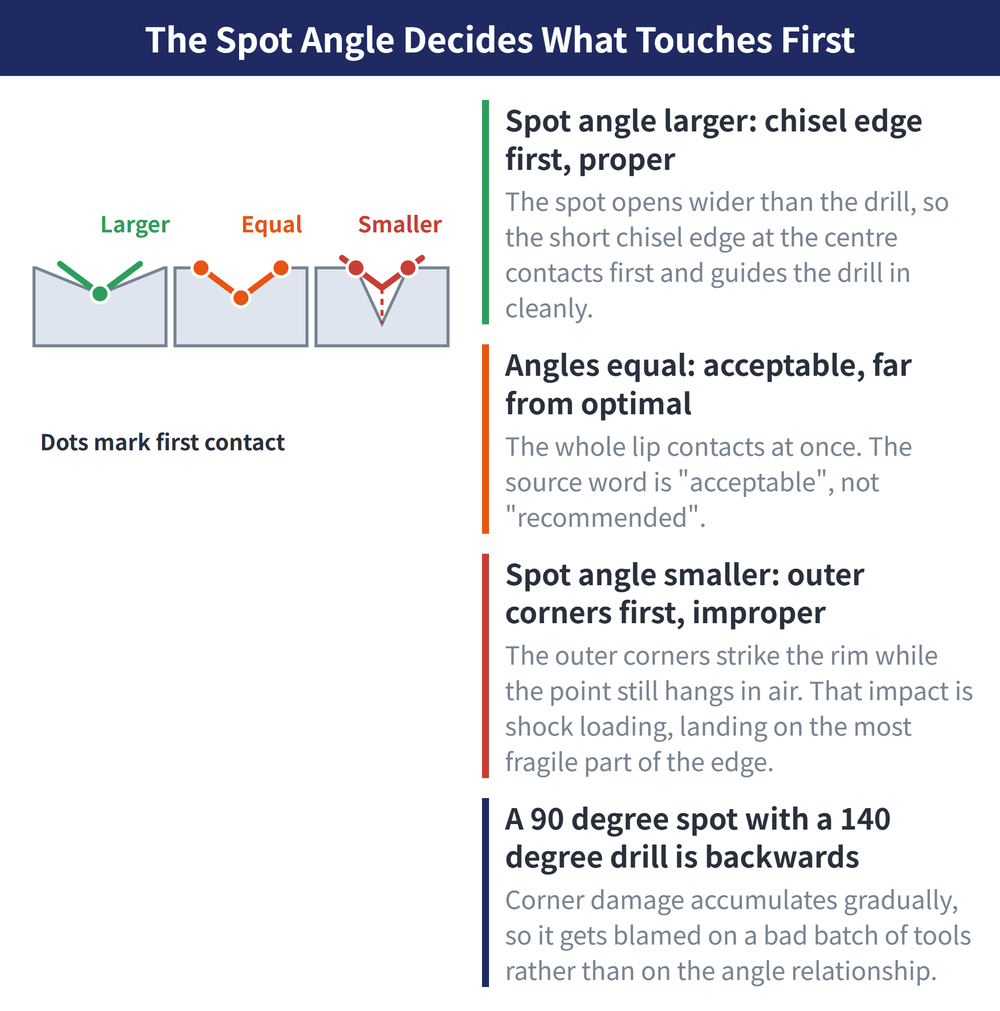
The reason is what touches the workpiece first. Initial contact between drill and workpiece is a critical part of the operation, and in most cases the chisel edge at the centre of the drill should make contact first. The spot angle decides whether it does.
| Angle relationship | Verdict | What actually happens |
|---|---|---|
| Spot angle larger than point angle | Proper | Chisel edge lands first, the drill enters cleanly |
| The two are equal | Acceptable, but far from optimal | — |
| Spot angle smaller than point angle | Improper | The drill’s outer corners contact before the chisel edge, producing shock loading and drill damage |
🔴 A 90 degree spot drill in front of a 140 degree drill has the relationship backwards. Every plunge then hammers the edge, and because the damage accumulates gradually it is easily blamed on a bad batch of tools.
⚠ This article states the angle relationship only and does not infer which spot drill suits which drill. Use the published specification of both tools.
1. Three things that get treated as one
| Method | What it does | When to use it |
|---|---|---|
| Spot drill | Cuts a shallow divot to fix the hole centre | Almost any case where walking must be prevented |
| Center drill | Produces a standardised centre hole form, protective chamfer included | Parts later held between centres, or needing a repeatable datum |
| Pre-drill | Drills a short way with a short drill close to the final diameter, to fix the drill centre | An alternative to spot drilling; choose case by case |
They serve different purposes, and they price and plan differently. Treating them as one thing most often ends with a center drill used where a spot drill belonged, adding an operation without improving accuracy.
2. Why a spot drill is shaped the way it is
Hole position error comes from three places: material behaviour, an uneven surface, and drill point geometry. Used correctly, a spot drill substantially reduces the chance of the drill walking. Every design feature maps to a function.
| Feature | Purpose |
|---|---|
| Short and stout | Very high rigidity, which is what fixes position |
| Thin web | Prevents walking during the cut |
| No land and no body relief | It was never meant to go deep |
| Not designed to cut past the point angle depth | Enough only to produce a dimple |
🔴 That last line is a prohibition: a spot drill is not a short drill. With no land and no relief, cutting past the point angle depth means drilling with a tool that has neither guidance nor chip evacuation. The tool change you saved usually comes back as a chipped edge.
A spot drill can also serve for countersinking, chamfer milling and deburring, which is often overlooked.
3. Spot drill or pre-drill? There is no standard answer
Both do the same job: fix the drill centre where the hole starts. There is no general rule for choosing; decide case by case by whether the tool is in stock, the workpiece shape and material, the hole requirements, the machine centre accuracy and the stability of the operation.
How many passes a large hole needs is a separate question: drill close to size with twist drills in stages, then finish with a core drill or a boring tool; see section 4 of Three Tools After the Drill.
4. Checking order on the floor
1. Decide whether this step is for location, datum or staging. Pick one.
2. If spot drilling, compare the angles first: spot angle larger than point angle.
3. Confirm the spot depth does not exceed the point angle.
4. When drills keep chipping at the corners and parameters check out, come back to this angle relationship.
For centre hole forms and cutting conditions, see Center Drill Usage Guide and Center Drill Cutting Conditions.
Frequently asked questions
Are a spot drill and a center drill the same thing?
No. A spot drill cuts a shallow divot to fix the hole centre. A center drill produces a standardised centre hole, normally because the part will later be held between centres or needs a repeatable datum. Different purposes, different operations.
Can a 90 degree spot drill precede a 140 degree drill?
No, that has the relationship backwards. The spot angle must exceed the drill point angle, otherwise the outer corners contact before the chisel edge and produce shock loading. The damage accumulates gradually and is easily misread as a tool quality problem.
Can I just use the spot drill to make shallow holes?
Not advisable. It has no land and no body relief, and it is not designed to cut past the point angle depth. Going deeper means drilling with a tool that has neither guidance nor chip evacuation.
Spot drill or pre-drill?
There is no general rule; choose case by case by tool availability, workpiece shape and material, hole requirements, machine centre accuracy and operation stability. Pre-drilling uses a short drill close to the final diameter; how many passes a large hole needs is a separate question.
Sources: ISCAR Drilling Handbook (Spot Drilling and Chamfering; Center Drilling). The angle rule is independently corroborated by Mitsubishi technical material.
Last updated: 2026-10-31









