
Ten Ways to Regrind a Drill: Name the Weakness First, and Why a Gun Drill Never Goes Freehand
There is no shortage of ways to regrind a drill, but almost nobody says which weakness each one is fixing. A standard twist drill has four built-in shortcomings, and ten regrinding methods each attack one of them — name the weakness first and you stop grinding blind. The second half covers gun drills: when to pull one off the machine, how much you can take off, which three features you may touch, and why it should never be done freehand.
1. Name the weakness: four things wrong with a standard twist drill
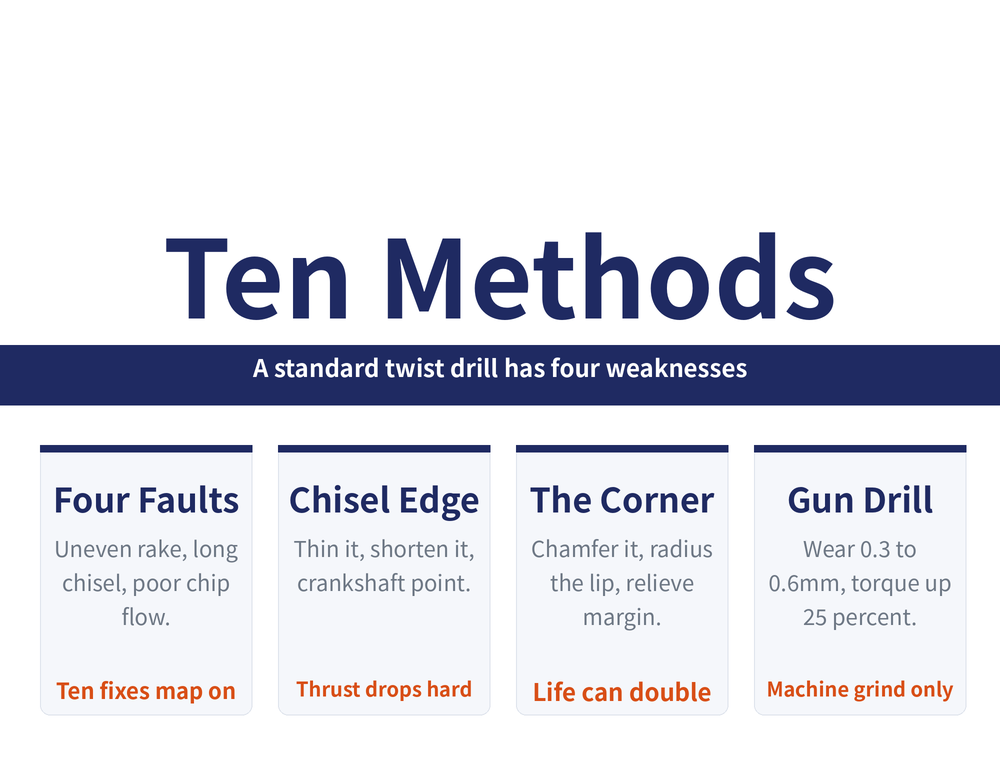
There are so many regrinding methods because the standard twist drill has four structural problems. Until you know which one you are fixing, you are grinding blind:
| Weakness | What actually happens |
|---|---|
| ① Uneven rake | Large rake at the periphery, negative near the web; poor cutting at centre |
| ② Long chisel edge | Poor centring so it wanders; negative rake and blunt, it scrapes rather than cuts |
| ③ Poor evacuation | Chip speed varies along the lip; carbon steel chips are wide, curl loosely, jam the flute |
| ④ Fast corner wear | Highest speed at the corner, zero margin relief, friction heat, thin tooth |
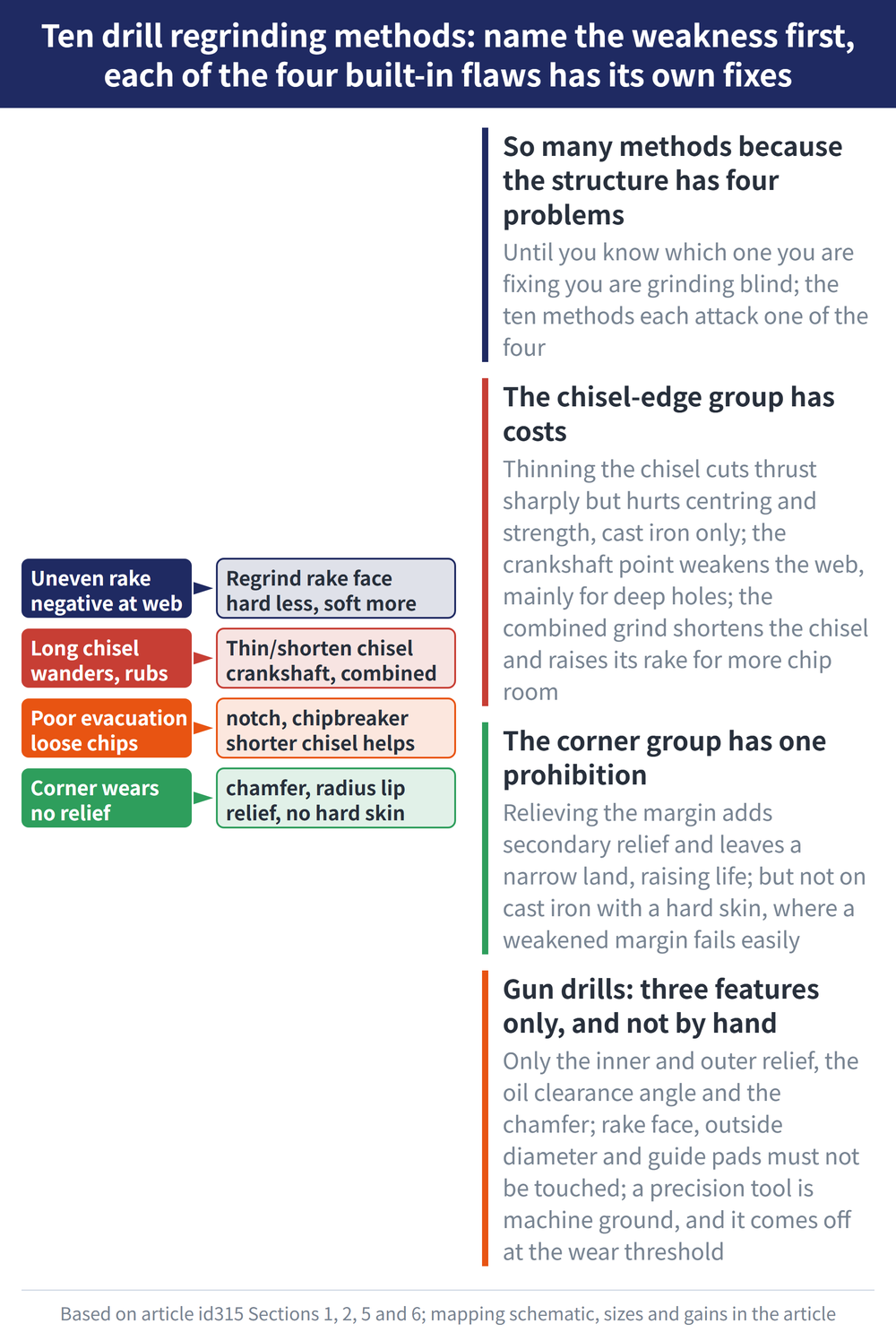
2. Which of the ten fixes which
| Method | Fixes | Key point |
|---|---|---|
| Thin the chisel edge | ② | Thrust drops sharply, but centring and strength suffer — cast iron only |
| Shorten the chisel edge | ②③ | Creates a break point on the lip, helps split and break chips |
| Crankshaft point | ② | Chisel rake raised, even positive; web weakens; mainly for deep holes |
| Combined grind | ②③ | Shorten the chisel and raise its rake; more chip room at the web |
| Regrind the rake face | ① | Hard material: cut peripheral rake for strength. Soft: raise web rake |
| Chip splitting grooves | ③ | Staggered slots in both flanks; tough material, larger deeper holes |
| Chipbreaker groove | ③ | Ground along the lip on the rake face; good on tough material |
| Corner chamfer | ④ | Transition edge at the corner: stronger point, less thrust, better heat flow |
| Radius lip drill | ④ | Periphery ground to a radius; longer edge, less load per unit; thin low-carbon plate |
| Relieve the margin | ④ | 0° secondary relief ground to 6°–8°, leaving a 0.1–0.2mm land; life can double |
One prohibition: cast iron with a hard skin must not have its margin relieved — weaken the margin and it breaks up. For the radius lip drill the proportions are R≈L≈M≈(0.6–0.65)d and bΦ=(0.03–0.05)d.
3. What the regrinding buys back
In summary, drilling steel against a standard twist drill, thrust drops by 35%–47% and torque by 10%–30%, which allows more feed and higher speed, so output rises three to five fold with better hole accuracy too. Single-source measured values — prove them yourself.
4. Grinding in a fixture: reading the k value
Regrinding in a fixture on the conical-grind principle, the drill goes into the fixture and the k value is set by diameter:
| Point angle 2φ | Diameter d (mm) → k |
|---|---|
| 118° | 30→51, 35→43, 40→36, 45→31, 50→23 |
| 130° | 30→47, 35→39, 40→31, 50→15 |
⚠ The 130° row has no entry for 45 in the original; nothing is filled in or interpolated here. The corner-chamfer parameter table has its relief column printed as cells merged across rows, so row-by-row correspondence cannot be read and that column is omitted. For angle definitions and symmetry checking see Inspecting a Tool After Regrinding.
5. Gun drills: when to pull it, how much you can take
Leave a gun drill on too long and the outer corner wears past the point where the regrind allowance grows and chip quality falls off — waiting costs you. Hence a wear criterion: at this much flank wear the drill comes off, whether or not it would still cut.
| How to judge | Threshold |
|---|---|
| Outer flank wear (D<15mm) | 0.3–0.5mm |
| Outer flank wear (D>15mm) | 0.4–0.6mm |
| Machine load meter | Torque 25% above its initial value means it is blunt |
How much can come off? Take a 10mm gun drill: tolerance h5, minimum 9.994mm. Grind away 10mm of edge length and the diameter drops about 0.005mm to roughly 9.989mm — while the hole itself normally expands 0.01–0.02mm in cutting, so even after 10mm the drill still produces an H8 hole. Where the hole has no accuracy requirement you can keep grinding until the guide pads stop working.
6. Three features only, and not by hand
A gun drill is reground on the inner and outer relief, the oil clearance angle and the chamfer only. The rake face, the outside diameter and the guide pads must not be altered. Baseline angles are 30° outer and 20° inner, right for most steels; when drilling stacked plate the inner angle should drop below 10° to keep the ejected cone small.
Because it is a precision tool it should be machine ground, not done by hand — usually on a universal tool grinder with a three-axis head and a dedicated bushing. The one exception is the 0.6mm chamfer, which can be touched up by hand on the face of a wheel; a diamond wheel is recommended. For high-strength alloy steels where chips will not break there are two special forms: the "three-angle" (first outer angle 45°, second 4°–8°, the first taken at a radial width of D/4) and the "chip-splitting step" (first outer angle offset 0.4–0.8mm so it does not join directly; better above 15mm diameter).
7. Frequently Asked Questions (FAQ)
Q: Can the ten methods be combined?
Yes — the combined grind is itself two of them at once (shorten the chisel plus raise its rake). Watch for conflicts though: thinning the chisel already weakens the web, and adding a crankshaft point weakens it twice; relieving the margin on hard-skinned cast iron is an explicit prohibition. Decide which weakness you are attacking, then check the two methods are not fighting each other.
Q: Does relieving the margin really double tool life?
The claim is "life can be doubled". The reasoning is straightforward: a standard drill's margin has zero secondary relief, so the whole length of it rubs the bore and makes heat. Ground to 6°–8° with a 0.1–0.2mm land left, the rubbing area collapses. But it is a single-source claim, and it comes with a material condition — not on hard-skinned cast iron.
Q: Why can't a gun drill be freehanded like a twist drill?
Because its edge geometry has to sit in an exact position — inner angle, outer angle and oil clearance are interdependent, and feel will not get you there. Shift the angle and the small cone the tool ejects changes shape, which is exactly what deep-hole work cannot tolerate. Ruin a twist drill freehand and you lose a drill; ruin a gun drill and you lose an expensive tool plus a batch of holes.
Q: How do I confirm a reground gun drill's angles?
Use a check bushing made from free-machining stock: drill it to 4D deep (D being the flute diameter) with a gun drill of known correct angles, then mill away the surplus at the blind end on a plane parallel to the axis and 1–1.5mm past it, far enough that the outer lip is fully exposed. To check, hold the bushing against the drill with the points coincident and the rake face parallel to the milled opening, and look at the point, the inner and outer angles and the oil clearance.
This article is part of Tool Regrinding: The Complete Guide — Decide Whether to Grind, Then Look Up How, With What, and How to Check; that guide shows how the whole topic fits together.
This article is part of Drill Bits: The Complete Guide - Start From Depth-to-Diameter, Then Pick the Drill and Set the Conditions; that guide shows how the whole topic fits together.
Published: 2026-08-18|Last updated: 2026-10-31









