
Drilling Parameter Conversion: RPM & Feed by Diameter
When the actual drill size differs from the catalog standard, you must convert the cutting parameters. Using the cutting-speed (vc), spindle-speed (n) and feed (f) formulas, you can transfer conditions between diameters and keep efficiency and quality stable. This guide covers the conversion formulas, a standard workflow and a worked example, plus correction factors like machine rigidity, holding and coolant.
1. Why Convert
| Situation | Description |
|---|---|
| Different diameter | Catalog gives 5mm data, you run 6mm |
| Different brand | Other-brand tools need converted conditions |
| Different setup | Different machine/environment needs recalculation |
2. Basic Conversion Formulas
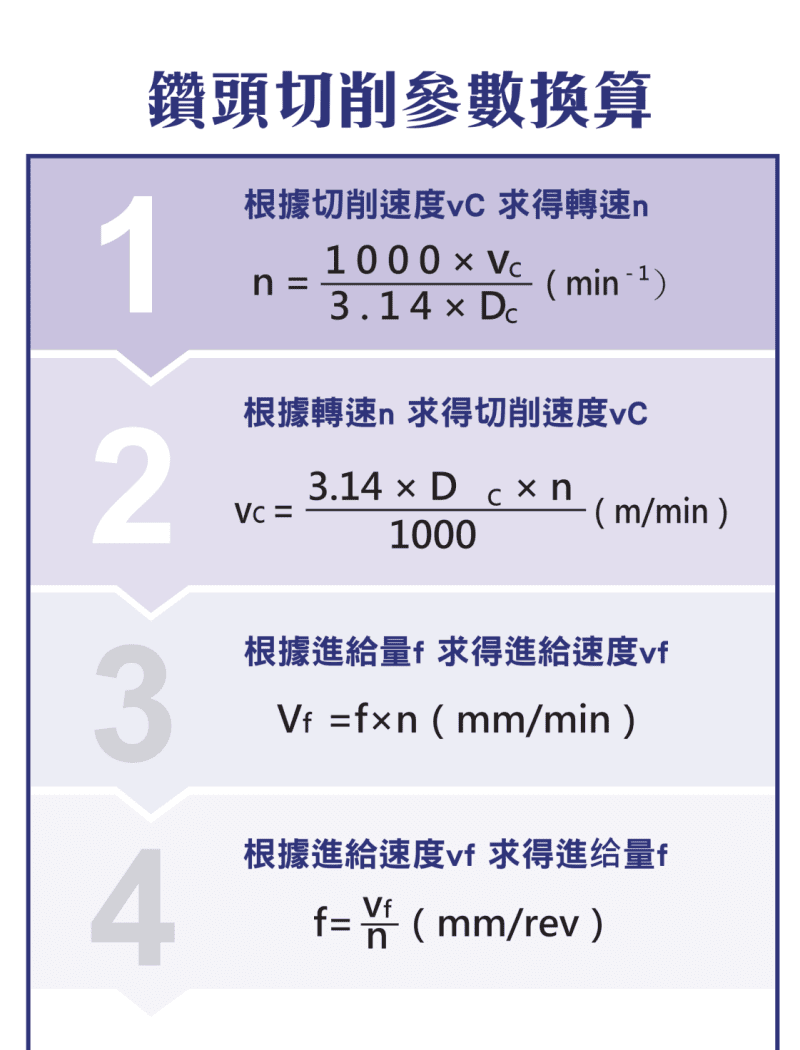
Spindle speed n = 1000 × vc ÷ (3.14 × Dc)
Cutting speed vc = (3.14 × Dc × n) ÷ 1000
Feed rate Vf = f × n Feed per rev f = Vf ÷ n
Dc is drill diameter (mm), vc is cutting speed (m/min), n is rpm (min⁻¹), f is feed per rev (mm/rev). For full parameter setting and factors, see the Drilling Parameters Guide.
3. Conversion Workflow
| Step | Action |
|---|---|
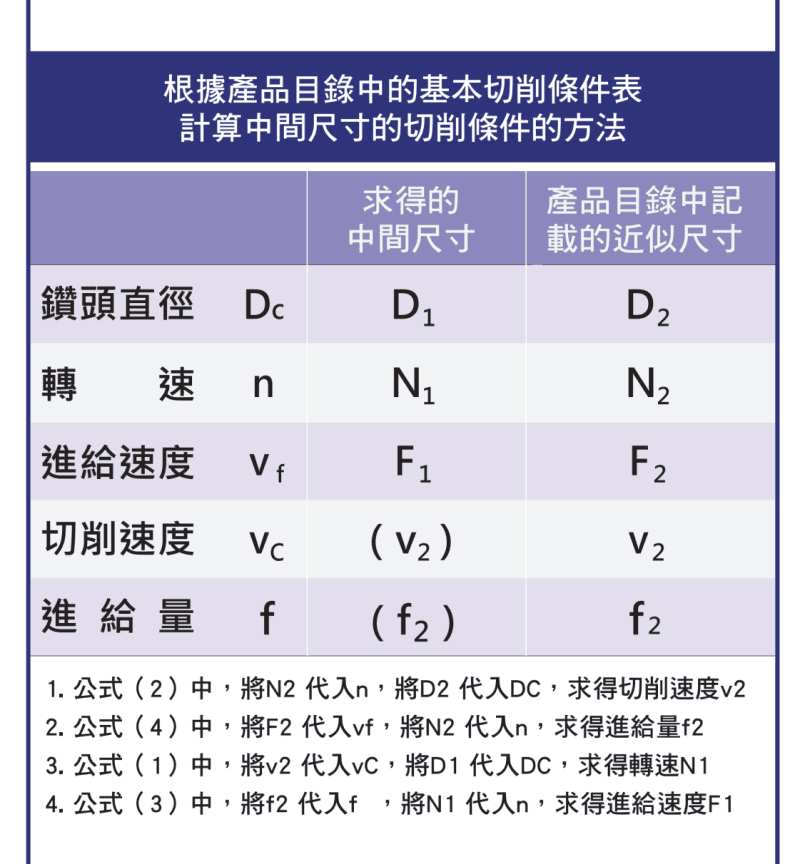
| 1 | From known rpm & diameter → find cutting speed vc |
| 2 | From feed rate → find feed per rev f |
| 3 | Apply new diameter → compute new rpm n |
| 4 | Compute the matching new feed rate Vf |
4. Worked Example (Illustrative)
The figures below only demonstrate the workflow; recalculate for your own conditions:
| Item | Value (example) |
|---|---|
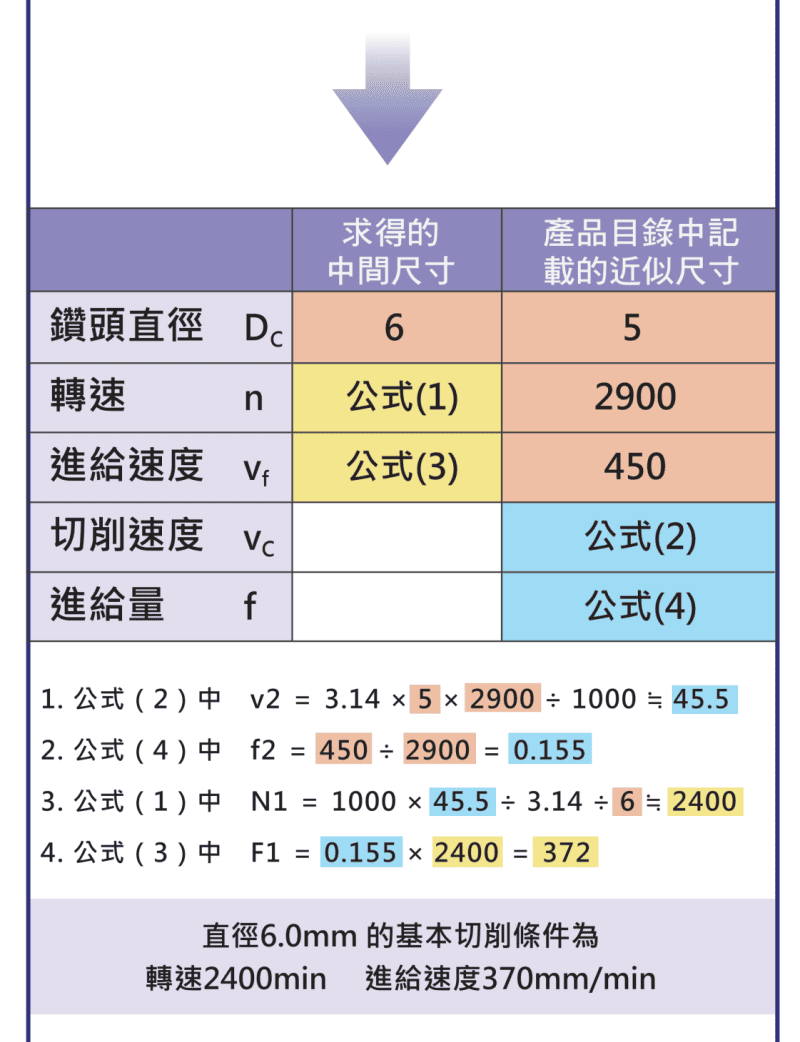
| Original / target | 5mm drill → 6mm drill |
| Material | S50C carbon steel |
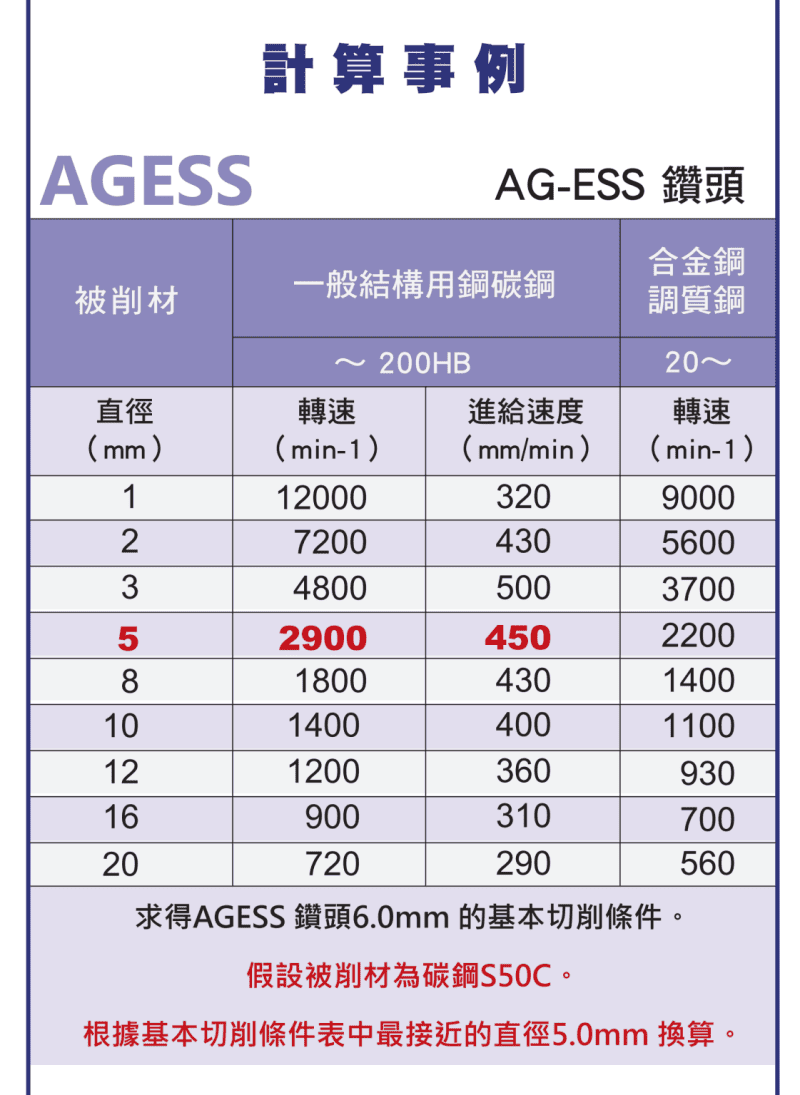
| Original conditions (5mm) | approx. 2900 rpm, feed rate approx. 450 mm/min |
| Cutting speed | approx. 45.5 m/min |
| Feed per rev | approx. 0.155 mm/rev (unchanged when diameter changes) |
| New rpm | approx. 2400 rpm |
| New feed | approx. 370 mm/min |
※ Indicative values, not guaranteed; use calculation and the tool catalog for actual settings.
Step 1: vc = 3.14 × 5 × 2900 ÷ 1000 ≈ 45.5 m/min
Step 2: f = 450 ÷ 2900 ≈ 0.155 mm/rev
Step 3: new n = 1000 × 45.5 ÷ (3.14 × 6) ≈ 2415, so about 2400 rpm
Step 4: new Vf = 0.155 × 2400 ≈ 372, so about 370 mm/min
5. Key Correction Factors
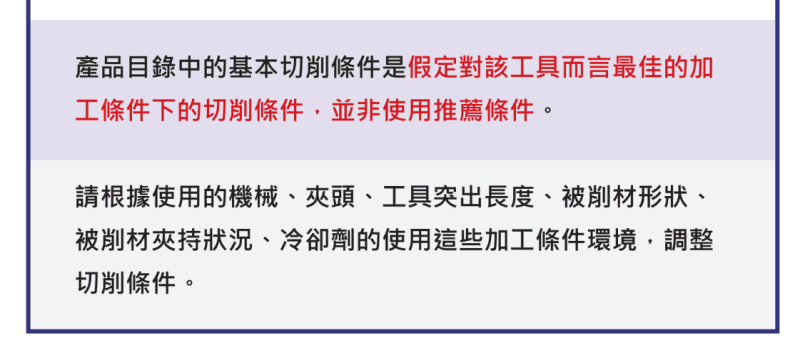
Converted conditions are only a theoretical start. Real machining must also account for machine rigidity, holding method (collet / drill chuck), tool overhang, workpiece shape and clamping, and coolant to reach the best result.
6. Common Mistakes
| Mistake | Consequence |
|---|---|
| Using values without converting | Faster tool wear |
| Ignoring feed adjustment | Unstable surface quality |
| Ignoring machine conditions | Vibration and runout |
7. Optimization Tips
Build a standard conversion procedure, automate it with a spreadsheet or system, fine-tune with test cuts, and accumulate a material database — that keeps conversion fast and reliable. Use chip form as a live indicator; see Drill Chip Formation Guide.
FAQ
Q: How do I adjust rpm after changing diameter?
First find cutting speed vc from the original conditions, then compute new rpm with n = 1000 × vc ÷ (3.14 × Dc). Larger diameter lowers rpm; smaller raises it.
Q: Do I need to convert the feed too?
Yes. When rpm changes, feed rate Vf = f × n changes too. Changing rpm without adjusting feed makes surface quality and chip breaking unstable.
Q: Can I run the converted values directly?
Treat them as a theoretical start, then fine-tune for machine rigidity, holding and coolant, and correct after checking chips and measured hole diameter.
Q: Why re-convert for a different brand?
Each brand has different geometry and coating, so recommended conditions differ. Reusing one parameter set across brands risks wear or chipping — reconvert per the catalog.
For the full reading guide on this topic, see Machining Calculation Reading Guide.
This article is part of Drill Bits: The Complete Guide - Start From Depth-to-Diameter, Then Pick the Drill and Set the Conditions; that guide shows how the whole topic fits together.
Published: 2026-03-19 | Last updated: 2026-10-08









