
Machining Calculation: A Complete Reading Guide
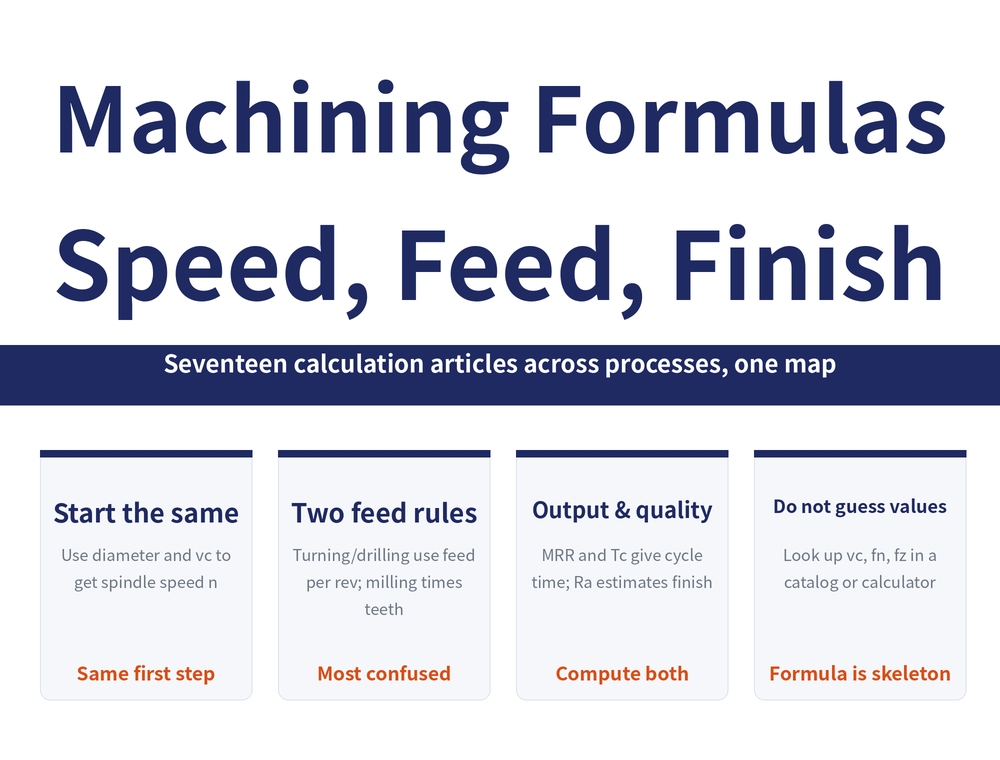
Machining involves a lot of numbers: speed, feed, material removal rate, cycle time, surface roughness, tapping torque—and each process computes them differently. The site has 17 articles on these. This is a reading guide: it does not repeat the formulas, it answers one thing—which quantity you need and which article to start from. The order is: first the common speed and rpm conversion, then feed and formulas for turning, milling, drilling and tapping, and finally how to estimate surface roughness and accuracy.
1. Start with the common ground: speed, rpm and feed conversion
Whatever the process, the starting point is using diameter and cutting speed to find rpm, then computing feed by process. Use this one-page cheat sheet to locate the quantity you need.
| Article | When to read it |
|---|---|
| Machining Formulas Cheat Sheet | ★ One-page cheat sheet of the shared formulas—start here |
2. Turning calculations
Turning uses feed per revolution; speed, feed and nose radius together decide output and finish.
| Article | When to read it |
|---|---|
| Turning Machining Formulas | ★ Turning vc, n, fn, MRR, Tc and Ra all in one place |
| Turning Cutting Conditions Guide | Read it for the speed / feed / tool life trade-off |
3. Milling calculations
Milling is multi-tooth cutting, so feed multiplies by the tooth count; effective diameter and chip thinning are the two most often miscalculated.
| Article | When to read it |
|---|---|
| End Mill Cutting Conditions Guide | ★ The full fz×z×n feed calculation for milling |
| Face Milling Formula Guide | For face-milling vc, fz, vf, Tc and Pc formulas |
| Effective Diameter and Ball Nose Speed | Ball and bull-nose vc must use effective diameter, not nominal |
| Chip Thinning and Feed Compensation | At light radial cuts or high speed, feed per tooth needs compensation |
4. Drilling calculations
Drilling, like turning, uses feed per revolution; the key is setting speed by material and recomputing when the diameter changes.
| Article | When to read it |
|---|---|
| Drilling Formula Guide | ★ Drilling vc, rpm, feed and cycle time in one place |
| Drilling Parameters Guide | Set the starting speed and feed range by material |
| Drilling Parameter Conversion | How to recompute rpm and feed for a different diameter |
5. Tapping calculations
Tapping rpm is set by lead and tapping speed; torque decides the holder and machine.
| Article | When to read it |
|---|---|
| Tap Cutting Speed Guide | For the tapping Vc formula and rpm conversion |
| Tap Torque Guide | Estimate tapping torque before choosing holder and machine |
6. Surface roughness and accuracy
After speed and feed, surface roughness and accuracy use another set of formulas; nose radius and stepover are the key variables.
| Article | When to read it |
|---|---|
| Surface Roughness: Ra vs Rz vs RzJIS | For the definitions and conversion of Ra, Rz and RzJIS |
| Turning Tool Nose Radius Selection | Nose radius rε feeds straight into the theoretical roughness formula—read it to size it |
| Milling Surface Roughness Formula | The cusp-height formula from ball-nose R and stepover P |
| Surface Roughness Chart by Process | To see the Ra range a given process can actually reach |
| Cutting Conditions vs Surface Finish | How cutting conditions affect accuracy and the trade-off |
7. FAQ
Q: Are the cutting formulas the same across processes?
The common quantities (cutting speed vc, rpm n) are the same; the difference is feed—turning, drilling and single-point boring use feed per revolution, while milling multiplies by the tooth count. See the Machining Formulas Cheat Sheet for the full conversion.
Q: Where do I look up vc, fn and fz?
Look them up in the tool maker's catalog or a calculator by material, grade and conditions—do not guess. The recommended ranges and how to plug them in are in each process article, sections 2 to 5.
Q: Can I estimate surface roughness with a formula first?
You can estimate the theoretical value. Turning commonly uses h≈fn²÷(8×rε)×1000 (μm, the feed-mark peak-to-valley height, not Ra); milling depends on ball-nose R and stepover. The real value is affected by built-up edge, vibration and wear—see section 6.
Q: Does tapping need a cutting-speed calculation too?
Yes. Tapping speed is set by lead and rpm, and you should also estimate torque to choose the holder and machine—see section 5.
Published: 2026-08-12|Updated: 2026-08-12









