
Dual Contact: Why the Flange Face Has a Gap Before Clamping
On a dual contact holder the flange face carries a gap before clamping, and it closes only because the spindle nose deforms elastically. Axial displacement is not a side effect of clamping; it is the condition that produces contact. This guide covers the mechanism and the magnitudes involved.
The counter-intuitive part first
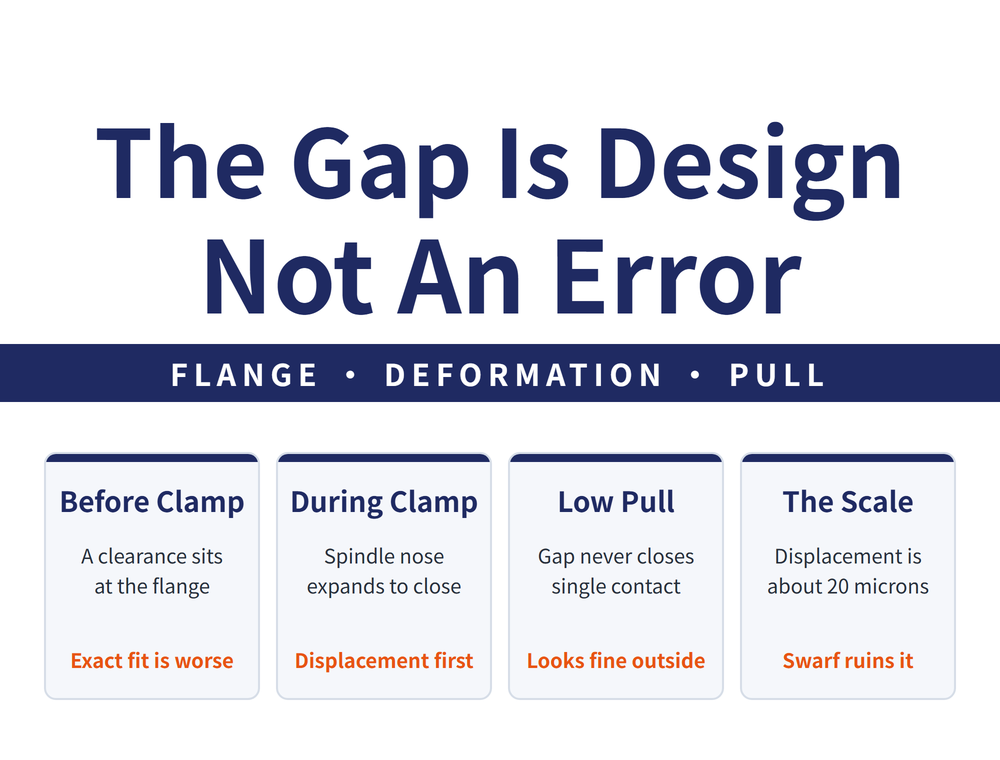
On a dual contact holder, the flange face has a gap before clamping. Many people assume dual contact simply means taper and face both fit exactly. If they genuinely fitted exactly, only one of them would end up carrying load.
🔴 Axial pull does more than draw the holder in. It uses elastic deformation of the spindle nose itself to expand the gap closed. In other words, axial displacement is a necessary condition for complete fit, not a by-product of clamping.
1. What each system bears on
| System | Support datum |
|---|---|
| Conventional taper holder | Supported on a reference diameter called the gauge line, mainly taper contact |
| Dual contact holder | Supported on the flange face, greatly increasing rigidity |
The difference is not simply one more face pressing. Taper contact relies on friction and wedge self-locking, giving good radial rigidity but limited resistance to tilting. Add the flange face and the lever arm lengthens, so resistance to bending moment is what really improves. That is why the difference shows up most at high speed and in heavy cuts.
2. What happens before and during clamping
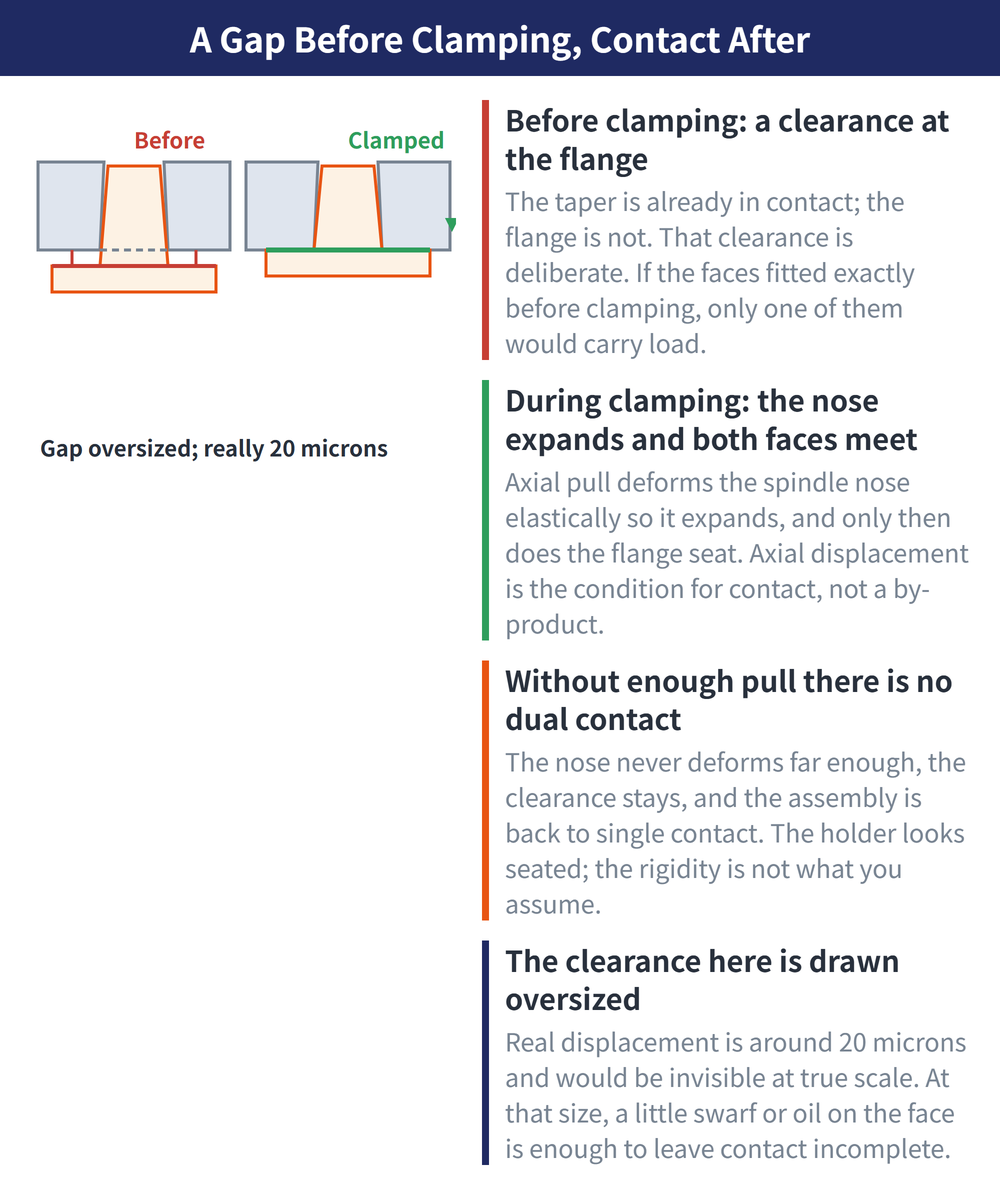
Before clamping, a small clearance exists at the flange face. During clamping, axial pull from the clamping mechanism expands the spindle nose through elastic deformation, and only then does the flange face reach complete fit.
Once that is clear, two shop-floor facts follow.
First, insufficient pull force means no dual contact. Without enough pull the spindle nose never deforms far enough, the flange clearance remains, and a holder bought for dual contact is still working on the taper alone.
Second, spindle nose condition directly affects it. The mechanism depends on the elasticity of the nose, so a worn, distorted or dirty nose gives incomplete contact, and none of that is visible from outside.
3. The magnitudes involved
| Spindle size | Clamping pull force | Axial displacement |
|---|---|---|
| No. 40 | About 800 kg | About 20 μm |
| No. 50 | About 2,000 kg | About 20 μm |
Worth noting: pull force differs by more than a factor of two while axial displacement stays in the same range. That range is only 20 μm, which is 0.02 mm. The entire mechanism plays out at that scale.
⚠ Both figures are manufacturer reference values and vary with spindle design. Use them to understand magnitude; do not treat them as acceptance criteria or maintenance limits. For your own machine, use the machine tool builder’s specification and a measured pull force reading.
4. Four practical consequences
1. Measure pull force periodically. It decays as the disc springs fatigue, and dual contact depends on pull force more than a plain taper does. When chatter starts after pull force has dropped, one manufacturer's answer is to switch to holders with an internal expanding mechanism, and it specifies a pull force of at least 500 kg on a 40-taper spindle and 1,500 kg on a 50-taper spindle for those holders (manufacturer reference values that apply only to that maker's internal expanding mechanism, not a general wear limit).
2. Clean the face as well as the bore. Chips on the face mean the gap never closes, and that face is the one dual contact adds.
3. Check spindle support before mixing. A dual contact holder will usually still fit an unsupported spindle; it simply reverts to single contact.
4. When tool change repeatability drifts, think pull force and cleanliness first, before suspecting the holder itself.
For the overall comparison of spindle taper systems, see Spindle Taper Systems Overview. For pull stud specifications, see What Is a Pull Stud. For holder care, see Tool Holder Maintenance.
Frequently asked questions
A gap at the flange before clamping sounds like poor accuracy. Is it?
No, it is deliberate. If the two faces already fitted before clamping, only one of them would actually carry load. The clearance exists so that axial pull can expand it closed through elastic deformation of the spindle nose, bringing both faces into contact.
What happens if pull force is low?
The spindle nose does not deform far enough, the flange clearance remains, and the assembly reverts to single contact. The holder looks seated and the program runs; the rigidity is simply not what you assume.
Axial displacement is only 20 μm. Does it matter that much?
The whole mechanism happens at that scale. Precisely because the scale is so small, a little swarf or oil on the face is enough to leave contact incomplete, and it is invisible from outside.
Can a dual contact holder go into an ordinary spindle?
Usually it will fit, but a spindle without support does not produce the fit mechanism, so the result is single contact. Getting the benefit requires support on both the spindle and the holder side.
Source: BIG DAISHOWA general catalog V15 (English), Features chapter, dual contact spindle system section; the pull force condition for the internal expanding mechanism is as stated in another manufacturer's tool holder catalog. 🔴 Pull force and axial displacement are manufacturer reference values that vary with spindle design. They are given here to convey magnitude and must not be used as acceptance criteria or maintenance limits; use the machine builder specification and a measured reading.
Last updated: 2026-10-22









