
Poor tool holder maintenance doesn't cost you linearly - it compounds: an uncleaned insert seat can eventually take down the machine itself. This guide covers the key maintenance checks for holders and tooling, correct torque wrench practice, why rust prevention matters more than it seems, and a ready-to-use maintenance checklist.
1. The Compounding Cost of Neglected Maintenance
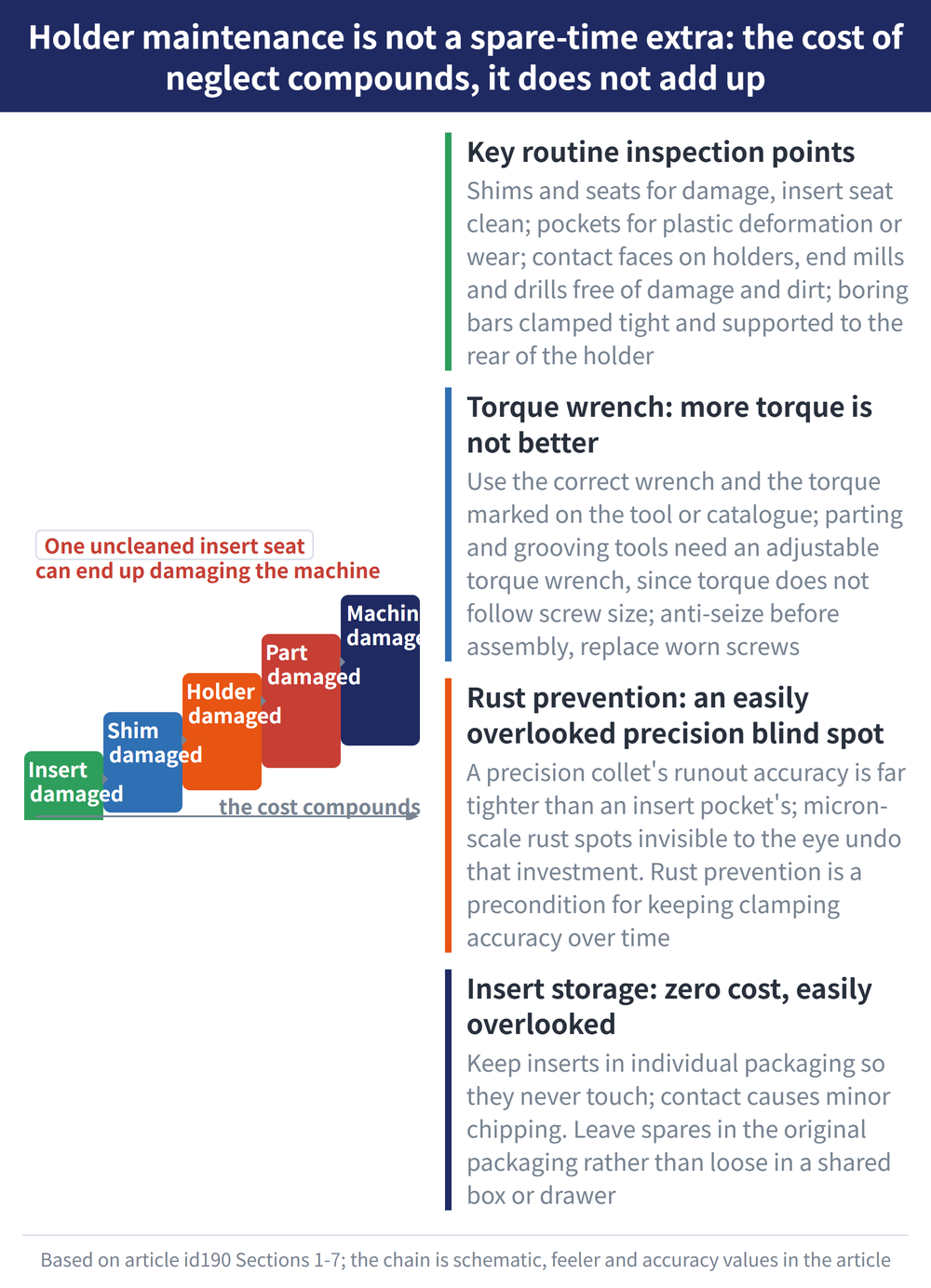
Poor tool maintenance sets off a chain reaction: damaged insert → damaged shim → damaged holder → damaged part → damaged machine, resulting in lower productivity and higher production costs. This chain is worth remembering - the cost of neglect isn't additive, it compounds: an insert seat that wasn't cleaned properly can eventually contribute to damaging the machine itself. Holder maintenance isn't a "do it when there's time" extra - it's the first line of defense for precision and cost control.
2. Key Routine Inspection Points
| Item | What to Check |
|---|---|
| Shims and shim seats | Check for shim damage; clean the insert seat and check the support location for damage; make sure shim corner radii haven't been knocked off during machining or handling |
| Insert pockets | Check for pocket damage or plastic deformation; check whether wear has enlarged the pocket, using a roughly 0.02mm feeler gauge to check clearance |
| Contact surfaces | Check the support and contact surfaces on holders, end mills, and drills for damage or contamination |
| Boring bar clamping | Clamp as tightly as possible in boring operations; if the bar isn't supported all the way to the holder's rear, overhang increases and vibration can result |
Runout, measured and reduced: see Tool Runout: Effects and Control.
3. Using the Right Torque Wrench - More Torque Isn't Always Better
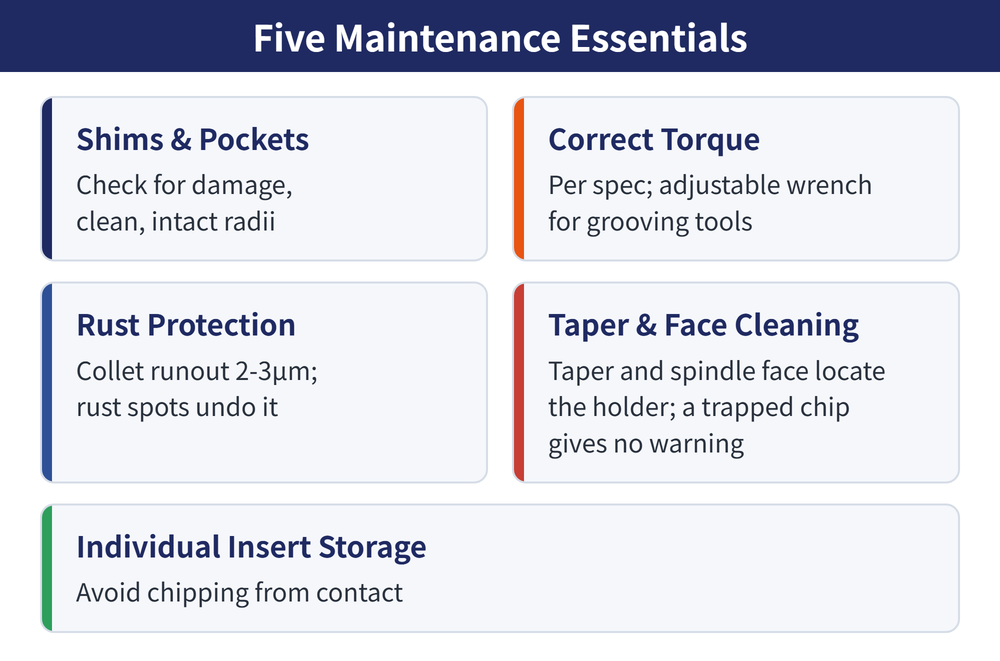
Always use the correct wrench and the correct torque (typically marked on the tool body or listed in the catalog) when tightening insert screws - this extends screw and wrench life and reduces the risk of screw breakage. One important note: parting and grooving tools need an adjustable torque wrench, because torque requirements don't correlate directly with screw size - counter to the usual assumption that bigger screws need more torque, so always check the tool's markings or catalog for the actual recommended value rather than estimating by eye. Before assembly, apply adequate anti-seize compound to both the threads and the screw head face to prevent galling, and replace worn or damaged screws outright rather than reusing them.
ER collet torque: see ER Collet Specification and Torque.
4. Rust Prevention - an Easily Overlooked Precision Blind Spot
Most clamping tools on the market don't offer complete rust protection, and even where some protection exists, it's typically only good to a visible level of coverage - yet a precision spring collet's own runout accuracy can reach the 2-3 μm level, far tighter than the roughly 0.01mm pocket tolerance typical of indexable tooling. If micron-scale rust spots - invisible to the naked eye - form on the bore surface, that precision investment is wasted. Rust prevention isn't a "nice-to-have" maintenance extra; it's a precondition for a precision clamping system to actually hold its accuracy over time. A manufacturer's real-world comparison found that after 4 months of use, an unprotected collet showed visible rust while a collet treated with rust protection showed none - a clearly visible difference.
5. Cleaning the Taper and Spindle Face
The holder taper, the spindle bore and the spindle face are the surfaces that locate the holder in the spindle. Dual contact systems (such as HSK) also rely on the flange face seating: the machining area is usually full of chips, the face picks them up easily during tool change, and a trapped chip gives no obvious warning - accuracy simply degrades quietly.
For dual contact systems one manufacturer gives three reminders: (1) clean the machining area - the ATC arm, the tool path, the magazine and the spindle surfaces - regularly, at least every 3 months (manufacturer reference value); (2) the machine should have a way to confirm the flange is fully seated; (3) the machine should have a way to clean the spindle flange face. Why even a small chip on the face matters is explained in Dual Contact: Why the Flange Face Has a Gap Before Clamping.
6. Insert Storage - a Zero-Cost Detail That's Easy to Overlook
Inserts should be kept in individual packaging to prevent them from contacting one another, because contact between inserts can cause minor cracking or chipping, damaging the carbide and reducing insert performance and life. It's best practice to leave spare inserts in their original packaging until they're about to go on the machine, rather than dumping spares loose into a shared box or drawer - a common shop habit that can degrade inserts before they've even been used.
Common collet damage: see Collet Damage and Deformation.
7. Maintenance Checklist Summary
| # | Check |
|---|---|
| 1 | Check tools for wear and shims for damage |
| 2 | Ensure the insert seat is clean |
| 3 | Ensure correct insert positioning |
| 4 | Use the correct wrench and driving tool |
| 5 | Tighten insert screws to the correct torque |
| 6 | Lubricate screws before assembly |
| 7 | Ensure the tool, holder, and spindle contact surfaces are clean and undamaged |
| 8 | Ensure the boring bar is securely clamped with an undamaged holder end |
Well-organized, well-recorded tool inventory management saves production costs - stability remains the key factor in any metal cutting operation, and the first step toward it often starts with a checklist as basic as this one.
FAQ
Q1: Should insert screws be tightened as much as possible?
No. Use the correct torque value marked on the tool or listed in the catalog. Over-torquing can break the screw or deform the insert, while under-torquing gives insufficient clamping force. This matters even more for parting and grooving tools, where torque doesn't correlate directly with screw size - always check the actual recommended value and use an adjustable torque wrench rather than judging by feel.
Q2: How much does rust in a collet bore actually matter?
It can matter a great deal. Precision spring collets can achieve runout accuracy around 2-3 μm, far tighter than the roughly 0.01mm tolerance typical of indexable insert pockets. Micron-scale rust spots on the bore surface - even ones invisible to the naked eye - are enough to undo that precision investment and increase runout after clamping. It's an easily overlooked but directly consequential maintenance blind spot.
Q3: Is it fine to keep spare inserts loose in the same drawer?
Not recommended. Inserts knocking against each other can cause minor cracking or chipping, damaging the carbide, even when no visible defect is apparent - this reduces insert performance and shortens tool life. Keep inserts in their individual packaging and only remove them right before they go on the machine, to avoid this kind of contact damage.
Q4: How often should a tool holder be inspected or retired?
There's no single industry-standard interval. It's best to run through the checklist above at a frequency matched to actual usage (for example, checking contact surfaces and pocket clearance at every tool change or daily maintenance). Once you find plastic deformation in the pocket, excessive clearance (checkable with a roughly 0.02mm feeler gauge), or visible damage to the taper or contact surfaces, plan for replacement - don't judge solely by elapsed time in service.









