
End Mill Edge Selection Guide | Sharp Edge vs Deep Flute Design Explained
End mill edge design directly affects machining accuracy, tool strength and cutting stability. Common edge forms include the sharp corner and the deep-long gash: the former offers high keenness and finishing capability, the latter boosts tool strength and chipping resistance. Different edge designs affect residual height, cutting load and chip behavior—and in ball-nose milling, edge geometry determines surface quality. Choosing the right edge form is key to efficiency and tool life.
Why Edge Design Matters
End mill edge geometry directly affects machining accuracy, cutting resistance, tool life and surface roughness. Different edge designs strike a different balance between efficiency and durability. The two main forms are the sharp corner (B in the figure) and the deep-long gash (A in the figure).
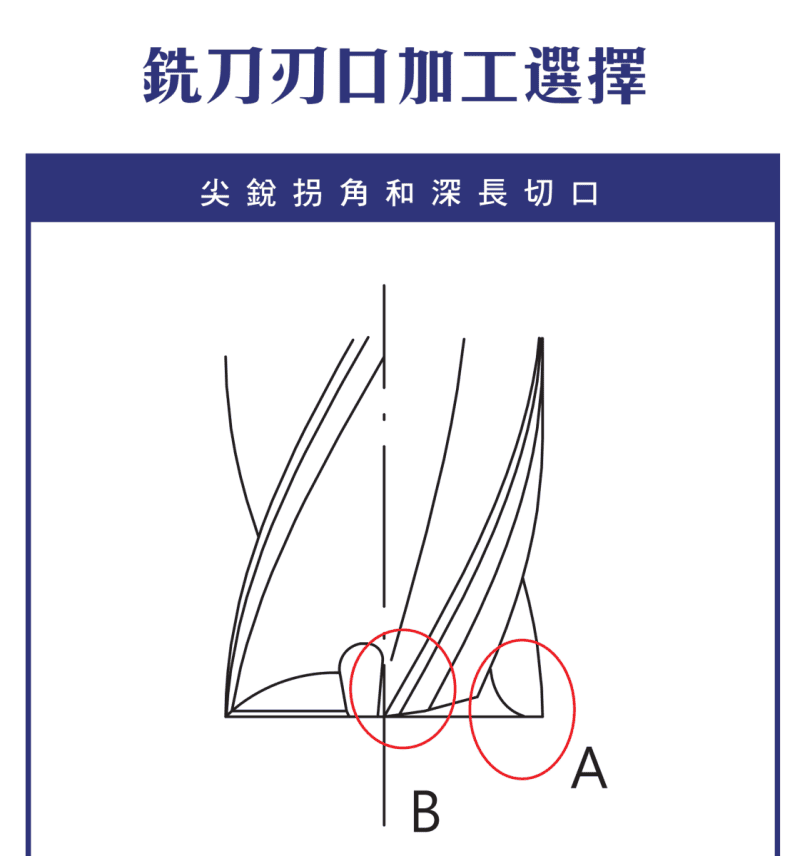
Sharp Corner Edge
Features: keen tip, high accuracy, suits finishing.
Limits: weaker chipping resistance and lower strength.
Use cases: precision machining and high surface-quality work.
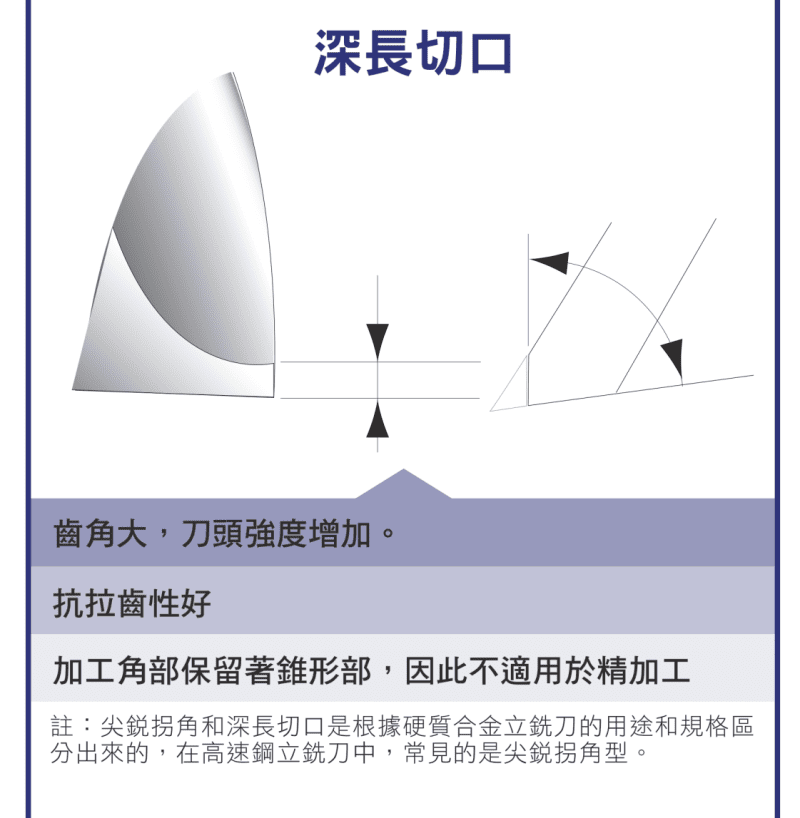
Note: sharp corner and deep-long gash are distinguished by the use and spec of carbide end mills; HSS end mills commonly use the sharp-corner type.
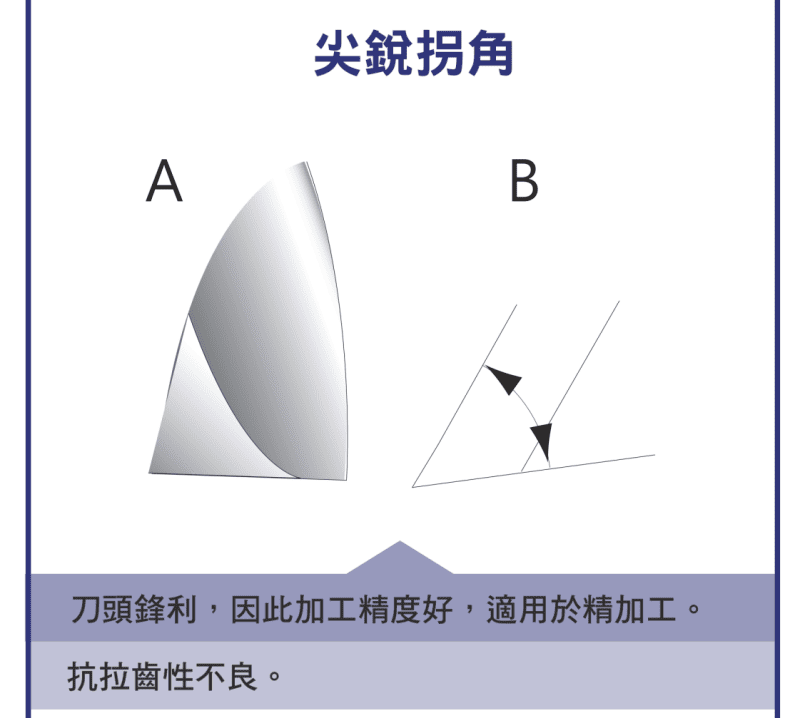
Deep-Long Gash Edge
Features: larger edge (tooth) angle, higher tool strength, good chipping resistance.
Limits: leaves a tapered residue at corners, unsuitable for high-precision finishing.
Use cases: roughing and high-load cutting.
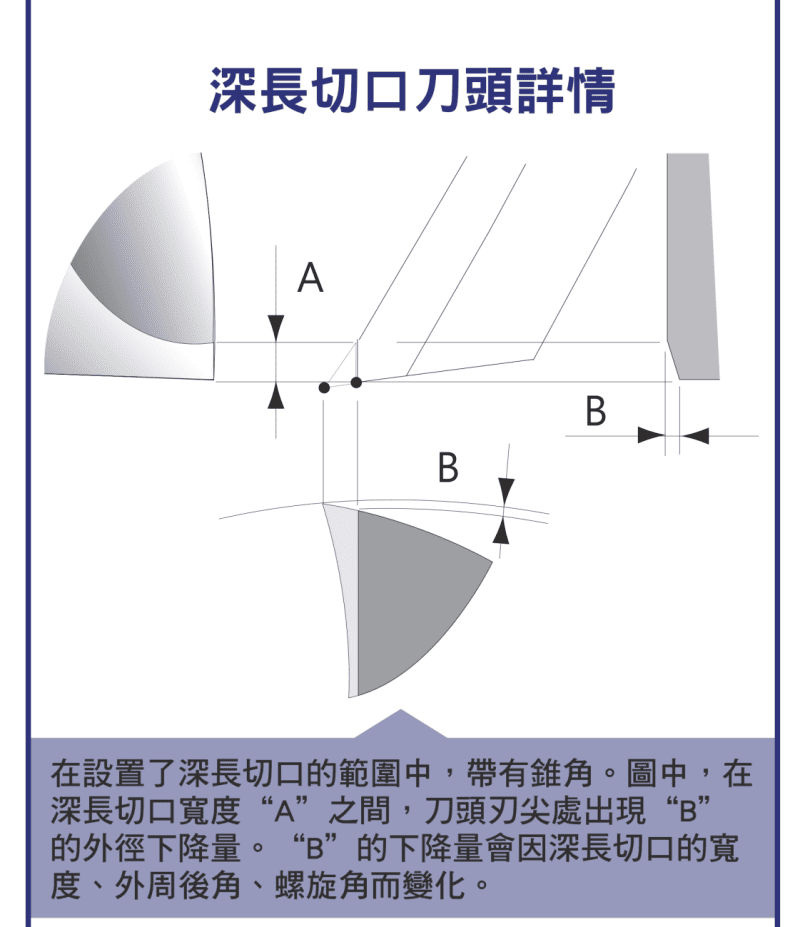
Edge Design's Effect on Residue
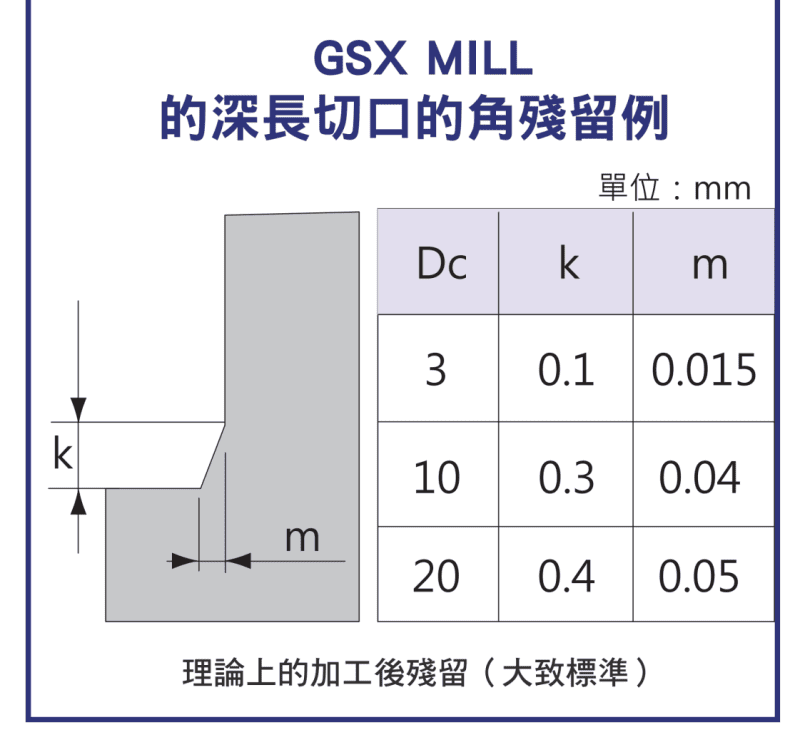
With a deep-long gash, the tool OD produces a drop amount (B). As shown below, within the gash width (A) the tip exhibits an OD drop B, giving the corner a taper and producing residual error. The drop B varies with:
| Item |
|---|
| Gash width (A) |
| Peripheral relief angle |
| Helix angle |
The table below gives theoretical corner residue for the GSX MILL deep-long gash (general standard, mm):
| Tool diameter Dc (mm) | k (mm) | m (mm) |
|---|---|---|
| 3 | 0.1 | 0.015 |
| 10 | 0.3 | 0.04 |
| 20 | 0.4 | 0.05 |
Ball-Nose Residual Height
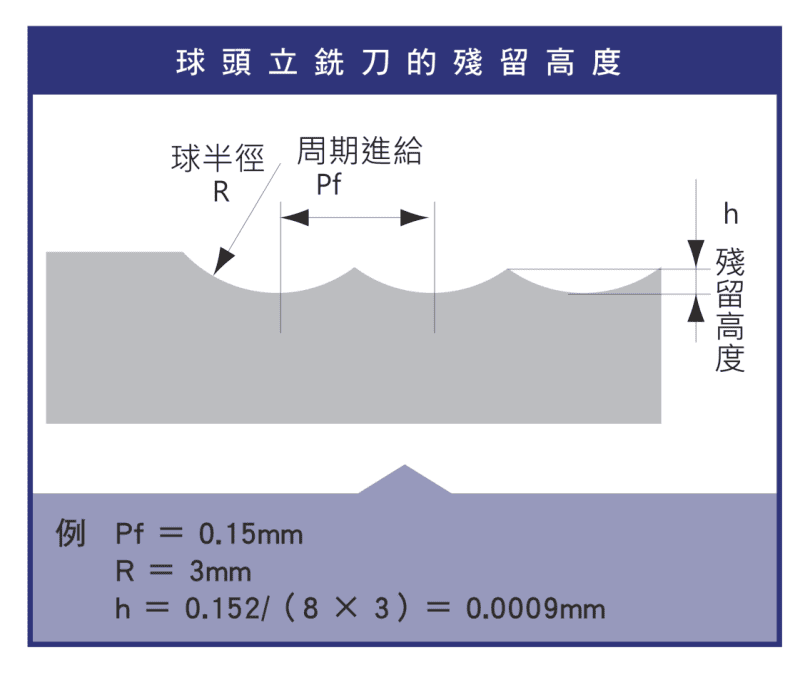
In curved (3D) machining, residual height h is set by ball radius R and stepover Pf: a bigger ball or a smaller stepover leaves less; when the stepover is much smaller than the tool diameter, the approximation in the figure below, h ≈ Pf² ÷ (8R), is enough. For the exact formula, setting the stepover and choosing the ball size, see Ball-Nose Finishing: Scallop Height, Stepover, and Which Ball Size.
Edge Selection Tips
| Item | Description |
|---|---|
| Finishing | choose a sharp edge. |
| Roughing | choose a deep-long gash. |
| High-strength cutting | prioritize tool strength (deep-long gash). |
| High surface quality | prioritize edge keenness (sharp corner). |
For edge, relief and margin structural names, see End Mill Parts Explained; for tool types (including ball nose) and how to choose, see End Mill Types and Features Explained.
FAQ
What's the difference between a sharp corner and a deep-long gash?
A sharp corner is keen, accurate and suited to finishing but chips more easily; a deep-long gash has a larger edge angle with better strength and chipping resistance, but leaves a tapered corner residue unsuitable for high-precision finishing.
Which edge for finishing?
Use a sharp edge for finishing (keen, accurate); use a deep-long gash for roughing or high-load cutting (strong, chip-resistant).
Why does a deep-long gash leave residue?
Within gash width A the tip has an OD drop B, giving the corner a taper; the drop varies with gash width, peripheral relief angle and helix angle.
How is ball-nose residual height calculated?
h = Pf² ÷ (8R), where Pf is feed pitch and R is ball radius; larger radius and smaller feed give lower residue and a smoother surface. e.g. Pf=0.15, R=3 → h≈0.0009 mm.
This article is part of End Mills: The Complete Guide - Know the Cutter, Choose It, Set the Conditions; Toolpaths Are Another Line; that guide shows how the whole topic fits together.
Published: 2026-03-19 | Last updated: 2026-10-19









