
Ball-Nose Finishing: Scallop Height, Stepover, and Which Ball Size
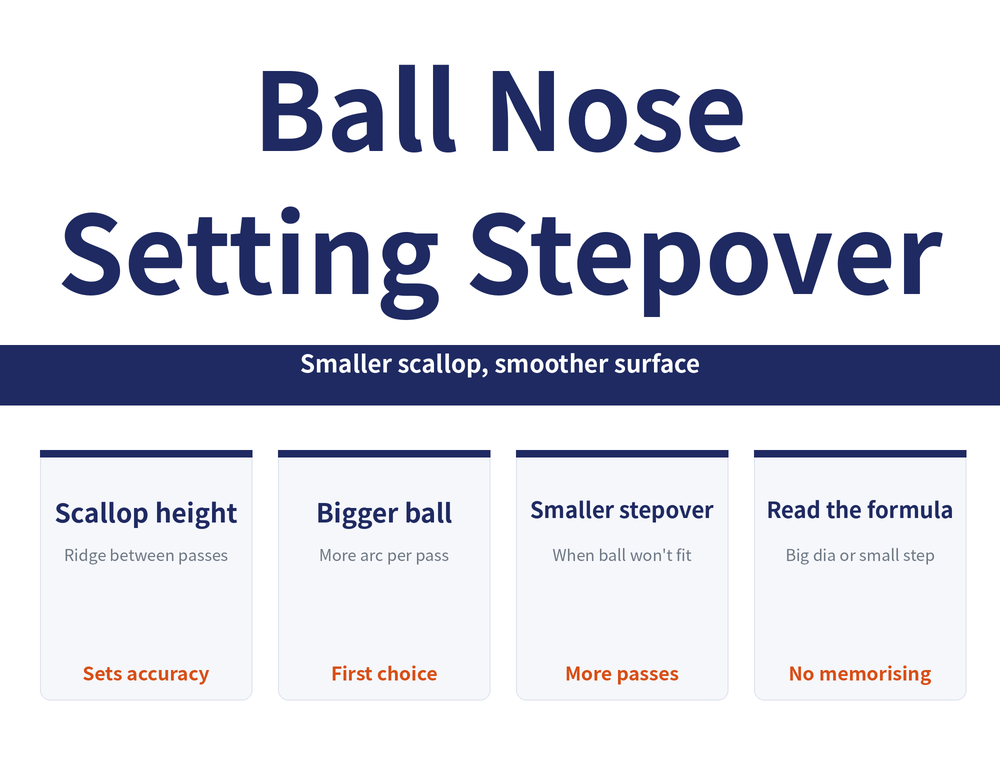
How smooth a finished surface comes out is decided by the scallop height. This guide helps you decide how to bring it down: move to a larger ball, or cut the stepover — the two routes cost you different things. The relationship between ball diameter, stepover and scallop height, and how to trade them off, are both covered.
1. Scallop Height Is What Decides How Smooth It Looks
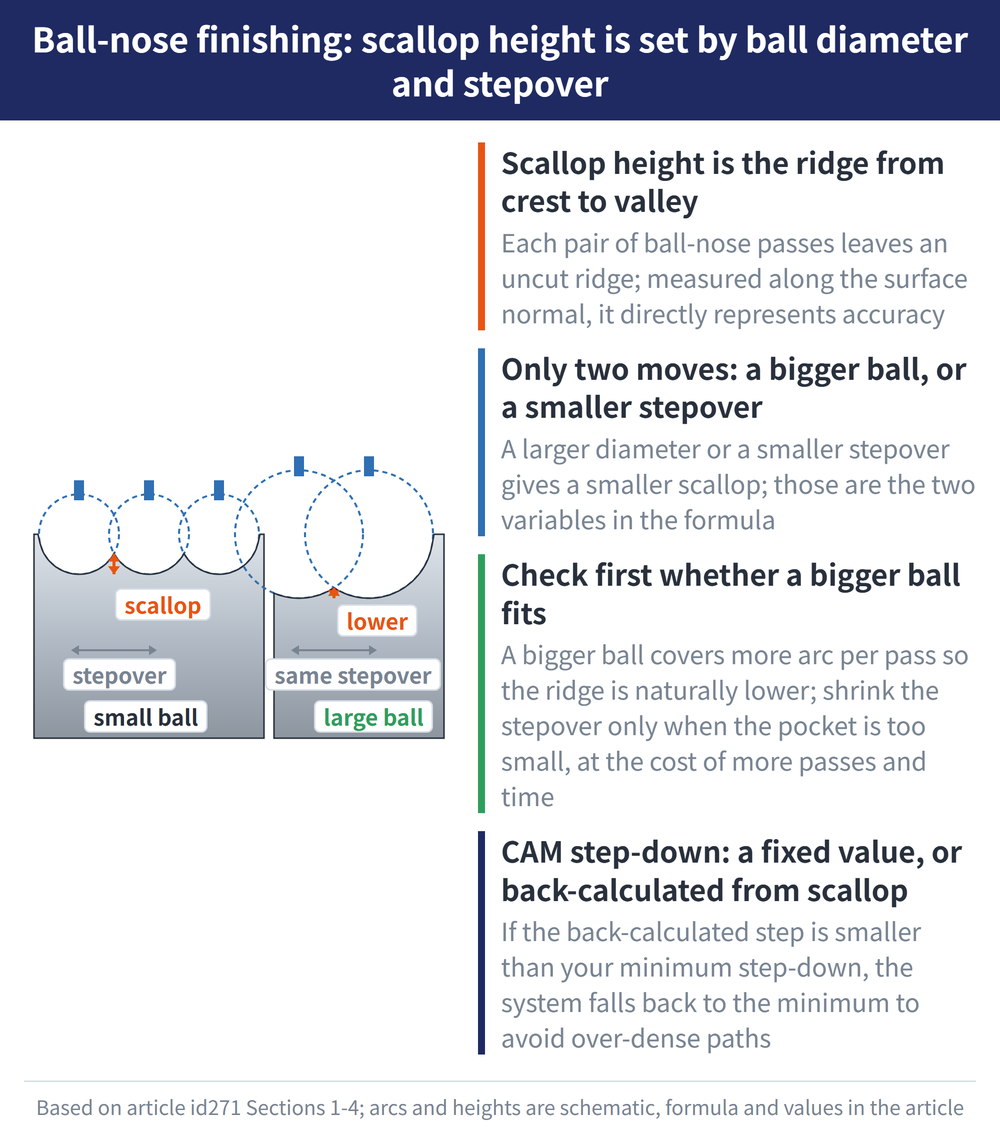
As a ball nose mills a surface pass by pass, an uncut ridge is left between each pair of passes. The scallop height is the height of that ridge from crest to valley, measured along the surface normal. It is the parameter that directly represents accuracy: the smaller the scallop, the smoother the surface. Controlling the finish on a curved surface means controlling this height.
2. The Formula: Scallop Is Set by Ball Diameter and Stepover
For a ball nose, scallop height h relates to tool diameter d and stepover b as:
h = d/2 − √( (d/2)² − (b/2)² )
Read it as: h equals half the diameter, minus the square root of (half-diameter squared minus half-stepover squared). No need to memorise it — just read the shape: a larger diameter d, or a smaller stepover b, gives a smaller scallop h and a smoother surface. That is the basis for the two moves in the next section.
When the stepover b is much smaller than the diameter d, the formula simplifies to the approximation h ≈ b² ÷ (4d) (often written h ≈ b² ÷ 8R, with R the ball radius), and the two give almost the same answer. Example: d = 6 mm, b = 0.15 mm gives 3 − √(9 − 0.075²) ≈ 0.00093765 mm exactly and 0.15² ÷ 24 ≈ 0.00093750 mm approximately. Another common form, h = R × {1 − cos[sin⁻¹(b ÷ 2R)]}, is exactly equal to it; see Milling Surface Roughness Formula: Ball Nose R & Stepover P.
3. For a Better Surface: Bigger Ball, or Smaller Stepover
The formula leaves only two moves, both of which bring the scallop down:
| Move | When to use it |
|---|---|
| Use a larger ball diameter | First choice when the magazine and space allow — a bigger ball covers more arc per pass, so the ridge is naturally lower |
| Reduce the stepover | When the pocket is too small to fit a bigger tool, a smaller stepover reaches the same scallop (at the cost of more passes and longer time) |
Check first whether a bigger ball fits; only shrink the stepover if it does not. For how cutting conditions overall affect accuracy, see cutting conditions vs surface finish.
4. Two Ways to Set the Step-Down in CAM
In equal-height finishing, the step-down (how far down each layer goes) can be specified two ways:
| Method | How it works |
|---|---|
| Minimum step-down | Give a fixed constant; every layer steps down by that amount |
| By scallop height | Driven by your target scallop plus a "maximum step-down" cap; the system back-calculates each layer's step |
Safety rule: if the step from the scallop calculation is smaller than the minimum step-down you set, the system falls back to the minimum step-down — a guard against over-dense paths and runaway compute time.
5. Frequently Asked Questions (FAQ)
Q: What is scallop height?
The height of the uncut ridge left between two adjacent ball-nose passes, measured along the surface normal. It directly represents accuracy — the smaller the scallop, the smoother the surface.
Q: Bigger ball or smaller stepover for a smoother surface?
Both work. When the magazine and space allow, use a larger ball first (it covers more arc per pass, lower ridge); only shrink the stepover when the pocket is too small for a bigger tool — the cost is more passes and longer time.
Q: How do I read the ball-nose scallop formula?
h = d/2 − √((d/2)² − (b/2)²), where h is scallop height, d is diameter and b is stepover. No need to memorise it — read the shape: a larger d or smaller b gives a smaller h and a better surface.
Q: How is the step-down set in CAM?
Two ways: give a fixed minimum step-down, or set a target scallop height and let the system back-calculate each layer's step. If that calculated step is smaller than the minimum step-down, the system falls back to the minimum to avoid over-dense paths.
This article is part of Milling Toolpaths: The Complete Guide - Roughing Strategy, Where to Plunge, and Choosing a Finishing Pattern; that guide shows how the whole topic fits together.
Published: 2026-08-12 | Last updated: 2026-10-19









