
End Mill Flute Count and Helix Angle: How to Choose
When choosing an end mill, flute count and helix angle have to be decided together, because they pull on each other — move one and the best value for the other shifts. This guide puts them in order: look first at whether the operation is slotting or finishing and whether the material is aluminum or steel, and set the flute count from that; then decide whether surface finish or cutting stability matters more, and set the helix from that. The trade-offs and where each belongs are tabled, so you can pick straight from the conditions in front of you.
Core Factors in End Mill Selection
End mill selection rests on two keys: flute count and helix angle. Together they affect surface accuracy, cutting resistance, chip evacuation and tool life.
Flute Count: 2, 3, 4 and 5+ Flutes
| Flute count | Characteristics | Suited to |
|---|---|---|
| 2-flute | Good chip evacuation, resists clogging | Slotting and aluminum / non-ferrous metals |
| 3-flute | Easy chip evacuation, low surface roughness; the outer diameter is harder to measure directly | Slotting, side milling, heavy-cut finishing |
| 4-flute | High rigidity and surface accuracy | Finishing and steel / cast iron |
| 5+ flutes (fine pitch) | Smallest chip space; rigidity and surface quality go up further | Finishing and shallow cuts; not for deep-slot roughing |
The more flutes, the less chip space and the higher the rigidity and surface quality—that is the core trade-off in choosing a flute count. For deep slots and roughing that must clear a lot of chips, start with 2 or 3 flutes; for finishing and shallow slots, move to 4 or more.
How Flute Count Affects Machining
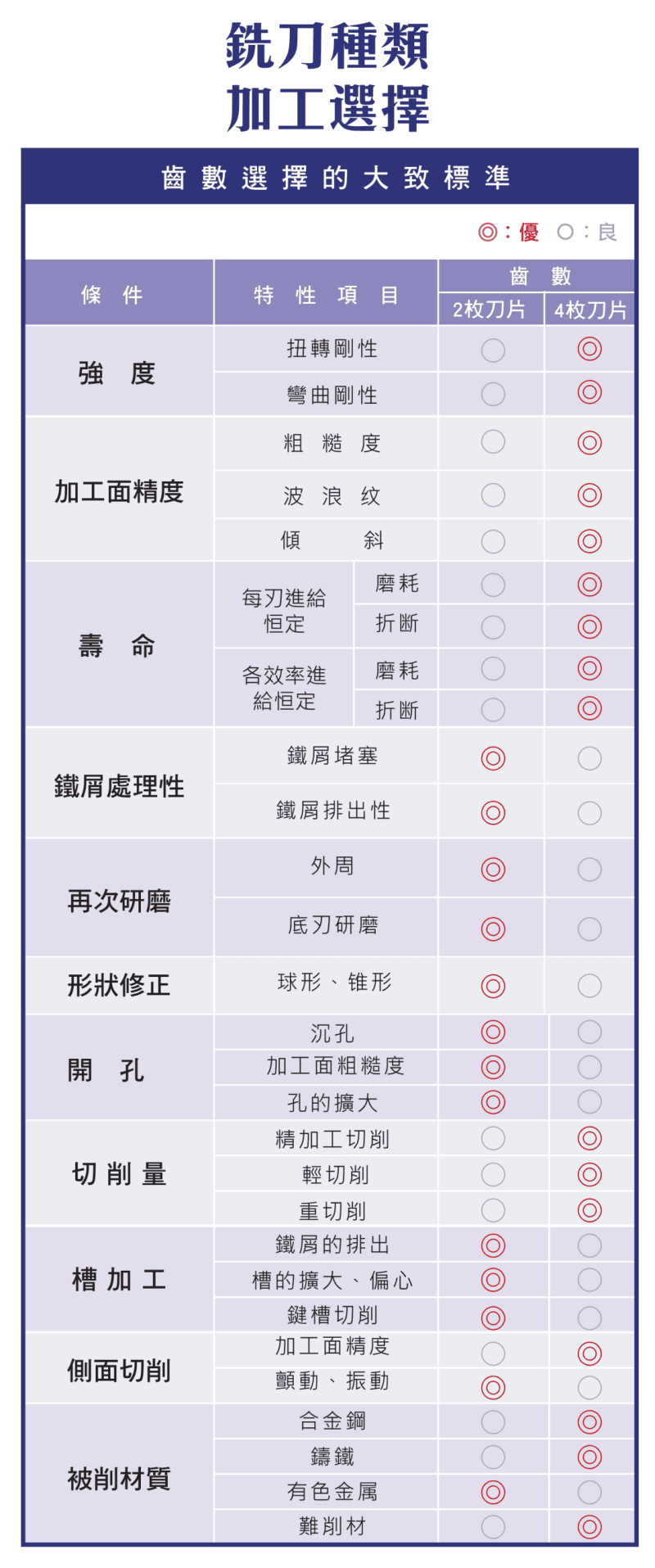
Overall, more flutes (4) win on accuracy, life and stability; fewer flutes (2) win on chip evacuation and regrinding. The table below is a general standard for flute selection (◎: Excellent ○: Good).
| Condition | Item | 2-flute | 4-flute |
|---|---|---|---|
| Strength | Torsional rigidity | ○ | ◎ |
| Bending rigidity | ○ | ◎ | |
| Surface accuracy | Roughness | ○ | ◎ |
| Waviness | ○ | ◎ | |
| Tilt | ○ | ◎ | |
| Tool life | Constant feed/tooth · wear | ○ | ◎ |
| Constant feed/tooth · breakage | ○ | ◎ | |
| Constant efficiency feed · wear | ○ | ◎ | |
| Constant efficiency feed · breakage | ○ | ◎ | |
| Chip handling | Chip clogging | ◎ | ○ |
| Chip evacuation | ◎ | ○ | |
| Regrinding | Periphery | ◎ | ○ |
| End-tooth grinding | ◎ | ○ | |
| Shape correction | Ball / taper | ◎ | ○ |
| Hole making | Counterbore | ◎ | ○ |
| Surface roughness | ◎ | ○ | |
| Hole enlargement | ◎ | ○ | |
| Cutting volume | Finishing | ○ | ◎ |
| Light cutting | ○ | ◎ | |
| Heavy cutting | ○ | ◎ | |
| Slotting | Chip evacuation | ◎ | ○ |
| Slot widening / eccentricity | ◎ | ○ | |
| Keyway cutting | ◎ | ○ | |
| Side milling | Surface accuracy | ○ | ◎ |
| Chatter / vibration | ◎ | ○ | |
| Workpiece | Alloy steel | ○ | ◎ |
| Cast iron | ○ | ◎ | |
| Non-ferrous metals | ◎ | ○ | |
| Difficult-to-cut | ○ | ◎ |
Helix Angle Selection
| Helix angle | Characteristics | Suited to |
|---|---|---|
| Low helix | High cutting resistance | Hard materials |
| Standard helix | Balanced cutting performance | General-purpose machining |
| High helix | Smooth cutting, good chip evacuation | Aluminum |
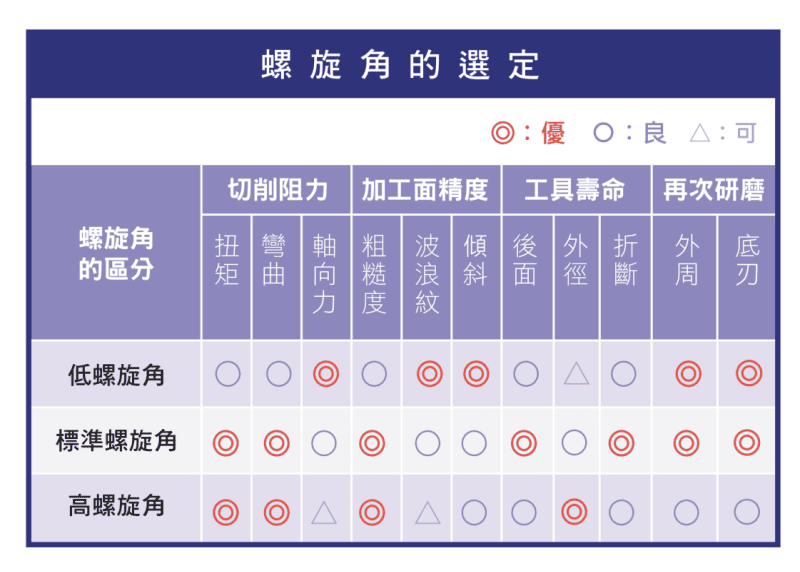
The table below is a general standard for helix-angle selection (◎: Excellent ○: Good △: Fair).
| Helix angle | Cutting resistance | Surface accuracy | Tool life | Regrinding | |||||||
|---|---|---|---|---|---|---|---|---|---|---|---|
| Torque | Bending | Axial force | Roughness | Waviness | Tilt | Flank | OD | Breakage | Periphery | End tooth | |
| Low helix | ○ | ○ | ◎ | ○ | ◎ | ◎ | ○ | △ | ○ | ◎ | ◎ |
| Standard helix | ◎ | ◎ | ○ | ◎ | ○ | ○ | ◎ | ○ | ◎ | ◎ | ◎ |
| High helix | ◎ | ◎ | △ | ◎ | △ | ○ | ◎ | ○ | ○ | ○ | ○ |
Helix Angle vs Machining Accuracy
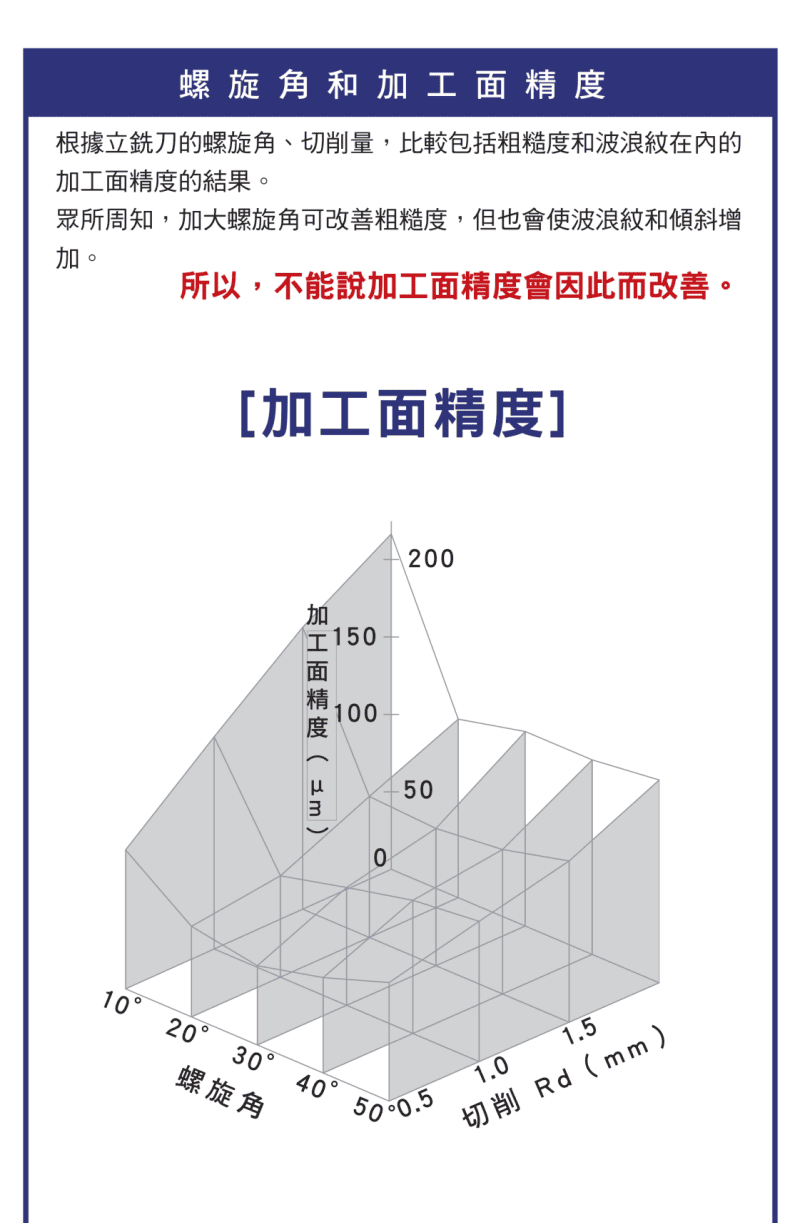
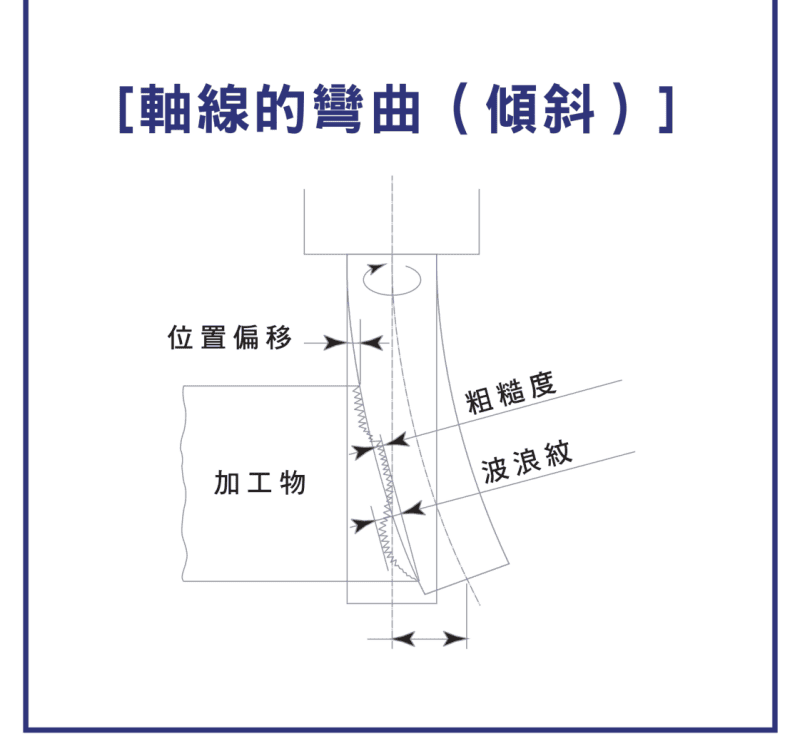
Comparing surface accuracy (including roughness and waviness) by helix angle and cutting volume shows that a larger helix angle improves roughness but also increases waviness and tilt (axis deflection). So you cannot simply assume surface accuracy improves with a larger helix.
Conclusion: a bigger helix angle is not always better—choose to balance your machining needs.
Cutting Conditions & Tool Selection Tips
| Machining need | Recommended choice |
|---|---|
| Slotting | 2-flute (good chip evacuation) |
| Side milling | 4-flute (good accuracy) |
| Finishing | More flutes + standard or high helix |
| Roughing | Fewer flutes + strong chip-evacuation design |
| Difficult-to-cut materials | Low helix + high rigidity |
| Aluminum | High helix + fewer flutes |
Flute count affects the tool factor in cutting-condition calculations—see End Mill Cutting Conditions Guide; for helix, margin and other structural names, see End Mill Parts Explained.
FAQ
How do I choose between 2-flute and 4-flute end mills?
2-flute evacuates chips well and resists clogging—good for slotting and aluminum / non-ferrous metals; 4-flute is rigid and accurate—good for finishing and steel / cast iron.
Is a bigger helix angle always better?
No. A larger helix improves roughness but increases waviness and tilt (axis deflection); choose to balance your machining needs.
Which flute count and helix for finishing?
For finishing, use more flutes (4 or more) with a standard or high helix to balance accuracy and surface quality.
How do I select tools for difficult-to-cut materials?
Use a low helix with a high-rigidity tool to withstand higher cutting resistance and reduce chipping risk.
For the full reading guides on this topic, see Tool Life and Wear: A Complete Reading Guide and Chip Control: A Complete Reading Guide.
This article is part of End Mills: The Complete Guide - Know the Cutter, Choose It, Set the Conditions; Toolpaths Are Another Line; that guide shows how the whole topic fits together.
Published: 2026-03-18 | Last updated: 2026-10-19









