
Exchangeable Head Drill Troubleshooting: Same Symptom, Opposite Fixes
In one handbook, one symptom, one product line tells you to cut the feed while another tells you to raise both speed and feed. This guide explains why troubleshooting tables cannot be copied across product lines, why the hole tolerance limits differ fivefold between oversize and undersize, and the three axes behind all ten symptoms.
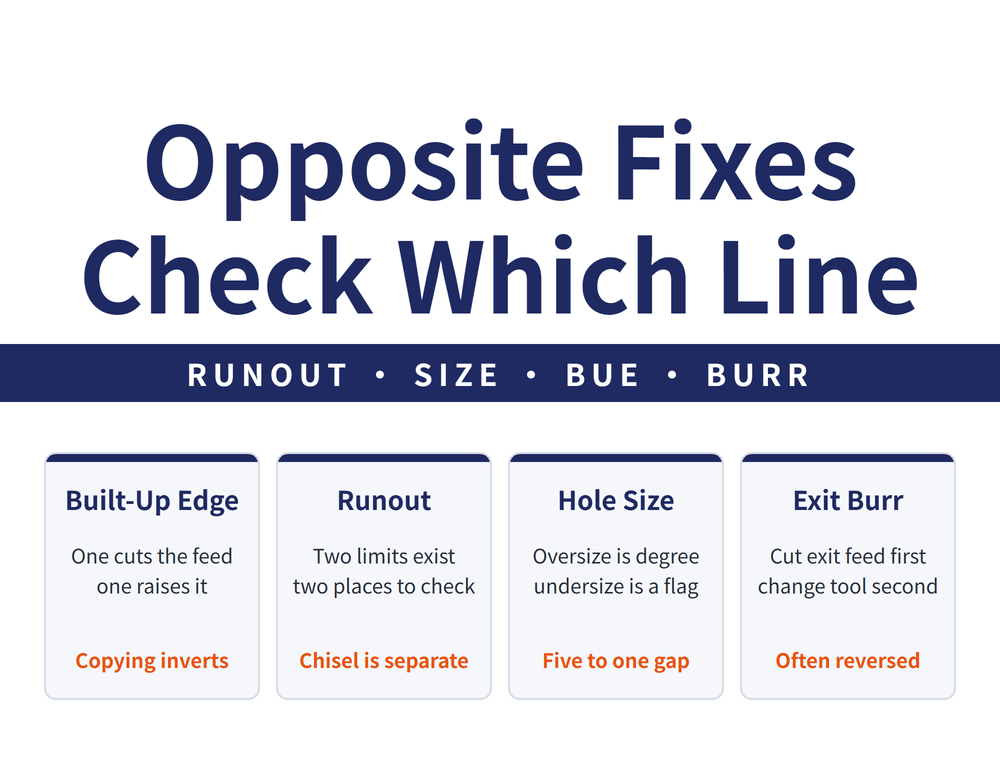
The easiest mistake first
Within a single manufacturer handbook, the same symptom gets opposite prescriptions on different product lines. Built-up edge is the clearest example:
| Line | Built-up edge remedy order as published |
|---|---|
| Line A | Check runout → reduce feed → check chisel point runout → change drill → increase workpiece clamping → raise internal coolant pressure |
| Line B | Increase cutting speed and feed → raise coolant pressure |
| Line C | Increase cutting speed → raise coolant pressure |
🔴 One says cut the feed, the other says raise speed and feed. Copying another line’s table gets the fix backwards, and a backwards fix rarely clears the symptom immediately. It usually drags on until the tool is scrap.
A plausible reason: built-up edge forms when cutting-zone temperature sits in the range where material adheres, and the standard remedy is to raise cutting speed out of that range. But if runout or chisel eccentricity is also present, raising speed brings on edge chipping first, which is why the other line puts runout first and feed reduction second. That paragraph is inference; the handbook gives no reason. What is certain is only that the two prescriptions genuinely differ and must be looked up per product line.
1. The limits differ too, and the model names look alike
| Line | Runout limit | Chisel point runout | Allowable incline | Feed reduction there |
|---|---|---|---|---|
| Line A | 0.02 mm | 0.02 mm | Up to 12 degrees | 30 to 50% |
| Line B | 0.02 mm | 0.02 mm | Up to 7 degrees | 30 to 50% |
| Line C | 0.02 mm | 0.02 mm | Up to 6 degrees | 30 to 50% |
| Line D | 0.03 mm | 0.03 mm | Up to 7 degrees | 50 to 70% |
Three things must not be mixed:
1. The runout limit is not one number. One line allows 0.03, the other three 0.02. Applying 0.02 to that line is too strict; applying 0.03 to the others lets bad tools through.
2. Allowable incline ranges from 6 to 12 degrees, a factor of two. The same sloped face goes from acceptable to outside the handbook simply by changing drill.
3. The feed reduction differs too. One line calls for 50 to 70%, the others 30 to 50%.
⚠ These are one manufacturer’s published values per product line. They must not be applied across product lines, still less across brands. Lines are labelled A to D here to make the point that they differ; look up the actual figures for the tool in your hand. For how to compare drills from two brands side by side, see Comparing Cutting Tool Brands: Which Spec Fields Line Up, and Which Only Count Within One Catalog.
One more item is easily missed: runout and chisel point runout are two separate checks, not one. Acceptable overall runout does not mean the chisel edge is centred, and chisel eccentricity is a leading cause of both hole position error and oversize holes.
2. The tolerance limits differ fivefold, and that is not a typo
| Verdict | Limit |
|---|---|
| Oversize | More than nominal diameter plus 0.15 mm |
| Undersize | Less than nominal diameter minus 0.03 mm |
The five-to-one asymmetry reflects the physics of drilling. Oversize is normal: runout, chisel eccentricity and vibration all open the hole up. Undersize is rare, needing elastic recovery of the material or severe wear to occur at all.
🔑 So with the same complaint of "wrong hole size", oversize is a matter of degree while undersize is an abnormality signal. Measuring 0.03 mm under nominal is worth stopping for, not just a tolerance miss.
3. Ten symptoms, three axes
Across four product lines and ten failure symptoms, the remedies land on three directions. Remembering these three beats memorising the whole table.
| Axis | Content |
|---|---|
| Check runout before touching parameters | Six of the ten symptoms open with "check runout", and runout and chisel point runout are measured separately |
| Coolant pressure is the universal second move | Seven of the ten list raising coolant or internal coolant pressure |
| Entry and exit get their own feed reduction | Feed reduction on entering an incline or rough face, and on exit, is set separately rather than across the whole stroke |
Exit burrs are worth singling out: the first published remedy is reducing feed by 50 to 70% on exit, and replacing the worn drill comes second. Many shops do it the other way round.
4. A sequence you can actually follow
1. Measure runout, then chisel point runout, separately.
2. Open the table for your own product line, not another one.
3. If the hole is undersize, stop and investigate rather than treating it as a tolerance issue.
4. Only then reach for coolant pressure.
5. Set entry and exit feed independently.
For the quantitative relationship between coolant pressure and flow, see Drilling Coolant: Chase Flow, Not Pressure. For general drill troubleshooting, see Drill Troubleshooting Guide.
Frequently asked questions
Can I use another product line’s troubleshooting table?
Not advisable. Within one handbook the same symptom can carry opposite remedies on different lines. Built-up edge is the example: one line says reduce feed, another says raise speed and feed. Copying across gets the fix backwards.
Is 0.025 mm of runout out of limit?
It depends on the product line. In the material checked, one line allows 0.03 mm and three allow 0.02 mm, so the same reading gives opposite verdicts. Use the handbook for the tool you are holding.
Does a slightly undersize hole matter?
Yes. The limits are asymmetric: oversize only counts beyond nominal plus 0.15 mm, while undersize counts at nominal minus 0.03 mm. Oversize is normal and undersize is rare, so an undersize hole usually signals something abnormal.
For exit burrs, change the drill or adjust parameters first?
The first published remedy is reducing feed by 50 to 70% on exit; replacing the worn drill is second. Many shops reverse that and find the burrs still there after fitting a new tool.
Sources: ISCAR Drilling Handbook (Exchangeable Head Drills Troubleshooting, four product lines); runout limits independently corroborated by Sandvik technical material. 🔴 All limits are that manufacturer’s published values per product line and must not be applied across lines or brands; lines are labelled A to D. The section on why the prescriptions differ is inference; the handbook gives no reason.
Last updated: 2026-10-28









