
Comparing Cutting Tool Brands: Which Spec Fields Line Up, and Which Only Count Within One Catalog
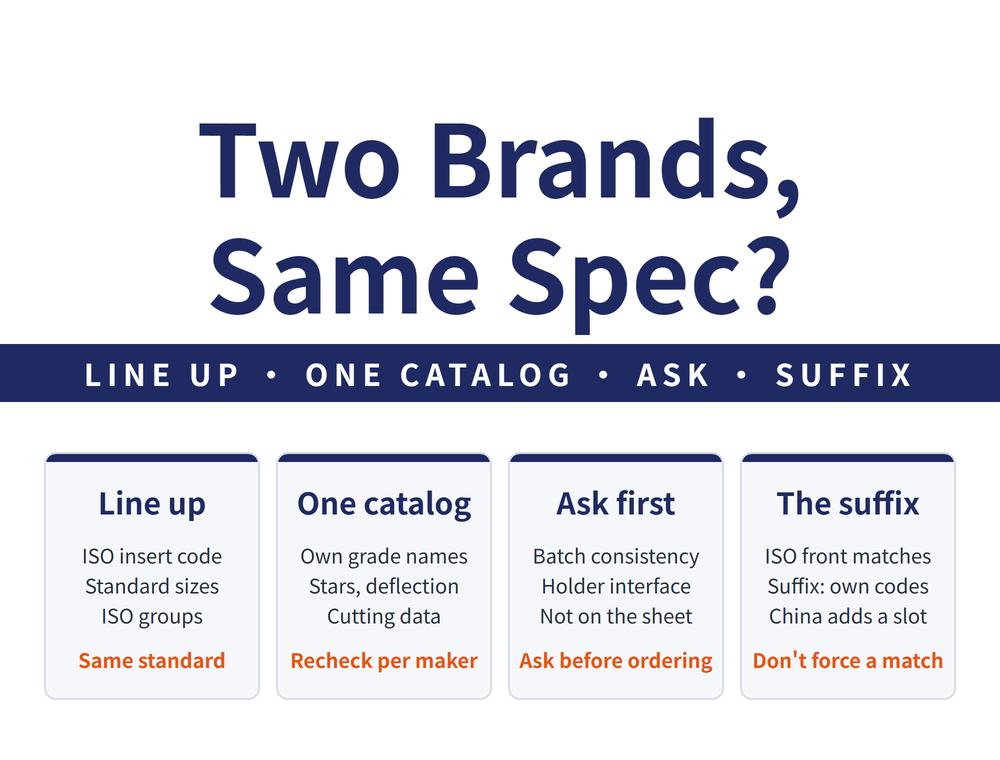
When two cutting tool brands quote the same spec, the fields you can line up side by side are the ones written to a standard: the ISO code at the front of the insert designation, dimensions written to ISO, and the ISO application group a grade maps to. Own grade names, chipbreaker codes, star ratings, deflection indexes and recommended cutting conditions only mean something within one maker's catalog. Batch-to-batch material consistency and whether the holder interface fits are not on the spec sheet at all, so ask before you order.
1. Sort both spec sheets into three zones first
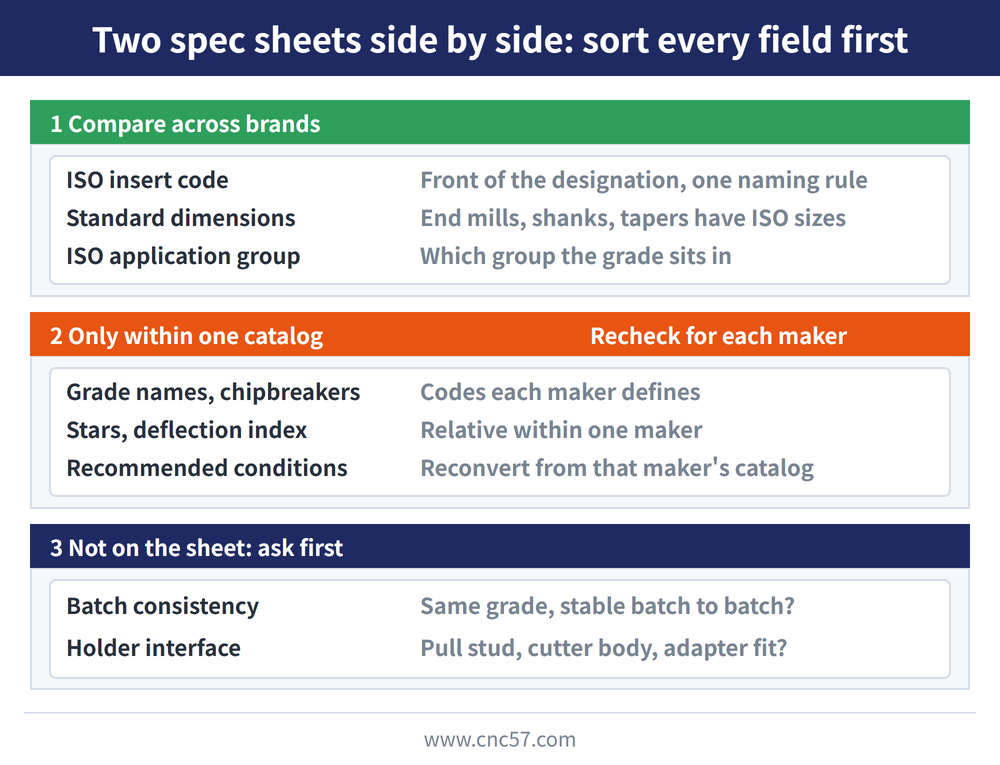
Not every field on two spec sheets for the same tool can be compared by size. Before you line them up, put each field into one of three zones:
| Zone | Fields | How to use it |
|---|---|---|
| Compare across brands | ISO insert code, dimensions written to ISO, ISO application group | Both follow the same standard; compare directly |
| Only within one catalog | Own grade names, chipbreaker codes, star ratings, deflection index, recommended cutting conditions | Maker-defined; check that maker's catalog |
| Not on the spec sheet | Batch-to-batch material consistency, holder interface fit | Ask the supplier before ordering |
🔑 The second zone is the one most often compared by size: both makers use the same field name, but each defines it its own way. Whether an item is worth a second maker at all: sort items first as in Too Many Items in the Tool Crib? Trimming Cutting Tool Inventory with Standardization, Dead-Stock Checks and Safety Stock.
2. Compare across brands: ISO code, standard dimensions, ISO application group
These three fields can be compared across brands because both makers write them to the same ISO rules:
| Field | Why it lines up | What to compare |
|---|---|---|
| Front of the insert designation | Named to ISO 1832; the first seven positions are mandatory standard code | Shape, clearance, tolerance class, chipbreaker and hole, size, thickness, corner, position by position |
| Type and dimensions | End mills, solid carbide end mills, straight shanks and 7:24 taper shanks all have ISO type and dimension standards | Compare dimension fields written to the standard directly |
| Application group behind the grade | Grade names differ, but nearly all major makers map to the ISO 513 P/M/K/N/S/H application groups | Whether both sit in the same group and the same sub-range |
📌 The sub-range numbers differ from group to group, so go by what the catalog lists; they run from finishing to heavy cutting. A matching group only means the range of use matches; the formulation may still differ. For how to read the ISO 513 material codes alongside the application groups, see How to Read Insert Material Codes: ISO 513 HW, HC, CA and DP Explained.
⚠ China-made insert designations often add a hyphen and two characters after the ISO code. That is a position added by the Chinese national standard for chipbreaker type and width; ISO 1832 has no such section, so reading it with ISO rules leaves the last two characters unmatched.
3. Grade names and suffix codes: each maker's own, so translate back to ISO
The front of the insert designation matches; the back end and the grade name need a different reading:
| Field | Why it does not compare across brands | What to compare instead |
|---|---|---|
| Own grade names | Each maker's own letters and numbers | Which ISO application group it maps to |
| Chipbreaker and suffix codes | ISO 1832 does not cover these details; makers add their own codes after the standard code | Look up what it is for in that maker's catalog |
To map a grade to its application group, start with Carbide Insert Coating Chart | ISO Grade Cross Reference Guide.
⚠ Some cross-brand grade charts are compiled by a single maker and state that the other companies have not endorsed them. A chart can tell you two grades belong to the same application group; it cannot tell you the switch will give the same tool life. Treat it as a starting point; see Tool Materials and Coatings: The Complete Guide - Separate Substrate From Coating, Then Work Back From the Workpiece.
4. Stars, indexes, thresholds and recommended conditions: only within one catalog
| Field | Why it does not compare across brands | What to compare instead |
|---|---|---|
| Star ratings | A relative grade inside one maker's range | Spec fields defined the same way everywhere |
| Deflection index | A relative value from the maker's own formula | Divide two values within one catalog to compare rigidity |
| Troubleshooting thresholds | Values stated per product line; they differ between lines | Check the manual for the tool in your hand |
| Recommended cutting conditions | Geometry and coating differ by brand, so recommended conditions differ | After switching, reconvert from that maker's catalog |
How to read star ratings: Reading an Abrasive Catalogue: The Six Material Groups, and Matching Stainless Grades to EN and AISI and Choosing a Flap Disc: Shape Sets the Contact Angle, Grit Follows the Job, Diameter Caps the Speed. How to compare deflection indexes: End Mill Length vs Deflection.
Why thresholds do not carry over to another maker: Exchangeable Head Drill Troubleshooting: Same Symptom, Opposite Fixes. How to convert conditions: Drilling Parameter Conversion: RPM & Feed by Diameter.
5. Not on the spec sheet: ask about material batches and interfaces
These cannot be written on a spec sheet:
| What to ask | Why you cannot see it | How to ask |
|---|---|---|
| Material batch consistency | Carbide figures look alike; the difference is whether they are achieved and how stable batches are | For the same grade, how stable is one batch to the next |
| Taper interface | Both are size 40 7:24 tapers, yet BT40 and CAT40 pull studs are not interchangeable | Which spindle you have, and which pull stud it takes |
| Cutter bodies and adapters | Mixing brands of shell mill arbors and cutter bodies, or modular adapters, is not recommended | Whether they belong to one system |
Why the same carbide figures cannot be compared directly: Carbide Grades Decoded: Grain Size, Cobalt and the Truth About TRS. Taper systems and pull studs: Spindle Taper Systems Overview: BT, HSK, Capto, SK, NT, CAT, MT and What Is a Pull Stud: Standards and Selection Basics. The risks of mixing bodies and adapters: Face Mill Arbors (Shell Mill Holders): Structure and Selection and Quick-Change / Modular Tool Holder Systems: Principles, Trade-offs & Inventory Savings. For how to put these questions, together with part numbers, application and quantities, into one RFQ, see How to Write a Cutting Tool RFQ (Request for Quotation): Part Number, Specs, Work Material, Quantity and Lead Time in One Go.
📌 After the paper comparison you still need a trial cut; see Switching Cutting Tool Brands: What to Check First, How to Run the Trial Cut, and Deciding on Cost per Part.
6. Frequently Asked Questions (FAQ)
Q: Which spec sheet fields can I compare directly between two cutting tool brands?
The fields written to a standard: the ISO code in the insert designation, type and dimensions written to ISO, and the ISO application group the grade maps to.
Q: Can I swap grades straight from a cross-reference chart?
Only as a starting point. A chart tells you two grades share an application group, not that the formulation or performance is the same; some charts are compiled by one maker without the other companies' endorsement.
Q: Can star ratings or deflection indexes be compared across brands?
No. Both are maker-defined relative values, so they only mean something within one catalog.
Q: What is not on the spec sheet and should be asked before ordering?
How stable the material is from batch to batch, and whether the interface fits: BT40 and CAT40 are both size 40 tapers, but their pull studs are not interchangeable.
When you put this into practice, the full cutting tool range filters by requirement; for spec questions, ask us on LINE.
Published: 2026-10-27 | Last updated: 2026-10-28









