Face Milling Tool Selection: Material, Geometry & Fixes
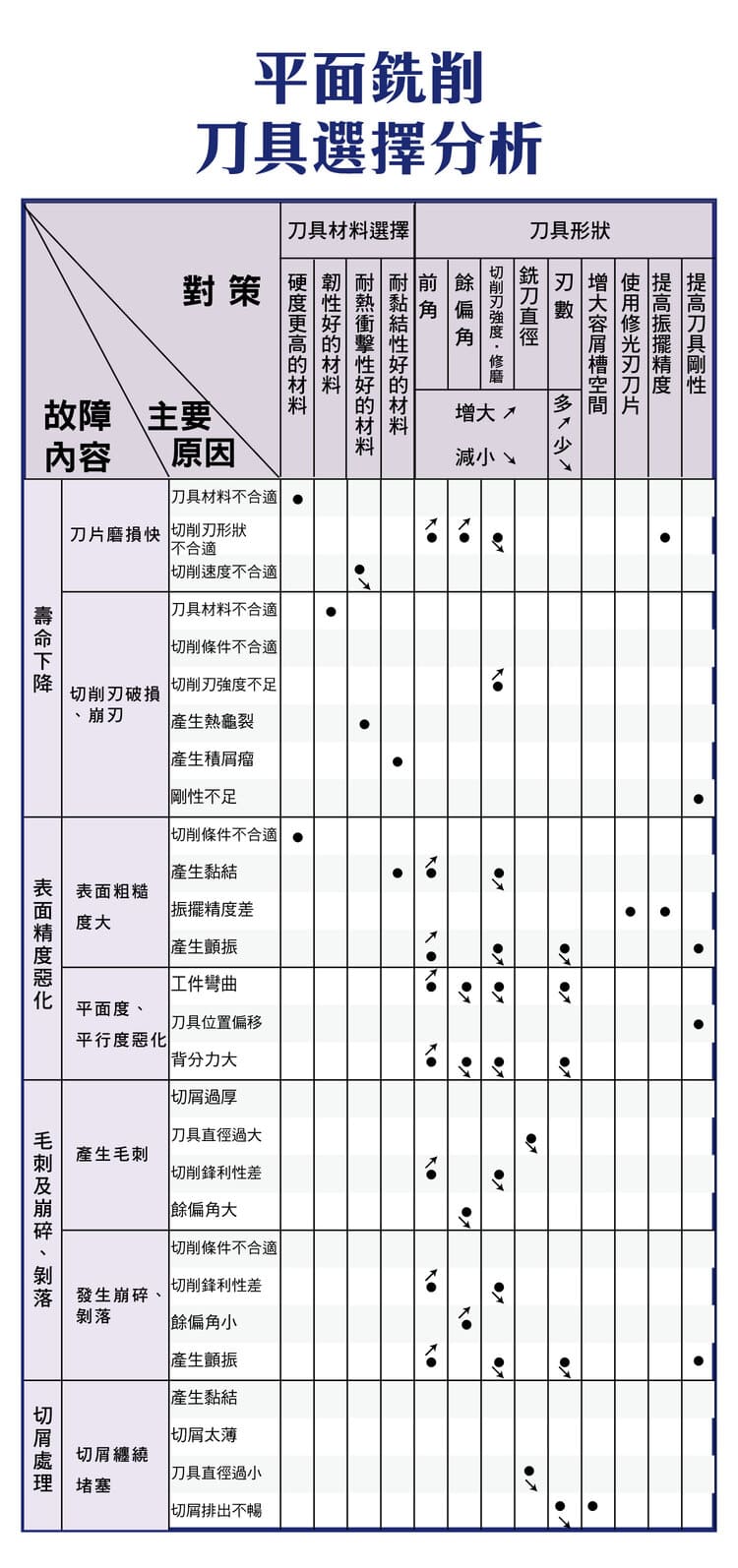
Tool selection in face milling directly affects tool life, surface finish and stability. Matching tool material (hardness, toughness, wear resistance) with geometry (rake, flute count, diameter, rigidity) solves fast wear, chipping, burrs and chip packing. A "problem → cause → tool fix" selection logic is key to face-milling efficiency and quality.
1. Tool Material Selection
| Material bias | Trait | Use |
|---|---|---|
| Hard / wear-resistant | High wear resistance, high speed | Hardened steel |
| Tough | Good impact resistance | Unstable / interrupted cuts |
| Heat-resistant | Withstands high heat | High-speed cutting |
| Anti-adhesion | Reduces built-up edge | Aluminium and sticky materials |
For full material and coating comparison see the Cutting Tool Materials Guide.
2. Tool Geometry Selection
| Item | Effect |
|---|---|
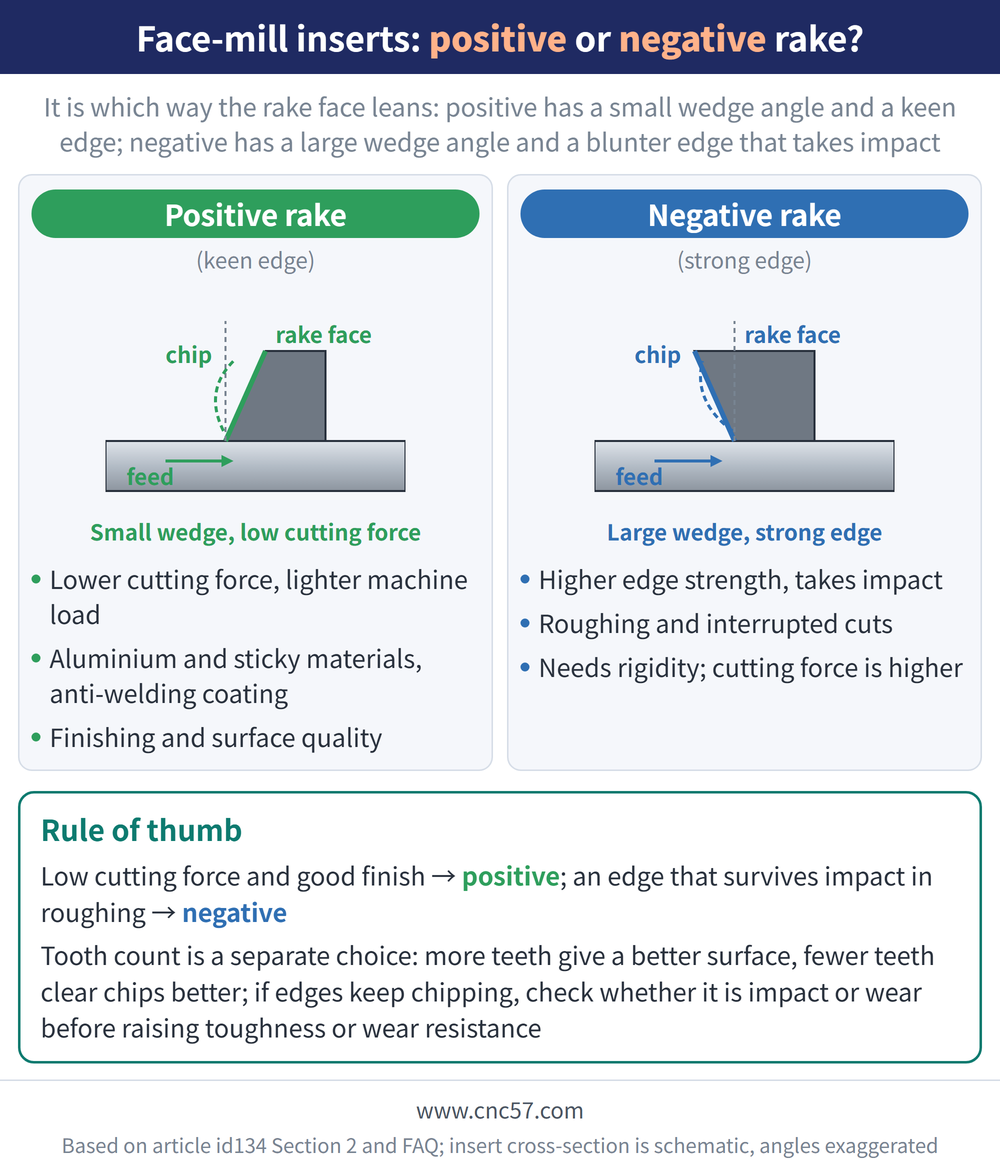
| Rake | Positive → lower force; negative → more strength |
| Flute count | More flutes → better finish; fewer → better evacuation |
| Diameter | Large → stable; small → flexible |
| Edge strength | High → roughing; low → finishing |
| Rigidity | High → less vibration; low → chipping-prone |
For detailed angle traits see the Face Milling Tool Angles Guide.
3. Problem → Cause → Tool Fix
| Problem | Cause | Tool fix |
|---|---|---|
| Fast insert wear | Wrong grade, speed too high | Wear-resistant grade/coating, lower speed |
| Breakage / chipping | Weak tool, low rigidity | Tougher grade, more rigidity |
| Poor finish | Vibration, low accuracy | More flutes, better accuracy, add wiper |
| Poor flatness / parallelism | Part distortion, tool offset | Reduce clamp distortion, correct runout, stiffen |
For clamp-induced distortion and fixes see the Face Milling Clamping Guide.
FAQ
Q: Are more flutes always better?
No. More flutes give higher feed at the same speed and a better finish, but less chip space and packing risk — good for steel and finishing; fewer flutes evacuate better, suiting aluminium and deep cuts. Pick pitch (coarse/medium/fine) by material, chip load and machine power. See Face Mill Pitch Selection: Coarse, Fine and Differential for details.
Q: How do I choose face-mill diameter?
A common rule is a cutter about 1.3–1.6× the cutting width, for sound entry/exit angles and stable load. Large diameter is stable but needs spindle power; small is flexible but less rigid. Check the machine has enough power.
Q: Repeated chipping — change grade or parameters?
Read the chipping type. Impact/interrupted-cut chipping → use a tougher grade, add rigidity, lower feed per tooth; wear-driven breakage → use a wear-resistant grade/coating and lower speed. Low rigidity is a common root cause.
Q: What tool for aluminium?
Aluminium is sticky — use positive, sharp edges and an anti-adhesion (BUE-resistant) insert/coating, with larger chip space and higher speed. Avoiding built-up edge is the key to aluminium face-milling finish.