
Form Turning Tools: Flat, Prismatic or Circular, and How to Choose Material, Rake, Clearance and Chatter Control
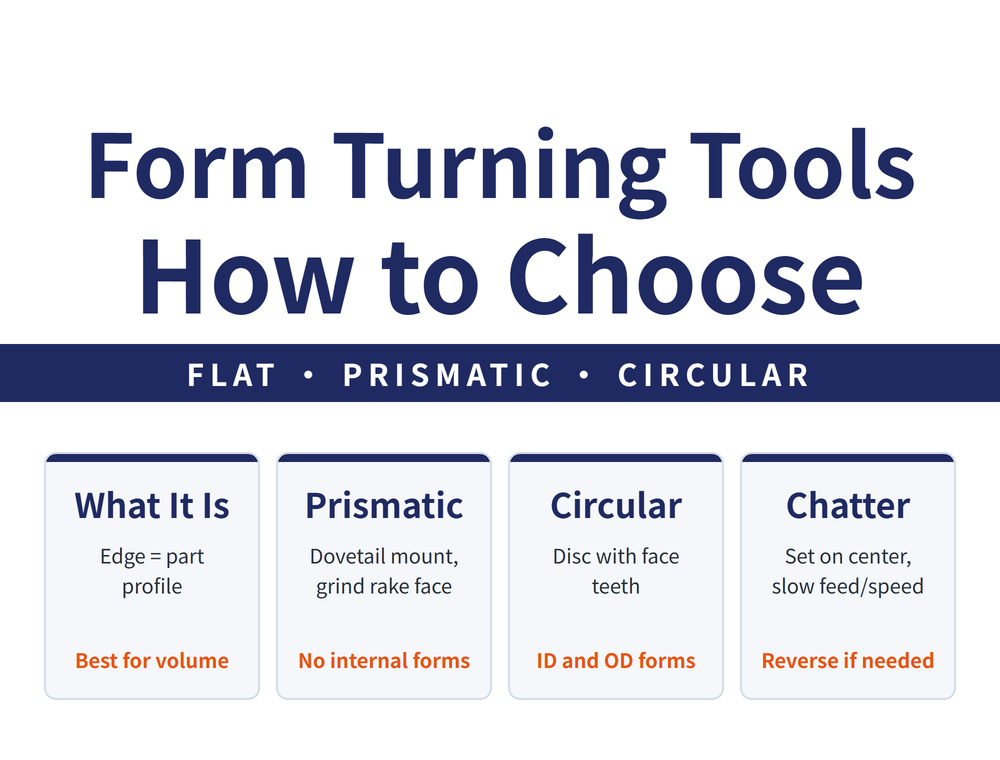
A form turning tool has its edge ground to the profile of the part, so one radial infeed turns the whole formed surface; it suits high-volume, high-accuracy turned parts. This guide helps you decide three things: which of the flat, prismatic and circular types to use; how to choose the tool material and the rake and clearance angles, and why roughing and finishing differ; and, because the large edge contact makes chatter easy, whether to look first at the machine, the tool setting or the cutting data.
1. What a form tool is and when it pays
A form turning tool, also called a profile tool, has an edge that matches the axial section of the part, and usually cuts the whole formed surface in one radial infeed.
| Aspect | What it means |
|---|---|
| Quality | Consistent shape and size, good interchangeability |
| Productivity | The whole formed surface in one cut |
| Tool life | Many regrinds, long total life |
| Cost | Complex edge, hard to design and make, expensive |
| Where used | Mainly semi-automatic and automatic lathes in volume; small batches can run on a conventional lathe |
In one line: the shape must be consistent and the quantity high enough to spread the tool cost.
2. Choosing between the three types
By construction and shape there are three types:
| Type | Features | Limits |
|---|---|---|
| Flat form tool | Body and mounting like an ordinary tool, easy to make, for simple shapes | High accuracy needs a tool grinder |
| Prismatic form tool | Head with a dovetail in the holder, raised as it is ground down; only the rake face is reground | More complex to make; cannot cut internal forms |
| Circular form tool | Disc with face teeth against turning; only the rake face is reground, with the most regrinds | Main edge must sit below the disc center |
A circular form tool cuts both internal and external forms and is easier to make, so it is the most widely used. If its main edge sits at the disc center the clearance angle in the cut is 0°; the drop below center depends on the tool diameter and the clearance angle: H = (D/2)·sin αf, with αf usually 6°-12°.
3. Material, rake and clearance: roughing and finishing differ
The main edge of a form tool is a curve, so the choice is mainly about rake and clearance angles.
| Item | Setting | Why |
|---|---|---|
| Material: steel, simple form | P-grade carbide | Wear resistance |
| Material: complex form | High-speed steel | Easier to make the edge |
| Roughing rake | Large | Large contact area and high cutting force |
| Clearance | Usually 6°-10° | — |
| Finishing rake | Small or 0° | Less profile error |
Profile error means that with a non-zero rake angle the turned profile no longer matches the edge shape; for an accurate finish, bring the rake towards 0°.
4. Chatter: four places to look
The whole edge of a form tool cuts at once, so the contact is large and chatter comes easily.
| Area | What to do |
|---|---|
| Machine | Enough stiffness, with clearances adjusted small |
| Tool setting | On center as far as possible: too high digs in, too low chatters; if needed mount it upside down and run the spindle in reverse |
| Cutting data | Lower feed and cutting speed |
| Coolant | Use it on steel; on cast iron run dry or use kerosene |
Mounting upside down with the spindle reversed puts the cutting force in the same direction as the weight of the spindle and part, which reduces vibration. For preventing dig-in see How to Prevent Tool Dig-In on a Lathe: Leadscrew Backlash, Quadrant Changes and Lead Angle Choice.
5. How the edge form is made
The accuracy of the edge sets the accuracy of the part:
| Method | Suits |
|---|---|
| Hand grinding | Flat form tools with lower accuracy needs |
| Tool grinder with a form wheel | Prismatic heads and high-accuracy tools |
| Wire EDM to cut the form | Without a tool grinder; the rake still needs grinding and the edge honing |
For the wire EDM route and its limits see Form Tools Cannot Be Ground by Feel: Build a Jig, or Cut the Tool on Wire EDM.
FAQ
Q: What is a form turning tool?
A turning tool whose edge is ground to the profile of the part, also called a profile tool. One radial infeed turns the whole formed surface, which suits high-volume, high-accuracy turned parts.
Q: Prismatic or circular form tool?
Choose circular if you need internal forms; a prismatic tool cannot cut them. Circular tools take the most regrinds, are easier to make and are the most widely used; prismatic tools are stable in accuracy and are reground only on the flat rake face.
Q: Why do form tools chatter so easily?
The whole edge cuts at once with a large contact area. Raise machine stiffness, set the tool on center, lower feed and cutting speed, and if needed mount it upside down with the spindle in reverse.
Q: What rake angle for finishing a form?
A small rake or 0°, to limit profile error. Only in roughing, where contact and cutting force are large, is the rake made large.
Need a form tool for your profile?
Form turning tools can be made to your drawing. Send us the part drawing on LINE and we will help you work out the tool form and material.
Last updated: 2026-10-20
For the full reading guide on this topic, see Turning: The Complete Guide.









