
Cutting Conditions vs Surface Finish
There is a clear trade-off between cutting conditions and both surface finish and tool life: lowering feed per tooth improves the surface but may shorten tool life, while raising feed or lowering cutting speed helps extend it. So what has to be decided first is not a parameter but a priority — efficiency, or surface accuracy, this time. Using measured S50C side-milling data, this guide lays out which way feed per tooth, cutting speed and flute count each push the balance, so you can set the conditions against your goal.
Cutting Conditions & Machining Quality
Cutting conditions simultaneously affect surface roughness, waviness, tool wear and efficiency. Notably, surface quality and tool life usually trend in opposite directions—pursuing accuracy often costs life, and vice versa.
The two test charts below (Chart 1: surface accuracy; Chart 2: tool life) use the same conditions:
| Item | Setting |
|---|---|
| Workpiece | S50C (HB220) |
| Operation | Side milling |
| Feed per tooth | a: 38 μm/tooth, b: 50 μm/tooth, c: 76 μm/tooth |
| Cutting speed | 16.5 / 25.0 / 37.7 m/min |
| Tools compared | 2-flute vs 4-flute |
Cutting Speed vs Surface Accuracy
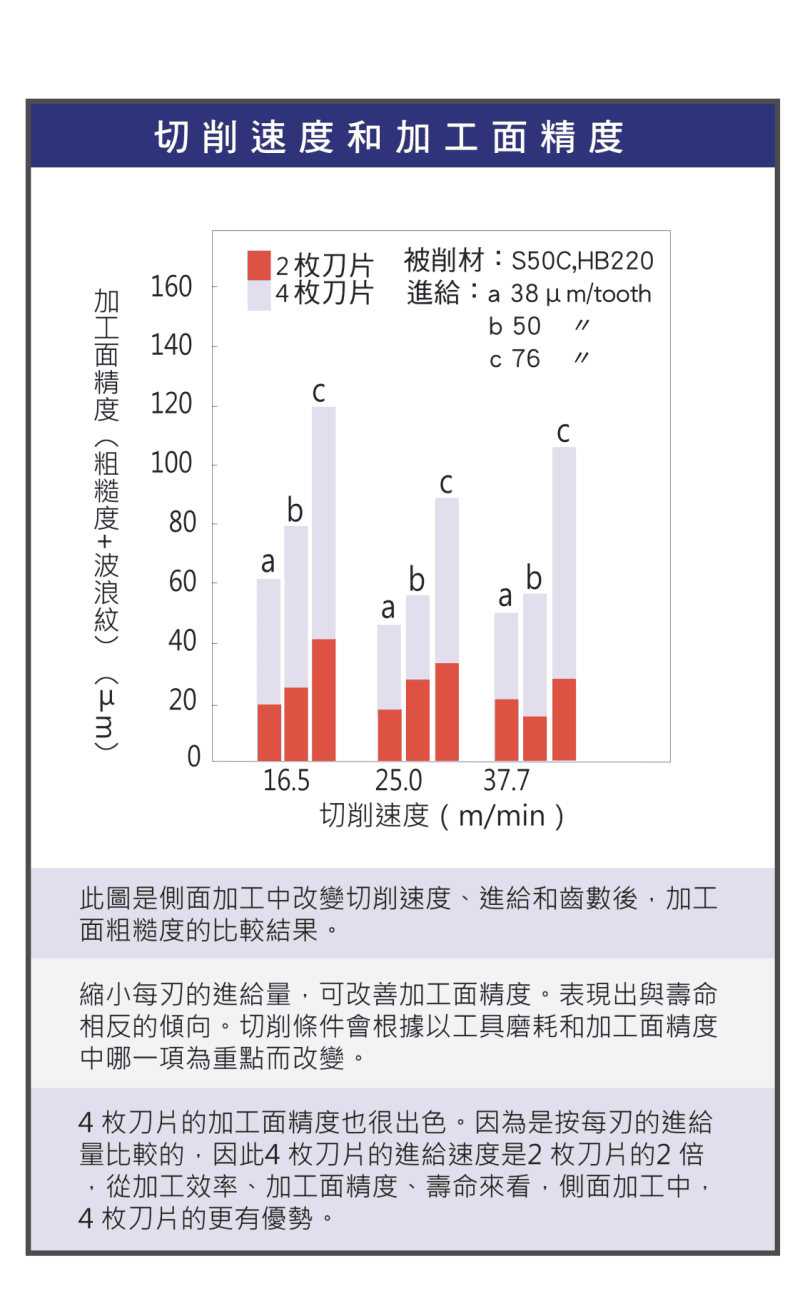
In side milling, higher cutting speed can improve the surface, but speed that is too high accelerates tool wear.
Conclusion: find the optimal cutting speed, not the highest.
The chart below (surface accuracy = roughness + waviness) shows that reducing feed per tooth improves surface accuracy, but this trend opposes tool life; adjust conditions depending on whether tool wear or surface accuracy is the priority. Note what the chart holds constant: it compares at the same feed per tooth, where the 4-flute removes twice as much per revolution, so its roughness + waviness reads higher than the 2-flute's. Tool selection, however, compares at the same feed rate — there the 4-flute needs only half the feed per tooth, and its surface accuracy is better than the 2-flute's.
Effect of Feed on Quality
The lower the feed per tooth, the better the surface quality and the lower the roughness; but tool life may drop at the same time.
Key point: over-reducing feed can backfire. Hastily lowering feed because life is short is reckless and may be counterproductive.
Flute Count: 2-flute vs 4-flute
At the same feed rate, a 4-flute needs only half the feed per tooth of a 2-flute, so its surface accuracy is better; the 2-flute earns its place on chip evacuation, and slotting, aluminum and non-ferrous work still call for it. For choosing flute count and helix angle, see End Mill Flute Count and Helix Angle: How to Choose.
Tool Life & Cutting Conditions
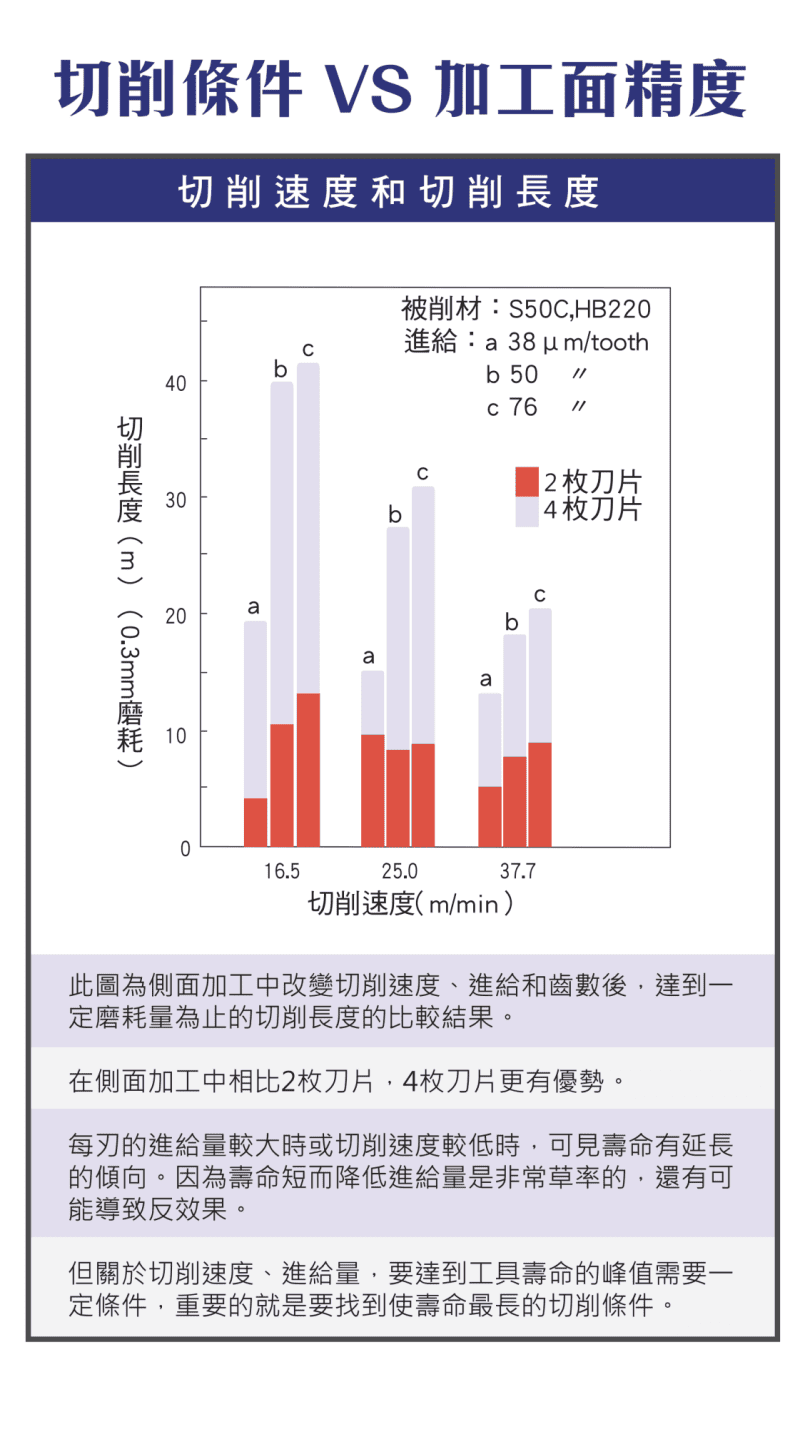
The chart below (cutting length = life until 0.3 mm wear) shows that lower cutting speed and larger feed tend to extend life.
But the optimal life point must be found by experiment—there is no fixed universal parameter. Reaching peak tool life requires specific conditions; the key is finding the cutting condition that maximizes life. To plug values into spindle-speed and feed calculations, see End Mill Cutting Conditions Guide.
Cutting-Condition Optimization Strategy
Balance three goals: surface accuracy, tool life and efficiency. Recommendations are summarized below:
| Machining need | Recommended cutting conditions |
|---|---|
| Finishing | Low feed + medium speed |
| Roughing | High feed + low speed |
| Side milling | Prefer 4-flute (best overall on efficiency, accuracy and life); switch to 2-flute when chip evacuation is tight — slotting, aluminum and non-ferrous |
FAQ
Can I have both surface accuracy and tool life?
They usually trend oppositely—lowering feed per tooth improves accuracy but shortens life; balance them based on whether accuracy or life is your priority.
Does faster cutting speed mean a better surface?
In side milling, higher speed can improve the surface, but too high accelerates wear; find the optimal speed rather than the highest.
What makes 4-flute better than 2-flute?
At the same feed rate the 4-flute needs only half the feed per tooth, so it gives a better surface, along with higher efficiency and longer life — the 4-flute is the stronger choice for side milling. The 2-flute's strength is chip evacuation, so slotting, aluminum and non-ferrous work still call for it.
Why shouldn't I just lower feed when life is short?
Hastily lowering feed because life is short is reckless and may backfire; peak life must be found experimentally—there is no fixed universal parameter.
For the full reading guides on this topic, see Surface Finish: A Complete Reading Guide, Tool Life and Wear: A Complete Reading Guide and Machining Calculation Reading Guide.
This article is part of End Mills: The Complete Guide - Know the Cutter, Choose It, Set the Conditions; Toolpaths Are Another Line; that guide shows how the whole topic fits together.
Published: 2026-03-18 | Last updated: 2026-10-19









