
Polygon and Expansion Clamping: Two Options Beyond the Usual Five
Beyond the five familiar clamping methods there are two more, each with a very specific home ground. One clamps by elastic deformation with no moving parts and reaches 0.3 mm shanks at very high speed. The other targets thread milling, and its reaming column is deliberately blank.
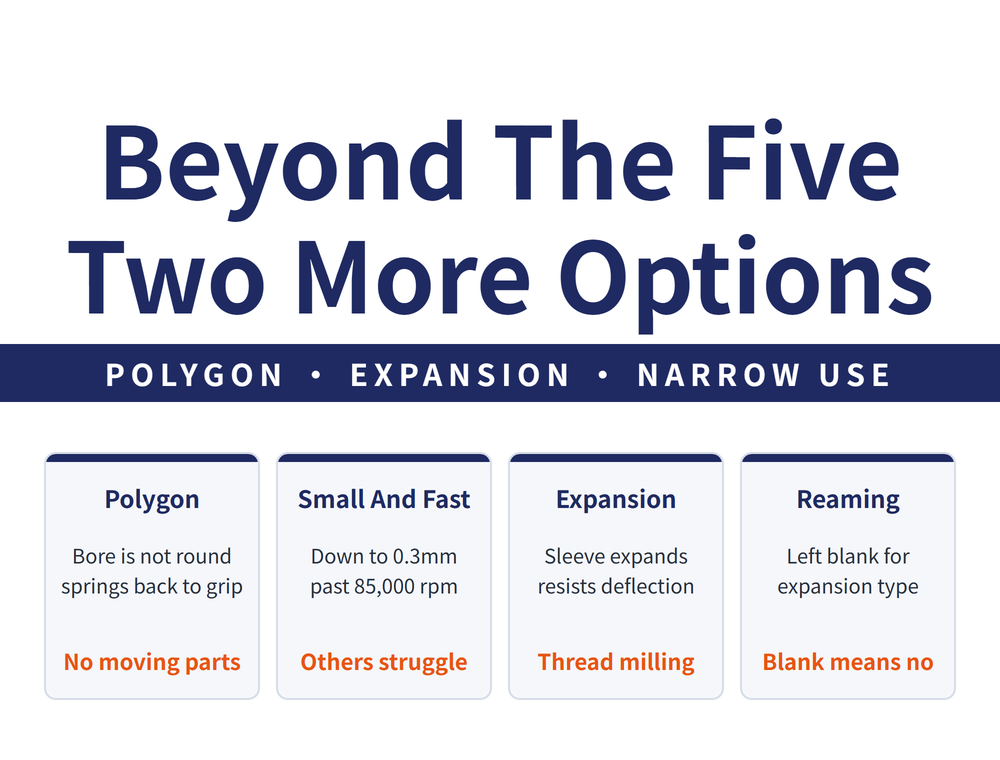
Why these two are worth knowing
Tool holder comparisons usually cover five methods: ER collets, milling chucks, hydraulic, shrink fit and side lock. Manufacturer catalogues carry two more, each aimed at a narrow but well defined use. They are not general purpose, and precisely because they are not, the gap is large when you land on their home ground.
1. Polygon clamping: elastic deformation, no moving parts
The principle takes three steps:
1. In its free state the bore is not round but polygonal.
2. External pressure deforms the bore into a true circle so the shank slides in.
3. Release the pressure and the bore springs back to polygonal, gripping the tool.
No moving part takes any part in that, which has several direct consequences.
| Property | Figure or note |
|---|---|
| Practically maintenance and wear free | No moving parts; the one-piece body is durable and insensitive to mechanical abuse |
| Concentricity | Under 0.003 mm, with runout and repeatability both at 3 μm |
| Clamping diameter range | 0.3 to 32 mm; the lower end is territory hydraulic and shrink fit struggle to cover |
| Speed | Rotationally symmetric; micro machining versions reach over 85,000 rpm |
🔑 That 0.3 mm lower limit is the practical value. Hydraulic and shrink fit both struggle at that size, and micro machining happens to need very high speed. Put those two together and you have its home ground.
⚠ Note the trade-off though. In the manufacturer suitability matrix, polygon clamping rates "suitable" for reaming, not the "highly suitable" that the adjustable zero-runout hydraulic type reaches. Its strength is small diameter plus high speed plus freedom from maintenance, not nulling runout to zero. For reaming, go back to the adjustable type.
2. Expansion clamping: built for thread milling
Clamping works by an elastic pressure medium expanding towards the expansion sleeve, centring and gripping the tool. The manufacturer maps three design points directly onto thread milling.
| Design | What it delivers |
|---|---|
| Monoblock body | Higher stability and rigidity |
| Reinforced expansion sleeve | Higher radial rigidity, carrying the heaviest loads and largest radial forces, preventing tool deflection |
| High torque transmission with strong vibration damping | No chatter marks on the thread flank |
🔴 Its reaming column in the manufacturer suitability matrix is blank. Blank means not suitable, not untested. That is an explicit division of labour: this is not a general purpose holder. You buy it for thread milling and roughing, not for doing everything.
Why thread milling in particular: radial forces there are high and constantly changing direction, so any tool deflection shifts the thread form. The reinforced sleeve is resisting exactly that.
3. All six side by side
| Clamping technology | Runout | Strongest at | Clear weakness |
|---|---|---|---|
| Hydraulic, zero-runout adjustable | 0, adjustable | Reaming, fine boring | More complex construction |
| Hydraulic, standard | 3 μm | General use where damping matters | — |
| Shrink fit | 3 μm | High torque, good accessibility | Needs heating and cooling equipment; weak damping |
| Polygon | 3 μm | Micro machining, very high speed, maintenance free | Not a zero-runout answer |
| Expansion | Not published | Thread milling, deflection resistance | Not suitable for reaming |
| ER collet, standard | 8 μm | Wide clamping range, low cost | Worst runout |
📌 There is no all-rounder in this table. Selection really means naming the one property you care about most: damping against chatter, adjustable zero against runout, polygon for small diameters at speed, expansion for thread milling, ER for range and cost. ⚠ The runout figure for expansion clamping is not published by the manufacturer and is left blank here rather than estimated.
4. When these two are worth a serious look
1. Tool diameter under 3 mm at high speed: ask about polygon.
2. No heating equipment on site and no appetite for maintenance: the maintenance-free claim genuinely saves work.
3. Thread form keeps drifting while parameters check out: look at deflection first.
4. If you need to ream, do not consider expansion clamping. That column is blank.
For the comparison of the five common methods, see Choosing a Tool Holder Clamping Method. For reaming selection, see Tool Holders for Reaming.
Frequently asked questions
With no moving parts, does polygon clamping really need no maintenance?
The manufacturer describes it as practically maintenance and wear free, because clamping relies on elastic deformation of the body and nothing moves to wear out. Ordinary taper cleaning and holder care still apply; that is a separate matter.
Can expansion clamping be used for reaming?
Not advisable. The reaming column in the manufacturer suitability matrix is blank, meaning not suitable. It is designed for radial deflection resistance and high torque transmission, with thread milling and roughing as its home ground.
Polygon clamping runs 3 μm runout, the same as shrink fit. What is the difference?
Clamping diameter floor, speed ceiling and maintenance. Polygon reaches 0.3 mm, micro machining versions exceed 85,000 rpm, and no heating or cooling equipment is needed. Shrink fit is stronger on torque and accessibility but weaker on damping.
Why are these two less common?
Because they are not general purpose. Each targets a narrow use, one small diameters at high speed and the other thread milling. Outside those two cases, the usual five are normally enough.
Source: SCHUNK Toolholding and workholding Product overview 2024 (polygon and expansion clamping sections; specification tables read back against the original images). 🔴 Table values are the manufacturer’s published figures for their own products. The runout figure for expansion clamping is not published and is left blank rather than estimated.
Last updated: 2026-09-14









