
Tool Holders for Reaming: Floating Is a Tapping Answer
Asking whether reaming needs a floating holder starts from the wrong place. Across four manufacturer catalogues, floating mechanisms are almost entirely for tapping. This guide explains why reaming selection turns on runout and damping, with a comparison across clamping types.
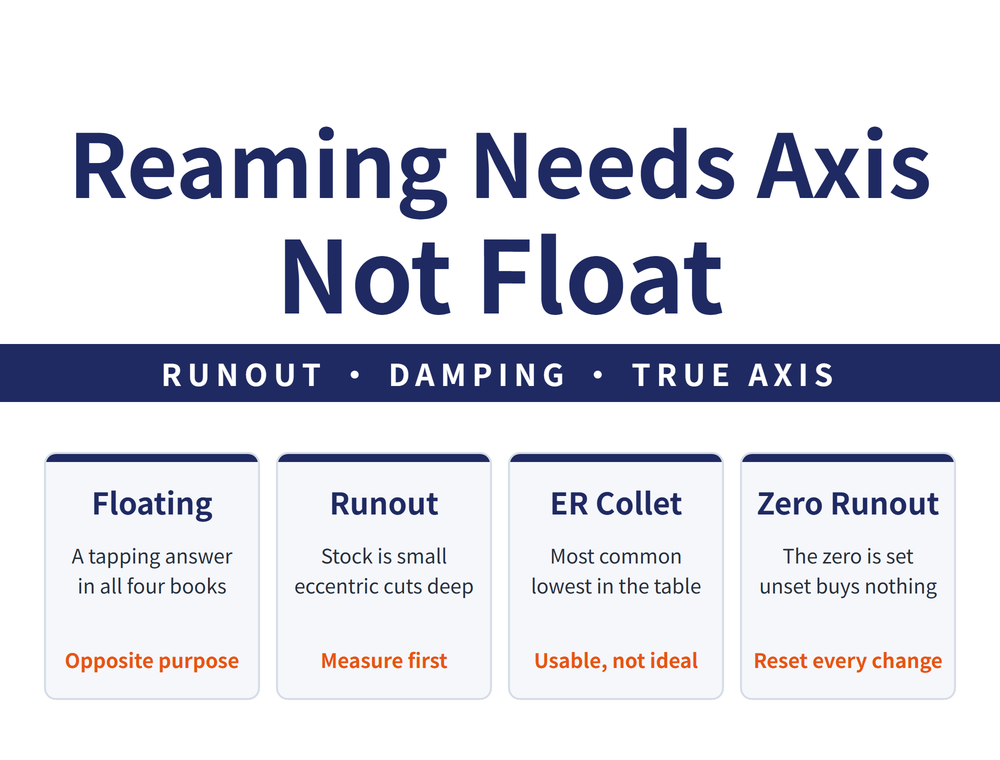
A very common question, asked the wrong way
Plenty of people ask whether reaming needs a floating holder, but the question is off from the start. Checking four separately sourced manufacturer catalogues gives a consistent answer: floating mechanisms are almost entirely for tapping.
Where "floating" appears in those catalogues, it is either an automatic tapping unit or a floating tap holder, with the stated purpose of absorbing hole centre deviation so the tap is not damaged, or it is the small length compensation on a rigid tapping holder that offsets pitch error between a synchronised spindle and the tap. Both are solving tapping problems.
🔴 The difference is purpose: reaming needs the tool to run on the correct axis, not to dodge deviation. Floating does exactly the latter. Using a deviation-absorbing mechanism for work that needs an accurate axis is backwards.
1. The two things reaming actually depends on
Runout accuracy decides whether the reamer runs on the line it should, and damping decides whether the cut stays stable. Reaming stock is small to begin with, so once the tool runs eccentric the depth of cut per side is uneven, and diameter, roundness and finish all suffer together.
| Clamping type | Runout | Repeatability | Reaming suitability | Damping |
|---|---|---|---|---|
| Hydraulic, zero-runout adjustable | 0, adjustable | Under 3 μm | Highly suitable | Good |
| Hydraulic, standard | 3 μm | Under 3 μm | Suitable | Good |
| Hydraulic, short | 6 μm | 6 μm | Suitable | Good |
| Shrink fit | 3 μm | 3 μm | Suitable | Moderate |
| ER collet, standard | 8 μm | — | Usable, lowest in the table | Fair |
The row worth studying is the last one. ER collets are the most common holder on the floor, yet their runout sits at the bottom of this table and their reaming suitability only reaches "usable". Not unusable, but it will not help you.
⚠ These figures are each manufacturer’s published values for their own products. Different brands and grades of the same type can differ considerably. They are used here to compare the ranking between types; for purchasing, use the datasheet of the actual holder rather than this table.
2. What the zero-runout type costs
The only entry rated highly suitable is the hydraulic holder adjustable to zero runout. An adjustment mechanism nulls the runout, so zero is achievable in principle. Two caveats follow.
First, the zero is set, not inherent. Without using the nulling function, repeatability returns to the under-3 μm level, much like the standard type. In other words, buying one and not adjusting it is the same as not buying it.
Second, adjusting takes time, and it starts again at every tool change. For small batches with frequent changes, that time can outweigh the accuracy gained. Whether it pays depends on how tight the hole tolerance is.
3. When to move up a level
1. Hole tolerance tightening to H7 or better while still on an ER collet: change the clamping type before anything else.
2. A bell mouth or taper at the hole entrance usually means the axis is not aligned, not that the reamer is at fault.
3. Regular tool marks on the surface: measure runout before changing the reamer.
4. For deep reaming, weight damping more heavily; shrink fit is only moderate on damping in this table.
Which chuck to use for tapping is a separate question, covered in Tool Holders for Tapping. For the overall comparison of clamping methods, see Choosing a Tool Holder Clamping Method. For measuring runout itself, see Tool Runout (TIR).
Frequently asked questions
Does reaming need a floating holder?
Generally no. Across four manufacturer catalogues, floating mechanisms are almost always labelled for tapping, to absorb hole centre deviation or compensate pitch error. Reaming needs the tool on the correct axis, so selection turns on runout and damping.
Can I ream with an ER collet?
You can, but its reaming suitability reaches only "usable" in the manufacturer comparison and its runout is the lowest in the table. Fine for loose tolerances; consider another type as tolerances tighten.
Is a zero-runout holder really zero?
The zero is set by adjustment. Without using the nulling function, repeatability returns to the level of a standard holder. Buying one and not adjusting it gains nothing, and the adjustment repeats at every tool change, so count that time as cost.
The reamed hole has a bell mouth. Is the reamer at fault?
Usually not. A bell mouth or taper at the entrance normally indicates the axis is out of alignment. Measure holder runout before reviewing the reamer.
Sources: SCHUNK Toolholding and workholding Product overview 2024; SCHUNK Clamping technology Overall catalog; BIG DAISHOWA general catalog V15. The use of floating mechanisms was cross-checked against FAHRION and NIKKEN catalogues. 🔴 Table values are each manufacturer’s published figures for their own products, used here only to rank the types; purchase against the actual holder datasheet.
Last updated: 2026-09-14









