
Tool Holder Clamping Methods: Collet / Hydraulic / Shrink / Side-Lock
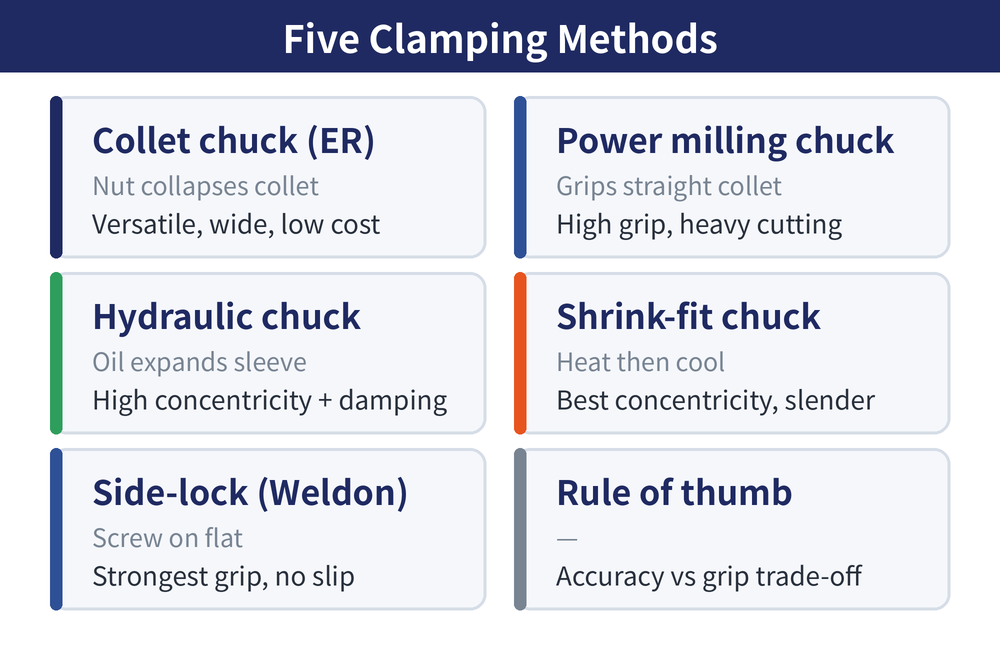
A tool holder's clamping method sets the tool's concentricity, grip force, change speed and resistance to slipping—directly affecting machining accuracy and stability. There are five common methods: collet chuck (ER, the most versatile), power milling chuck (heavy cutting), hydraulic chuck (high concentricity with vibration damping), shrink-fit chuck (best concentricity, for high speed and slender tools) and side-lock (Weldon, strongest grip, never slips). This guide compares each method's principle, concentricity, grip, change speed and use, so you can pick the right holder for the job.
1. Why the clamping method matters
How the holder grips the shank decides four things: concentricity (less runout means less tool-tip runout and better finish), grip force (enough to resist cutting torque without slipping), change speed (line efficiency) and rigidity / damping (cutting stability). No single method is best at everything—selection is a trade-off between "accuracy" and "grip" for the job at hand.
2. Five clamping methods compared
| Method | Principle | Concentricity | Grip | Change | Use |
|---|---|---|---|---|---|
| Collet chuck (ER) | Nut collapses the collet | Medium (good in precision grade) | Medium | Medium | General milling/drilling/tapping |
| Power milling chuck | Needle/mechanical grip on a straight collet | Medium | High | Medium | Heavy cutting, high torque |
| Hydraulic chuck | Oil chamber expands a thin sleeve | High, with damping | Medium | Fast (turn one screw) | Finishing, fine boring/reaming, damping |
| Shrink-fit chuck | Heat to expand, cool to grip | Best | High | Slow (needs heater) | High speed, deep cavity, 5-axis, slender nose |
| Side-lock (Weldon) | Side screw presses on a shank flat | Poor (offset) | Strongest, never slips | Fast | High feed, heavy cutting, indexable drills |
Concentricity and grip above are relative (they vary by brand and spec). ER is the most versatile and spans diameters by swapping collets; power chucks and side-lock lead on grip; hydraulic and shrink-fit lead on concentricity and stability.
3. The key trade-off: concentricity vs grip
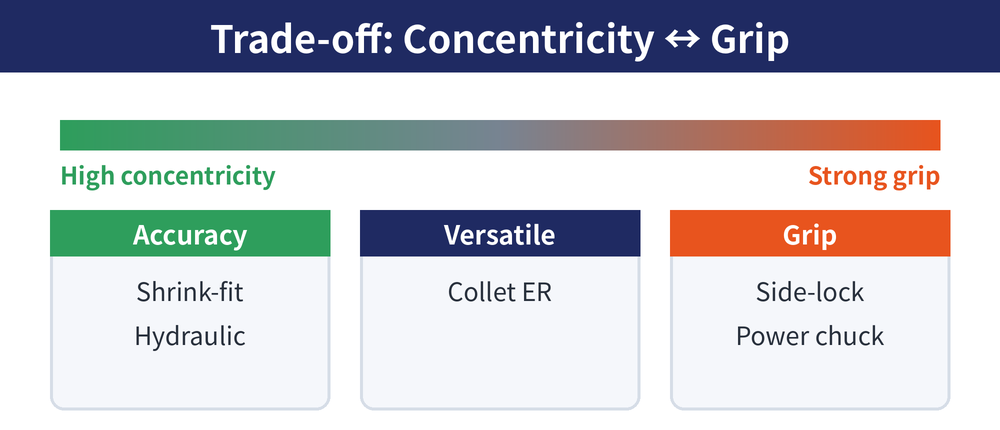
The five methods roughly sit on a "concentricity ↔ grip" spectrum:
Accuracy end: shrink-fit and hydraulic—low runout (typically a few µm, reference); shrink-fit suits high-speed slender tools, hydraulic adds damping for fine boring and reaming.;Versatile middle: collet chuck (ER)—moderate on both, wide range, low cost; the most universal choice.;Grip end: side-lock and power chuck—hold hardest and resist slipping, for high feed and heavy cutting, though side-lock is offset with poorer concentricity.。
4. How to choose (by need)
| Requirement | Suggested method | Why |
|---|---|---|
| General work, budget first | Collet chuck (ER) | Versatile, wide range, low cost |
| High speed, high precision, 5-axis | Shrink-fit chuck | Best concentricity, slender nose, well balanced |
| Fine boring, reaming, damping | Hydraulic chuck | High concentricity, suppresses vibration |
| Heavy cutting, high torque | Power milling chuck | High grip torque, good rigidity |
| High feed, must not slip | Side-lock (Weldon) | Positive mechanical lock, resists pull-out |
The method must match the collet/shank: ER and power chucks use their collets (see How to Choose a Collet, ER Collet Specs & Torque); side-lock needs a Weldon flat on the shank; shrink-fit uses solid carbide shanks. For polygon and expansion clamping, two methods beyond these five, see Polygon and Expansion Clamping; for reaming, see Tool Holders for Reaming. For chatter and overhang, see End Mill Troubleshooting Guide.
5. Shrink-Fit Holders: Loading, Unloading and Heating
A shrink-fit holder's bore is made slightly smaller than the tool shank: heat expands the bore, the shank goes in, and as the holder cools and contracts, the interference between the two does the clamping. No nut or screw supplies the force, so it cannot be over-tightened and every clamping ends up the same. The holder body is made of a heat-resistant steel.
Heating methods have moved on: early on a torch was used directly, which easily overheated the holder; then hot air, which takes a long time; then an electrically heated copper sleeve pressed against the holder, which itself gets very hot. Today the mainstream is induction heating - a powered coil creates a magnetic field that makes the holder body heat up and expand on its own, giving the fastest tool change. So plan for a heating unit together with shrink-fit holders.
6. Shrink-Fit Holders: Cooling and Bore Care
After the tool is changed the holder has to cool, and the time until it can be held by hand depends heavily on the method. From longest to shortest: natural cooling, air cooling, contact cooling, water cooling. Water cooling with cutting fluid also washes away some of the carbon deposits; dry the holder afterwards so the outside does not rust.
Repeated heating leaves carbon deposits in the bore. Once they build up on the bore wall the tool can stick in the holder and refuse to come out, so clean the bore regularly with a cotton swab dipped in alcohol; for small-bore shrink-fit holders, cleaning at every tool change is recommended.
7. Hydraulic Chucks: Usage Precautions
A hydraulic chuck clamps accurately and damps vibration, but it limits what you can clamp and how you tighten it. The table collects the precautions listed in manufacturers' catalogues; makers do not all list the same points, so follow the catalogue and manual for the chuck you use.
| Precaution | Detail |
|---|---|
| Shank tolerance | Use tools with a shank tolerance within h6. |
| Shank type | Do not clamp shanks with a side lock flat (Weldon shanks), nor straight shanks with a flat. |
| Type of work | Roughing end mills are not recommended. |
| No empty clamping | Do not tighten the chuck without a tool in it. |
| Minimum clamping length | Insert the shank at least to the minimum clamping length. This length depends on the model: for the same φ6, the catalogues of two series from different makers list 25 mm and 28 mm, so do not borrow the value from another maker or another series. |
| Checking the clamping force | Check the clamping force periodically. Some makers offer a clamping force test bar: insert it to the minimum clamping length and turn the clamping screw all the way in; if it can be pulled out with two fingers without much effort, the clamping force is no longer sufficient. |
Precautions per the BIG general catalogue (high-precision hydraulic chucks); the h6 shank requirement is also stated in the Ann Way 2026 tool catalogue (AHC high-precision hydraulic chucks). The φ6 minimum clamping lengths are catalogue values: 25 mm for the BIG high-precision hydraulic chuck, BBT30/BBT40 series, 28 mm for the Ann Way AHC. The test bar check follows the SCHUNK catalogue (TENDO series).
FAQ
Q: Which has better concentricity, hydraulic or shrink-fit?
Both are high-concentricity. Shrink-fit usually has the lowest runout and can be made very slender, ideal for high-speed and 5-axis deep cavities; hydraulic is also very good and adds vibration damping, ideal for fine boring, reaming and chatter control. Hydraulic changes faster (one screw), while shrink-fit needs a heater. Actual runout follows the catalogue.
Q: Why is side-lock still common if its concentricity is poor?
Side-lock uses a side screw pressing on the shank's Weldon flat—a positive mechanical lock that never slips and resists axial pull-out, giving the strongest grip for high feed, heavy cutting and indexable drills. The cost is that the screw pushes the shank off-centre, so concentricity is poorer. It is used where grip or anti-pull-out matters, not for finishing.
Q: Shrink-fit is slow to change—is it worth it?
It depends on the work. Shrink-fit needs a heater and is slower to change, and one holder fits one shank diameter (solid carbide). But its concentricity is the best, the nose is slender and it is well balanced, clearly improving finish and tool life in high-speed, deep-cavity, 5-axis and slender-tool work. It pays off in high-speed production finishing; for varied low-volume work, ER is more flexible.
Q: If I buy only one type, which should it be?
Generally the collet chuck (ER): wide range, spans different shank diameters by swapping collets, low cost, and it handles milling, drilling and tapping. Add shrink-fit, hydraulic, power or side-lock later for a specific need (high-speed precision, or heavy cutting with no slip).
This article is part of Tool Holders: The Complete Guide - One End Meets the Spindle, the Other Holds the Cutter; that guide shows how the whole topic fits together.
Published: 2026-07-21 | Last updated: 2026-10-24









