
Pull Studs: The Same Thread Does Not Mean Interchangeable
Same BT40, same M16 thread, and still not interchangeable once the standard changes. This guide covers taper-to-thread mapping, the hardness requirements of the two material systems, and why this small part failing costs a spindle.
The question asked most often, and got wrong most often
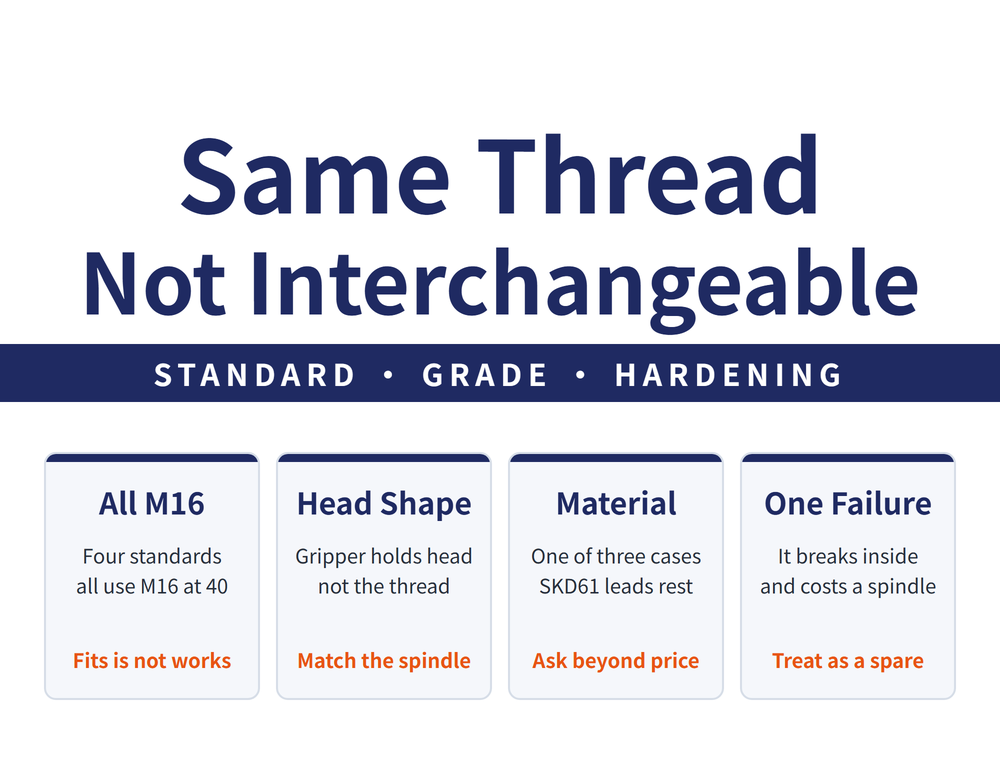
"What pull stud does my BT40 take, and what thread?" The thread is easy: M16. But that answer misleads, because the same 40 taper with the same M16 thread is still not interchangeable across standards.
🔴 A matching thread only means it screws into the holder. It says nothing about whether the spindle gripper engages correctly. Head geometry, angle and length differ between standards, and that head is what the gripper actually touches. Fitting is not the same as working.
1. Taper size to thread
| Taper | MAS 403-BT | DIN 69872 | ISO 7388-2B | CAT (inch) |
|---|---|---|---|---|
| 30 | M12 | — | — | — |
| 40 | M16 | M16 (both A and B forms) | M16 | 5/8"-11 |
| 50 | M24 | M24 (both A and B forms) | M24 | 1"-8 |
MAS 403-BT is the one seen most often on Taiwanese shop floors. Several smaller specifications do not map to a taper number at all, including the compact sizes used on engraving machines, whose threads fall between M8 and M12.
⚠ This table only settles half the question, which thread. Whether a stud will actually work has to be matched against the gripper specification of your spindle. This article does not judge which standards can be mixed; that depends on actual head geometry, so use the machine builder or holder supplier specification.
2. Two material systems, and not every grade qualifies
Pull studs divide into two classes by base material and heat treatment, each with its own requirements.
Case hardened: case depth 0.4 to 0.7 mm, surface hardness HRC 56 to 60, core hardness HRC 35 to 45, and thread hardness reaching only HRC 48 to 50. Three grades are usable, but only one of the three actually qualifies; the other two lack strength.
Quenched and tempered: treated hardness HRC 48 to 50, core hardness HRC 40 to 45. Three grades again, rated as follows: one is weaker while the other two are good, with studs made from SKD61 the best of them.
| System | Key hardness requirements | Rating |
|---|---|---|
| Case hardened | Surface HRC 56 to 60, core HRC 35 to 45, thread only HRC 48 to 50 | Of the three usable grades, only SNCM420 qualifies; SCM415 and SNCM220 lack strength |
| Quenched and tempered | Treated HRC 48 to 50, core HRC 40 to 45 | SCM440 is weaker; SNCM439 and SKD61 are both good, with SKD61 the best |
Two mechanical properties govern the choice: tensile strength and shear strength. A pull stud carries both during clamping and tool change, and it does so on every single tool change.
3. Why such a small part deserves attention
The pull stud is the bolt at the back of the holder that the spindle gripper pulls on. It is small, it is cheap, and it usually sits near the bottom of a purchase order. The consequence of failure is completely out of proportion to that.
🔴 One broken stud costs a spindle repair. It fails inside the spindle, the tool loses retention at that moment, and the damage does not stop at the bolt. Saving the price difference on one bolt puts an entire spindle at risk.
This is also why material and heat treatment matter: in the case hardened system the thread reaches only HRC 48 to 50, and the thread is exactly where the tensile load sits.
4. Four checks when buying or replacing
1. Name the standard, not just "a BT40 pull stud".
2. Match the spindle gripper, not the holder thread.
3. Ask about material and heat treatment, not only price.
4. Manage it as a consumable and replace on schedule rather than waiting for failure.
For basic pull stud specifications, see What Is a Pull Stud. For the comparison of taper systems, see Spindle Taper Systems Overview. For why dual contact depends so heavily on pull force, see Dual Contact: Why the Flange Face Has a Gap.
Frequently asked questions
BT40 pull studs are M16. Does that make them universal?
No. A matching thread only means it screws into the holder. Head geometry, angle and length differ between standards, and the head is what the spindle gripper engages. Match the gripper specification to confirm fitness for use.
Which material should a pull stud be?
The grades split into two systems. Among the three case hardened grades only SNCM420 qualifies. Among the quenched and tempered grades SCM440 is weaker while SNCM439 and SKD61 are both good, with SKD61 rated best. Ask about material and heat treatment together, not just price.
Do pull studs need scheduled replacement?
Treating them as consumables is advisable. They carry tensile and shear load on every tool change, and they fail inside the spindle where the consequences far exceed the value of the part.
Why is thread hardness lower than surface hardness?
In the case hardened system surface hardness reaches HRC 56 to 60 while the thread only reaches HRC 48 to 50, and the thread is where the tensile load acts. That is one of the reasons material and heat treatment have to be right.
Sources: pull stud material and heat treatment specifications; thread mapping across standards from the ANWEI catalogue (MAS 403-BT, MAZAK, DIN 69872, ISO 7388 and CAT pages). 🔴 This article does not judge which standards may be mixed; interchangeability depends on head geometry and the spindle gripper specification, so use the machine builder or supplier data.
Last updated: 2026-09-14









