
Roughing, Semi-Finishing, Finishing: Why You Cannot Skip the Middle
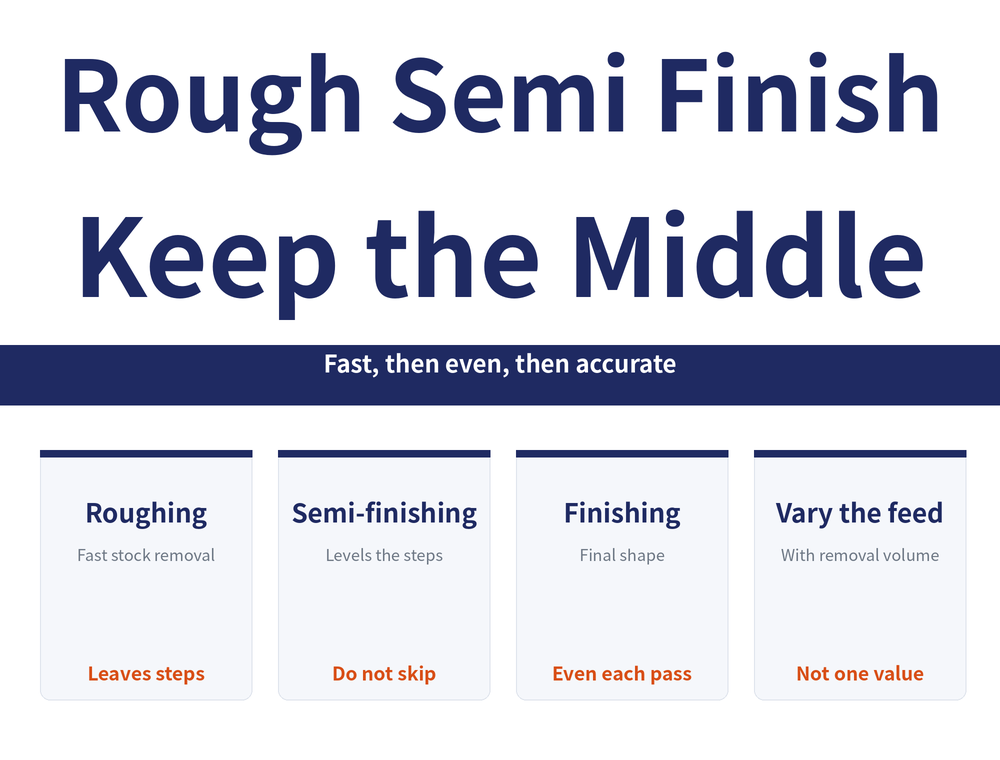
Surface work (moulds, impellers and the like) runs in three stages: roughing, semi-finishing and finishing. Skip the middle one and finishing tends to break tools or drift on size. This guide explains what semi-finishing actually does, why you cannot skip it, and why the feed should not stay one flat value.
1. What Each Stage Leaves for the Next
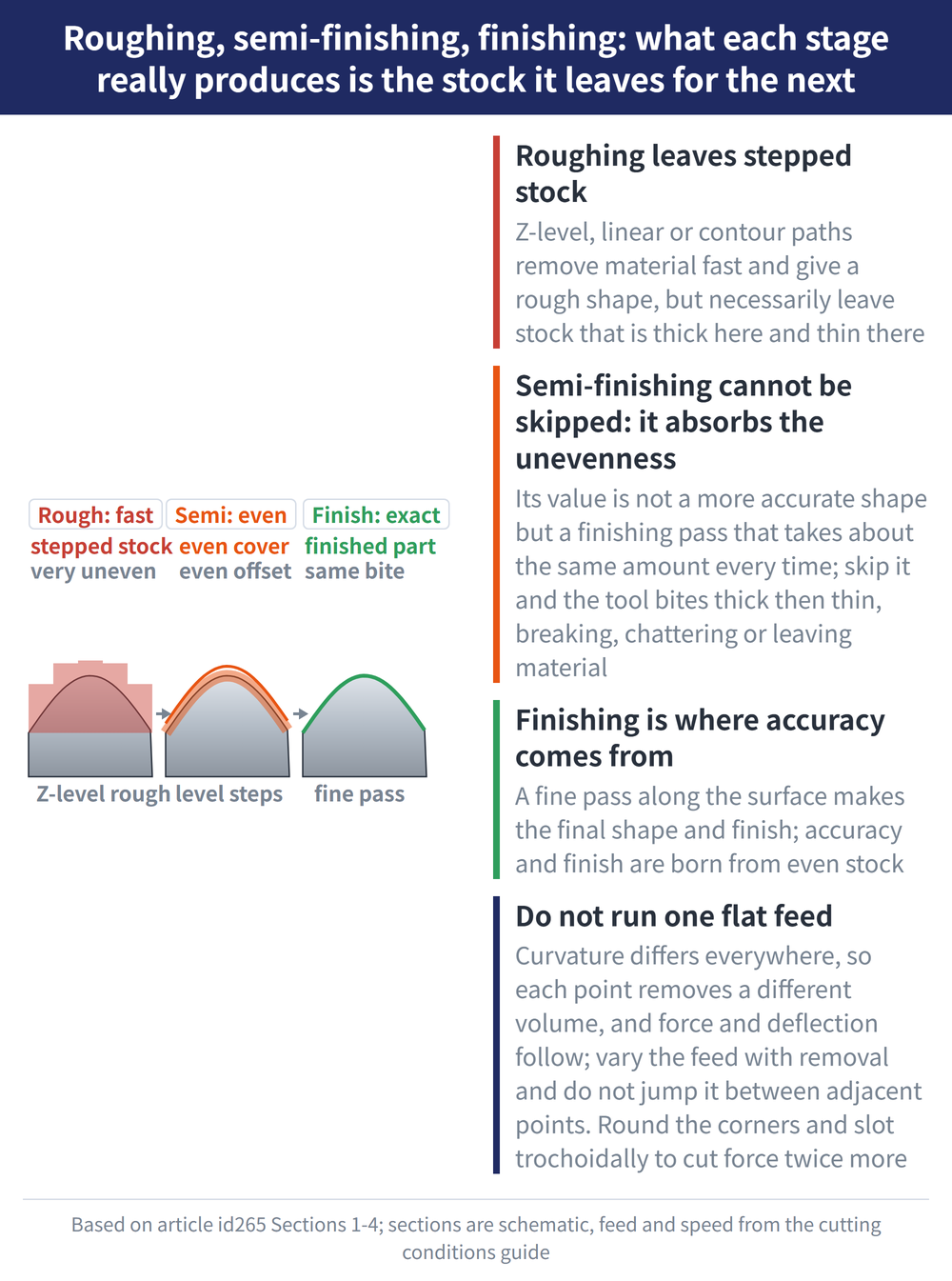
Surface work runs in three stages, and what each really produces is not the shape but the state of stock it leaves for the next:
| Stage | Task | Usual path | Stock left |
|---|---|---|---|
| Roughing | Fast removal, rough shape | Z-level, linear or contour | Stepped (very uneven) |
| Semi-finishing | Level the steps | Constant offset along the surface | Even cover |
| Finishing | Final shape and surface | Fine pass along the surface | Finished part |
2. Why You Cannot Skip Semi-Finishing
Roughing on a Z-level path necessarily leaves stepped stock (thick here, thin there). Jump straight to finishing and the tool bites the thick then the thin, the load swings hard, and the result is a broken or chattering tool, or material left uncut.
Semi-finishing is valuable not for making the shape more accurate but for absorbing the unevenness of the stock, so finishing takes about the same amount every pass — that is where accuracy and finish come from. In short: roughing is fast, semi is even, finishing is accurate; skip the middle and you hand roughing’s unevenness straight to finishing.
3. Do Not Run One Flat Feed
Even with even stock, the surface has different curvature everywhere, so each cutter-location point removes a different volume — different volume, different force, different cutter deflection, which shows up directly as error and surface defects. It is geometry, not the machine or tool.
So the right way to save time is not to raise the feed everywhere but to vary it with removal volume: run faster where little is removed. Two rules — in semi-finishing watch the actual removed volume (ease the feed if force is high), in finishing watch the surface curvature; and do not jump the feed between adjacent points or the machine shakes (use the CAM feed smoothing or accel control). For the actual feed and speed figures, see the end mill cutting conditions guide.
4. Two More Ways to Cut the Force
At corners, use a rounded path instead of a sharp one with interpolation, so the force does not spike. And do not slot by plunging with the full cutter diameter as the slot width (the force is very high); a trochoidal path cuts it right down — for how to tune trochoidal parameters, see trochoidal parameter tuning.
5. Frequently Asked Questions (FAQ)
Q: Can I skip semi-finishing?
Not advised. Roughing leaves stepped stock, so finishing straight after bites thick then thin and tends to break or chatter; semi-finishing evens the stock so accuracy and finish hold.
Q: The finished surface shows regular marks and drifts on size — how do I trace it?
Check first whether the stock is uneven (semi-finishing not done well) rather than swapping tools. Even the stock and the marks and drift usually clear.
Q: How do I shorten surface machining time?
Not by raising the feed everywhere, but by varying it with removal volume — faster where little is removed; and do not jump the feed between adjacent points or the machine shakes.
Q: The slotting force is too high, what now?
Do not plunge with the full cutter diameter as the slot width; use a trochoidal path to spread the load and the force drops sharply.
This article is part of Milling Toolpaths: The Complete Guide - Roughing Strategy, Where to Plunge, and Choosing a Finishing Pattern; that guide shows how the whole topic fits together.
Published: 2026-08-11 | Last updated: 2026-08-11









