
Tuning Trochoidal Milling: Speed for Tool Life, Feed for Time
Trochoidal milling (the cutter takes a small width and large depth along a series of small looping arcs, instead of plunging with the full diameter as the slot width) cuts force and heat sharply. But how do you tune it? This guide covers one key, often-confused rule: extending tool life and shortening time call for opposite knobs.

1. What Trochoidal Milling Does
Traditional slotting engages the full width of the cutter, with very high force and poor heat escape; a trochoidal path spreads the load along the whole flute length, so heat is much lower and you can push efficiency. For the overall strategy of trochoidal and dynamic milling, see the trochoidal and dynamic milling guide; this page is about tuning the parameters.
2. The Key Rule: Opposite Knobs for Life and Time
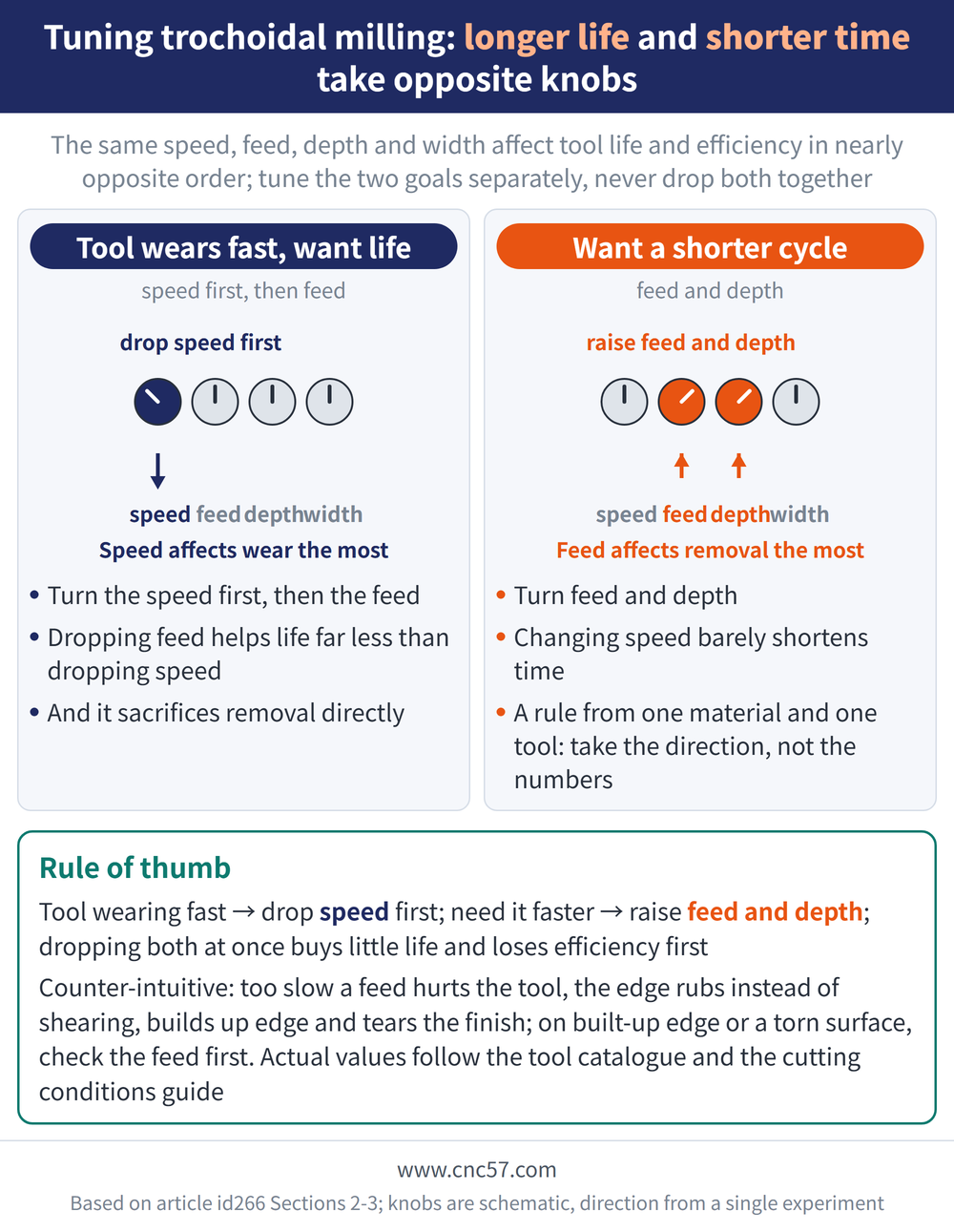
The same four parameters — speed, feed, depth and width — affect tool life and efficiency in nearly opposite order (from one experiment on SCM415 chrome-moly steel; treat it as direction, not universal numbers):
| You want | Turn this first | Why |
|---|---|---|
| Tool wears too fast, want longer life | Speed first, then feed | Speed affects tool wear the most |
| Want to shorten time | Feed and depth | Feed affects removal the most; speed barely helps |
What it means on the floor: the common move is to drop speed and feed together when a tool wears fast, but this experiment shows dropping the feed helps life far less than dropping speed, while directly sacrificing removal. Tune the two goals separately, not together.
3. Counter-Intuitive: Too Slow a Feed Hurts the Tool
Many assume a slower feed is safer, but on a tough material (such as a low-carbon alloy steel) it is not: too slow and the edge rubs the surface instead of shearing cleanly, forming a built-up edge that shortens life and tears the finish. If you see built-up edge or a torn surface, check first whether the feed is too slow.
A caution: the above is a rule from one material and one tool. Take the direction, but the actual speed and feed differ by material and diameter; go by your tool catalogue and the end mill cutting conditions guide, not by someone else’s numbers.
4. Frequently Asked Questions (FAQ)
Q: My trochoidal cutter wears fast, what now?
Check the speed first (it affects wear most); do not rush to drop the feed — it helps life little and sacrifices efficiency.
Q: How do I make trochoidal milling faster?
Turn up feed and depth (they affect removal most); changing speed barely shortens time.
Q: The trochoidal edge has built-up edge and a torn surface?
Usually the feed is too slow, so the tool rubs rather than cuts. Tough materials especially dislike a slow feed; raise it a little.
Q: How does trochoidal differ from ordinary slotting?
Ordinary slotting engages the full diameter with high force; trochoidal takes a small width and large depth along a series of small looping arcs, spreading the load so force and heat are much lower.
This article is part of Milling Toolpaths: The Complete Guide - Roughing Strategy, Where to Plunge, and Choosing a Finishing Pattern; that guide shows how the whole topic fits together.
Published: 2026-08-11 | Last updated: 2026-10-19









