
Choosing a Thread Turning Insert: Full Profile, Partial Profile or Multi-Tooth, Then Geometry and Infeed
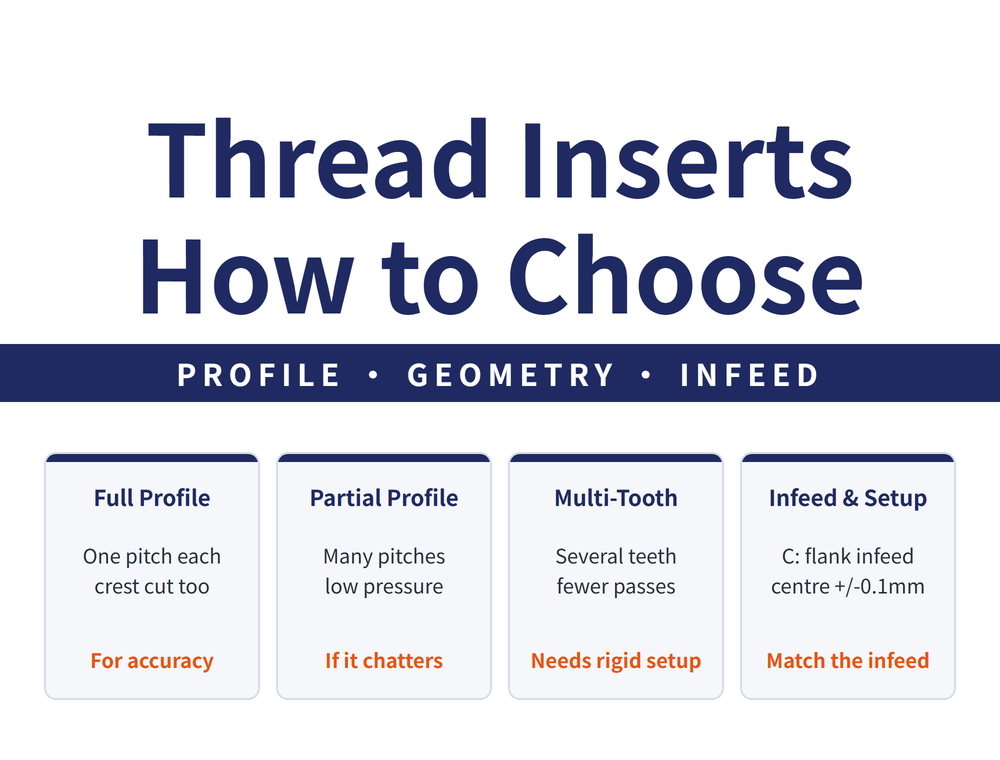
Choose the insert profile first: full profile for accuracy (one insert per pitch, the crest is finished in the same pass), partial profile for a small tool stock or when the thread chatters (one insert covers several pitches with lower cutting pressure), and multi-tooth for speed (several teeth cut at once and passes drop, but the setup must be rigid). Then pick the geometry by workpiece material, knowing that the geometry limits the infeed method; finally fit the right shim and set centre height within ±0.1 mm.
1. The Order of Choices
| Order | What to decide | Where to look |
|---|---|---|
| 1 The thread | Internal/external, hand, profile, pitch, starts, tolerance | Drawing |
| 2 Insert profile | Full profile, partial profile or multi-tooth | Section 2 |
| 3 Geometry and grade | By workpiece material and toughness needed | Section 3 |
| 4 Shim | Match the lead angle for large, even flank clearance | Thread Lead Angle & Insert Selection |
| 5 Infeed and setup | Infeed method, number of passes, centre height | Section 4 |
Check the machine first as well: spindle speed, how rigid the clamping is, tool overhang and whether a threading cycle is available will limit the later steps.
2. Full Profile, Partial Profile or Multi-Tooth
| Insert | Gain | Cost |
|---|---|---|
| Full profile | Root and crest formed together; best profile control, less deburring | One insert per pitch; higher tool pressure |
| Partial profile | One insert for several pitches, smaller stock; lower cutting pressure | Crest set by the previous turning pass; burrs to remove; smaller nose radius, shorter tool life |
| Multi-tooth | Several teeth cut at once; two teeth can roughly halve the passes | Rigid clamping, short overhang; room to run out at the end |
In one line: full profile for accuracy, partial profile for a small stock, multi-tooth for speed. When a thread keeps chattering, a partial profile insert is often the fix because its cutting pressure is lower.
With a full profile insert, leave 0.06–0.14 mm extra on the diameter (0.03–0.07 mm per side) in the previous turning pass so the insert finishes the crest to size; the blank then does not have to be turned to an exact diameter first.
Some makers' catalogues describe a full profile insert as having a crest-finishing edge and a partial profile insert as having none; the crest-finishing edge is the part that cuts the crest to size. There is also a semi crest-finishing type made for trapezoidal threads only: it still needs one insert per pitch and a separate finishing step, so it is not a partial profile insert. Mixing up the names can mean buying a single-pitch trapezoidal insert as if it were a general-purpose one.
3. Geometry Follows the Material and Ties Down the Infeed
| Geometry (one maker's grouping) | Character | For |
|---|---|---|
| A | Good chip forming in most materials | First choice for most operations |
| F | Sharp edge | Sticky, soft or work-hardening materials |
| C | Chip breaker | Low-carbon and low-alloy steel; also stainless |
The C geometry with a chip breaker only suits flank infeed; with radial infeed the chip breaker does nothing. Choose the grade by workpiece material and the toughness you need; for reading grade codes, see Insert Selection: A Complete Reading Guide.
4. Infeed Method and Setup
| Infeed | Suits |
|---|---|
| Radial infeed | Fine pitches, work-hardening materials; the only option on older non-CNC machines |
| Flank infeed | First choice for most thread turning; good chip control, lower chatter risk |
| Alternating infeed | Large profiles, coarse pitches; longest tool life, needs special programming |
For radial versus flank infeed, see Thread Infeed Methods Explained; for splitting depth across passes, see CNC Thread Cutting Depth Guide.
When mounting, keep centre height within ±0.1 mm: too high, the clearance shrinks and the edge rubs on the work and breaks; too low, the thread profile may come out wrong. If problems show up, check Thread Machining Troubleshooting Guide.
Frequently Asked Questions (FAQ)
Q: What is the difference between full profile and partial profile threading inserts?
A full profile insert also finishes the crest, so the profile is well controlled, but one insert covers one pitch only. A partial profile insert covers several pitches with a smaller stock, but the crest depends on the previous turning pass and burrs are left; its nose radius is also smaller, so tool life is shorter.
Q: My thread keeps chattering. Which insert should I try?
Try a partial profile insert: it does not finish the crest, so cutting pressure is lower. Also keep the overhang short and use flank infeed.
Q: When is a multi-tooth insert a good choice?
In volume production where you want fewer passes. Tool pressure rises with the number of teeth, so clamping must be rigid, overhang short, and there must be room to run out at the end of the thread.
Q: How accurate must the centre height of a threading insert be?
Within ±0.1 mm. Too high and the edge rubs on the work and breaks; too low and the thread profile may come out wrong.
Sources: insert profiles, geometries, infeed methods, full profile stock allowance and centre height per Sandvik Coromant thread turning technical data; crest-finishing edge and tool life differences per Mitsubishi Materials thread turning technical data.
This article is part of Thread Machining: A Complete Reading Guide; that guide shows how the whole topic fits together.
Last updated: 2026-10-10









