
Insert Selection: A Complete Reading Guide
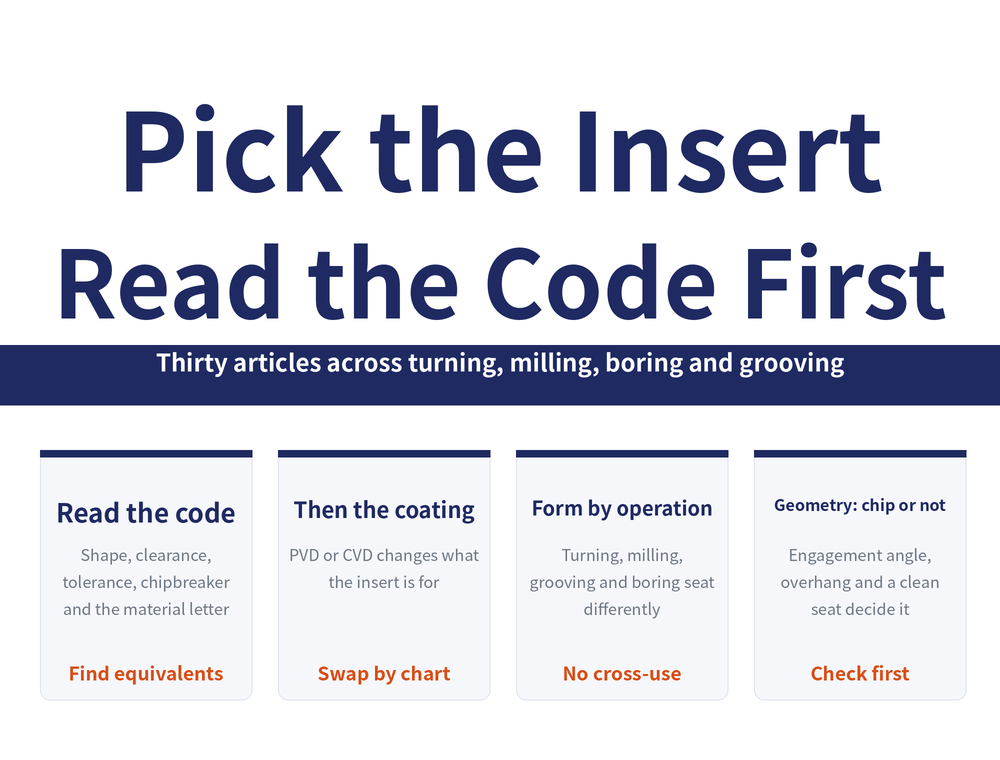
Indexable inserts span turning, milling, grooving and boring, and this site has 30 articles on how to pick them. This page is a reading guide. It does not repeat what those articles say; it answers one question: for the insert you need, which article should you open first.
1. Start With the Standard: How Inserts Are Named and Looked Up
An insert code is a string of positions. Read the code first, and only then can you find equivalents and matching holders.
| Article | When to open it |
|---|---|
| ISO Turning Insert Guide | The main entry point: reading a CNMG-style code position by position |
| Reading Insert Material Codes: ISO 513 | The material-group letter is read separately from the shape code |
| Insert Angle: Negative vs Positive | Matching negative, 7 degree and 11 degree inserts to part and rigidity |
| Thread Lead Angle and Shim Selection | Threading inserts need the shim matched to the lead angle |
2. Read the Coating: Same Body, the Coating Decides the Job
With the same body, changing the coating changes the workpiece and the speed it suits.
| Article | When to open it |
|---|---|
| PVD vs CVD Coating Guide | Separate the two coating processes before choosing between them |
| Carbide Insert Coating Chart | The cross-reference for swapping to an equivalent grade |
| CVD Insert Coating Chart | ISO classes and brand alternatives on the CVD side |
| PVD Insert Coating Chart | ISO classes and selection on the PVD side |
3. Beyond Carbide: Other Insert Families
Beyond carbide, CBN and PCD each have their own window; forced outside it, they only chip.
| Article | When to open it |
|---|---|
| CBN and PCBN Cutting Guide | Where the high-hardness-steel and cast-iron grades belong |
| Hard Turning Guide | Turn-instead-of-grind starts with the insert grade |
4. Read the Geometry: Chipbreaker, Wiper, Pitch and Engagement
Chipbreaker, wiper, pitch and engagement angle decide the chip, the finish and the impact the edge takes.
| Article | When to open it |
|---|---|
| Turning Wiper Insert Guide | Why a wiper lets you double the feed and still improve finish |
| Face Mill Pitch Selection Guide | Coarse, close and differential pitch for different stability |
| High-Feed Milling Guide | These inserts trade small depth for high feed by geometry |
| Milling Entry, Exit and Engagement | Engagement angle decides the impact the insert takes |
5. Pick by Operation: Turning, Milling, Grooving, Boring
Fix the operation first, turning, milling, grooving or boring, before the insert form can settle.
| Article | When to open it |
|---|---|
| Turning Tool Selection Process | The six-step turning route from part to insert; read it first |
| Grooving and Parting Tool Selection | Three grooving methods and the inserts that match |
| Grooving: Overhang, Bar and Seating | Seating and location decide whether a grooving insert chips |
| Grooving Operations Guide | Different groove types call for different inserts and paths |
| Milling Methods Overview | Fix the milling method first, then the insert follows |
| Rough Boring Tool Selection | Edge count, rake and lead angle for rough boring |
| Boring Bar Guide | Bar and insert come as a set; read the codes together |
| Indexable Drill Guide | Selecting TVF and TVFZ inserts for an indexable drill |
6. When It Goes Wrong: Insert-Related Troubleshooting
When an insert fails, match the symptom first, then work back to selection, conditions or clamping.
| Article | When to open it |
|---|---|
| Face Milling Troubleshooting Guide | Symptom, cause and fix for face-milling inserts |
| Parting and Grooving Troubleshooting | Wear, finish, chip control and vibration one by one |
| Boring Troubleshooting Guide | Vibration, chip and feed-mark fixes in boring |
| Boring Chip Control and Coolant | Chipbreaker plus through-coolant to control the chip |
7. The Setup Around the Insert: Holder, Maintenance, Finish
Holder, a clean seat and finish control all have to hold up the insert, however good it is.
| Article | When to open it |
|---|---|
| Anti-Vibration Tool Holder Guide | At long overhang even a good insert needs a damped bar |
| Tool Holder Maintenance Guide | A dirty seat means an inaccurate insert location |
| Face Milling Surface Finish | For finish, pair the wiper insert with runout control |
| Turning Cutting Conditions Guide | A well-chosen insert still fails on mismatched conditions |
8. Frequently Asked Questions (FAQ)
Q: Do I have to memorise the whole insert code?
No. Learn the first few positions (shape, clearance, tolerance, chipbreaker) and the material letter; look the rest up in a chart. See the ISO Turning Insert Guide and Reading Insert Material Codes.
Q: How do PVD and CVD coatings differ, and how do I choose?
They are different processes with different wear-and-toughness bias. Read the PVD vs CVD Coating Guide first, then use a coating chart to find an equivalent grade.
Q: Can one insert serve turning, milling and grooving on the same part?
No; the form and seating differ. Use Section 5 to fix the form by operation, then go back to the code and coating.
Q: If an insert keeps chipping, is the insert itself the problem?
Not necessarily. Chipping often comes from engagement angle, overhang or a dirty seat. Check Sections 4, 6 and 7 before changing grade.
Published: 2026-08-11 | Last updated: 2026-08-11









