
Thread Whirling Explained: Eccentricity, Tilt Angle and Hard Milling Above 60 HRC
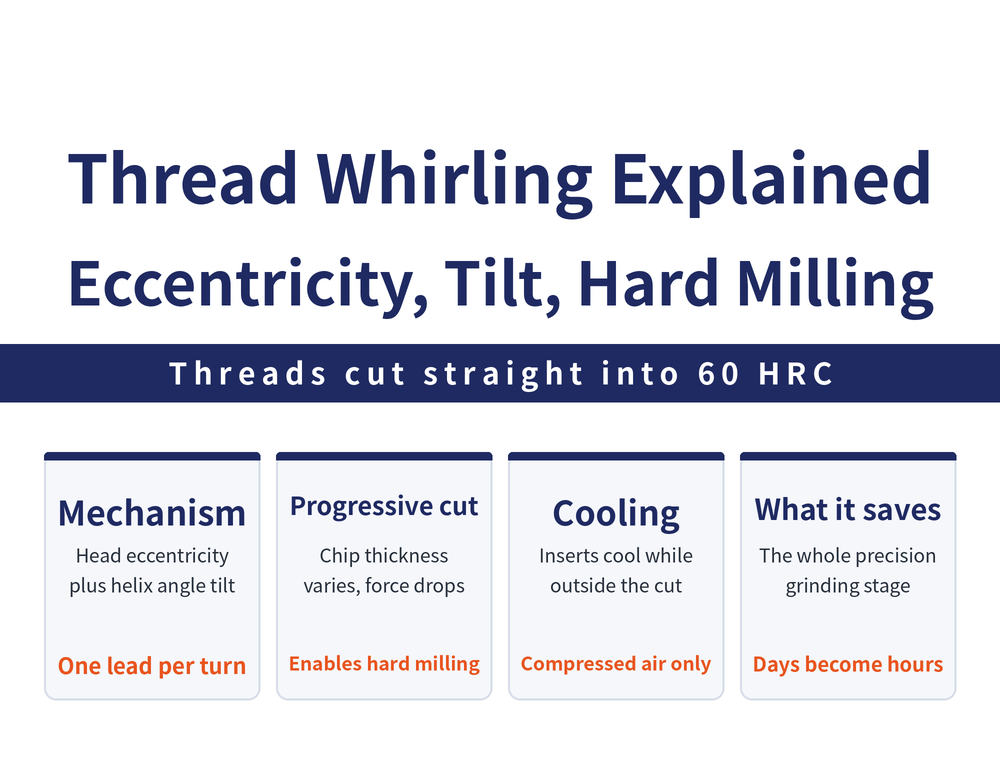
Ball screw threads used to require cutting soft, hardening, then precision grinding. Thread whirling collapses that into one operation: the thread is milled directly into a workpiece already hardened above 60 HRC. What makes it possible is not a harder tool but the progressive interrupted cutting created by cutter head eccentricity — and it runs without coolant.
1. The mechanism: eccentricity and tilt
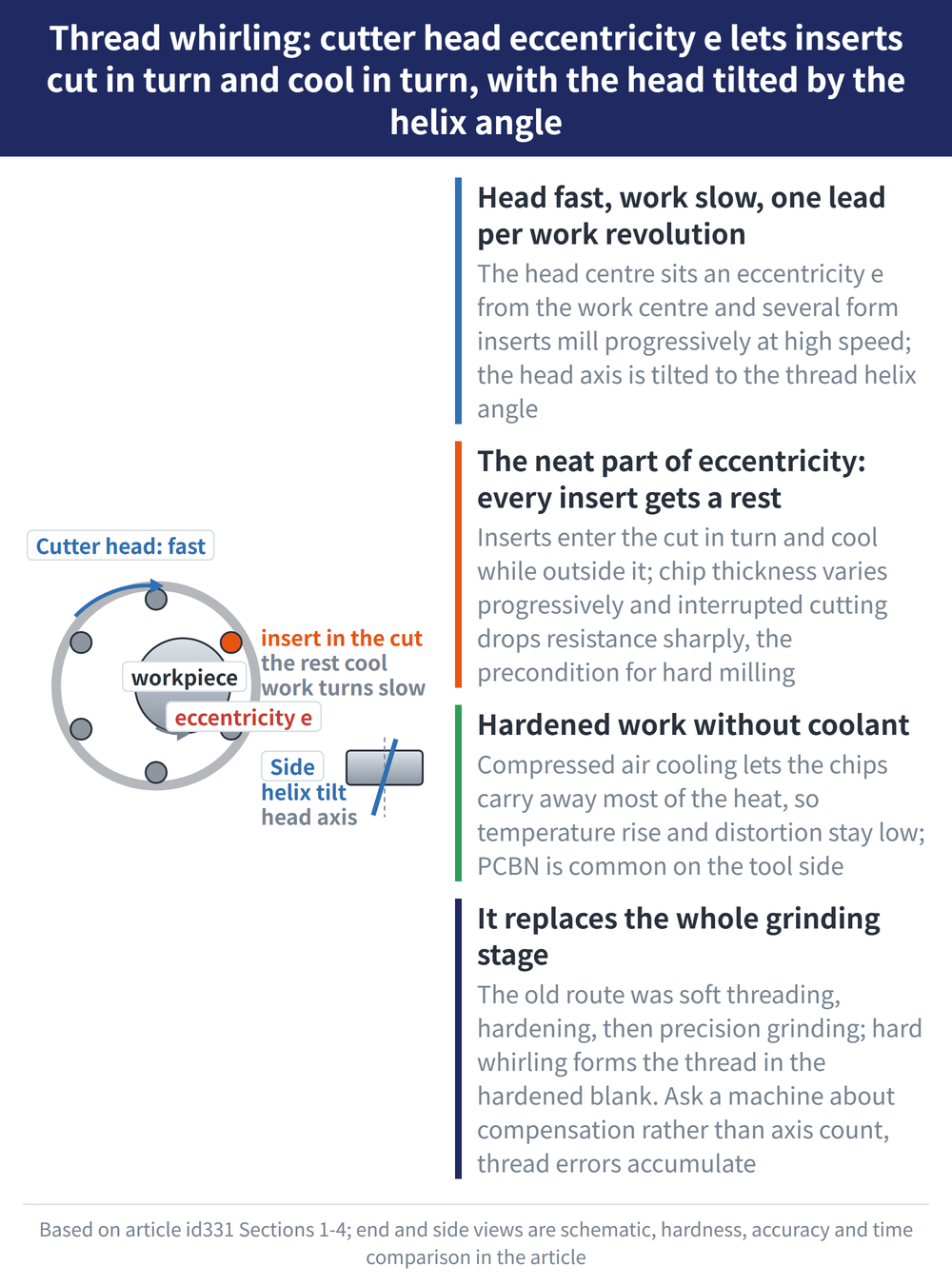
Thread whirling uses several form tools mounted in a cutter head, and works through the eccentricity e between the cutter head's centre of rotation and the workpiece centre to perform progressive high-speed milling. The cutter head axis is tilted relative to the workpiece axis by the helix angle βc of the thread being produced.
During machining the workpiece rotates slowly while the cutter head rotates at high speed, either in the same direction as the workpiece (climb) or against it (conventional). For each full revolution of the workpiece, the cutter head advances axially by one lead, and the thread is generated. The method divides into external and internal whirling, with external the more widely used; internal whirling heads come in radial and tangential insert arrangements.
Note this is a completely different mechanism from thread milling by interpolation: the latter relies on toolpath, this on the eccentricity and tilt of a cutter head generating the form directly. For the overall classification of thread tools, see the thread tool specification chart.
2. Why it can cut hardened workpieces
| Mechanism | What it delivers |
|---|---|
| Progressive stock distribution | Chip thickness varies progressively, lowering cutting force |
| Eccentricity e | Inserts not yet in the cut have ample time to cool, raising tool life and surface quality |
| Interrupted cutting | Cutting resistance drops sharply — the precondition for hard milling |
| Compressed air cooling | Chips carry away most of the heat, keeping workpiece temperature rise and distortion low |
The second item is the neatest part of the mechanism: eccentricity does not only define the cutting path, it also gives every insert a rest period. Inserts enter the cut in turn, and cool while outside it — which is precisely why tool life holds up without coolant.
Reaching direct hard milling above 60 HRC also requires three further conditions: advanced tool materials with precision cutter head manufacture, the strengthened dynamic rigidity of current CNC whirling machines, and the practical validation of high-speed hard and dry cutting theory. PCBN is common on the tool side — see the CBN and PCBN tooling guide.
3. What the machine has to compensate
A CNC whirling machine has three basic motions: high-speed rotation of the cutter head, axial movement of the head relative to the workpiece, and radial movement of the head relative to the workpiece. But what sets the accuracy ceiling is not the axes — it is compensation.
Current machines compensate lead error caused by thermal distortion, thread pitch diameter error caused by tool wear, and the effect of thermal distortion on cutter head concentricity and running accuracy. With these in place, ball screw accuracy can reach DIN 69051 class 3.
In other words, when evaluating a whirling machine, asking about compensation items tells you more than asking about axis count — thread errors are cumulative, and whatever is not compensated grows along the thread length.
4. Which operation it replaces
The traditional route has three stages: cut the thread soft, harden, then precision grind. Hard whirling compresses this to one: mill the thread directly into the already-hardened blank.
One comparison makes the gap clear: after switching to PCBN tooling for whirling, a process previously measured in days fell to a matter of hours (single-source measurement showing roughly two orders of magnitude, for order-of-magnitude reference). That gap comes from eliminating the entire grinding stage, not merely from cutting faster.
Two further sets of measurements indicate achievable accuracy: machining ball screws and ball nuts hardened to 60–62 HRC, lead accuracy and profile accuracy held in the low-to-mid micron range with surface roughness Ra down to a fraction of a micron (again single-source, dependent on machine, tooling and workpiece). For reading roughness see surface roughness Ra vs Rz.
As a "cutting instead of grinding" strategy it belongs to the same family as hard turning — the difference being that hard turning handles general rotational surfaces while whirling handles a generated form. See the hard turning guide.
5. Frequently Asked Questions (FAQ)
Q: Is thread whirling the same as thread milling by interpolation?
No. Thread milling generates the thread through helical toolpath interpolation; whirling generates it directly through cutter head eccentricity and helix angle tilt, on dedicated machines, mainly for precision drive components such as ball screws.
Q: How can hardened material be machined without coolant?
Because inserts enter the cut in turn and eccentricity gives those outside the cut time to cool. Combined with compressed air cooling, chips carry away most of the heat, keeping temperature rise and distortion low.
Q: What should I look for in a whirling machine?
Compensation capability. Lead error, pitch diameter error and thermal effects on cutter head running accuracy set the accuracy ceiling; thread errors are cumulative and grow along the length if uncompensated.
Q: Where does the cost saving mainly come from?
The entire precision grinding stage. The traditional route is soft threading, hardening, then grinding; hard whirling forms the thread directly in hardened material, with a time difference of up to two orders of magnitude.
Published: 2026-08-26 | Last updated: 2026-08-26









