
Hard Turning Guide: Replacing Grinding at HRC45–65
Hard turning uses a CBN (cubic boron nitride) insert to turn hardened steel at HRC45–65 directly, replacing traditional grinding with turning. It is efficient, flexible and can run dry — but it demands more of machine rigidity, tooling and parameters. This guide covers when replacing grinding pays off and how to set it up.
1. What Hard Turning Is and Why It Can Replace Grinding
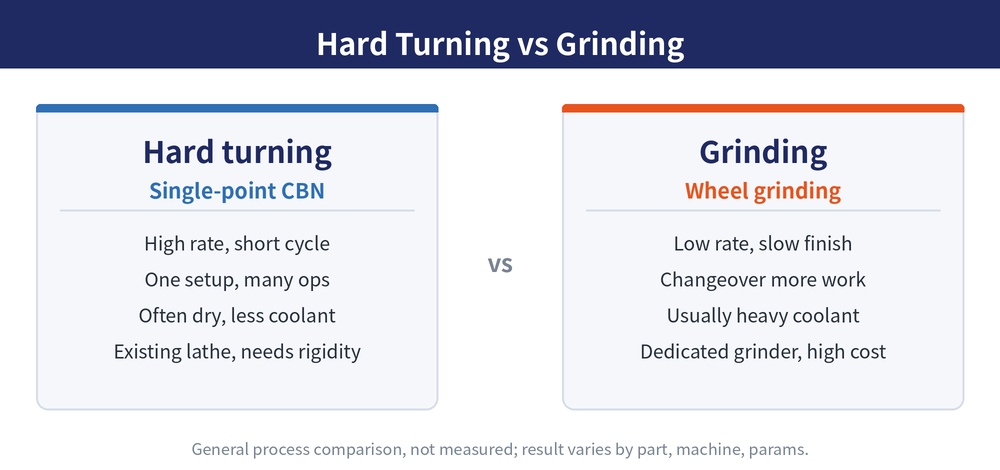
Hard turning is single-point turning of hardened steel (HRC45–65 is the typical range) with a CBN or ceramic insert, reaching a surface quality close to grinding. The insert must be clearly harder than the workpiece to cut hardened material reliably.
CBN (cubic boron nitride): second only to diamond in hardness and, unlike diamond, does not react with iron — making it well suited to turning hard and hardened steels.
Replacing grinding pays off by finishing several operations in one clamping, cutting machine changes and often running dry to save coolant. For reading and converting hardness, see Hardness Conversion Chart; for the overall strategy, see Hardened Steel Machining Guide.
2. Hard Turning vs Grinding: Strengths, Weaknesses and When to Use Each
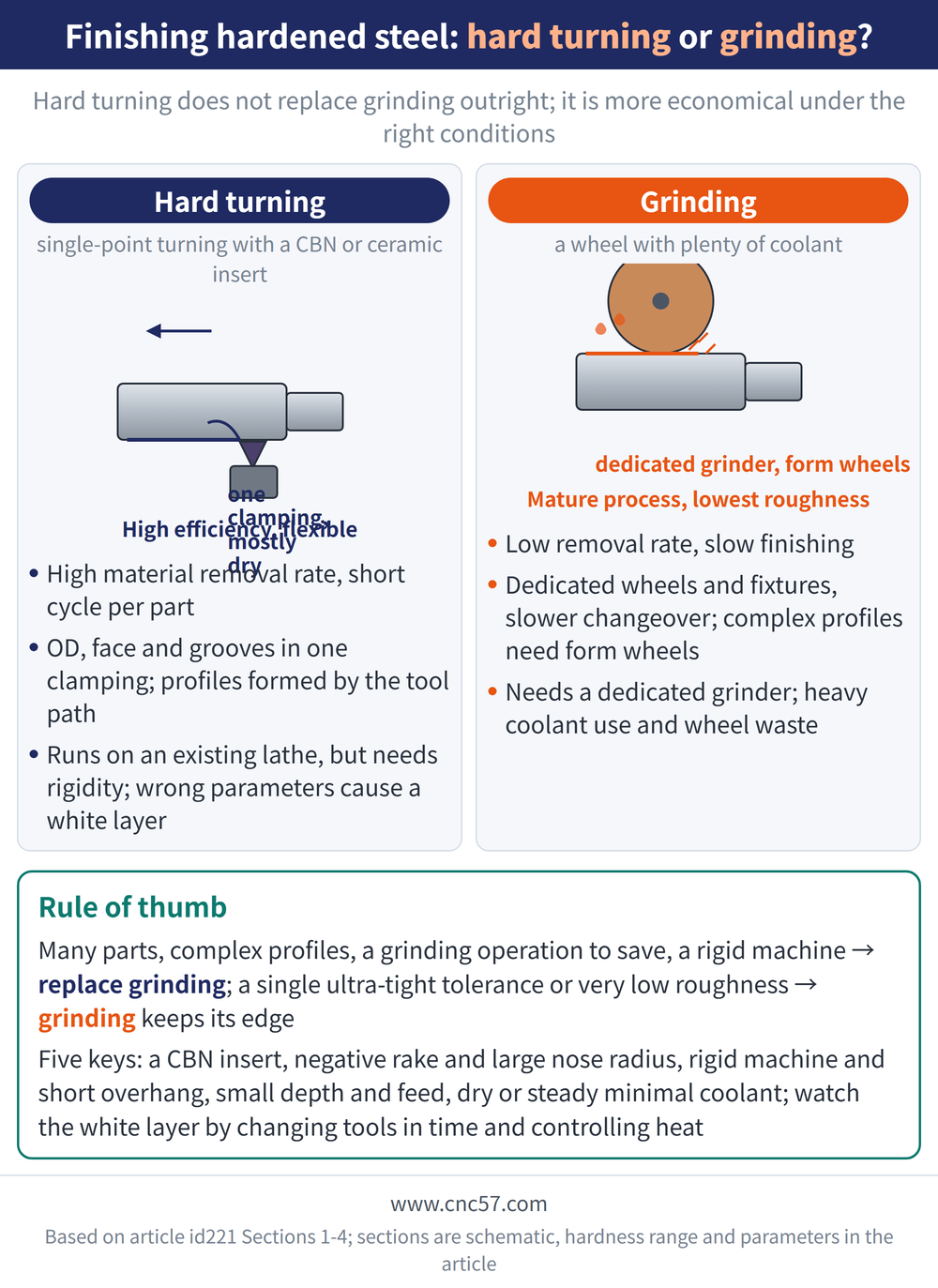
Hard turning does not replace grinding outright; it is more economical under the right conditions. A point-by-point comparison:
| Criterion | Hard turning | Grinding |
|---|---|---|
| Efficiency | High material removal rate, short cycle per part | Low removal rate, slow finishing |
| Flexibility | OD, face, grooves and more in one clamping | Often needs dedicated wheels and fixtures; changeover is slower |
| Complex shapes | Profiles and steps formed by tool path | Complex profiles need form wheels, more limited |
| Environmental | Often dry, little coolant | Usually heavy coolant plus wheel-waste handling |
| Equipment cost | Runs on an existing lathe, but needs high rigidity | Needs a dedicated grinder, higher machine investment |
| Surface integrity | Wrong parameters can form a white layer; control heat and tool wear | Mature process, but grinding burn is still possible |
This is a general process comparison, not measurements taken by this site; actual results depend on workpiece, machine and parameters.
When to use it: high part counts, complex profiles, wanting to drop a grinding operation, and sufficient machine rigidity all favour replacing grinding. Conversely, a single very tight tolerance or extremely low roughness requirement still favours grinding.
For how much it actually saves, twelve quantified cases are in How Much Does Hard Turning Actually Save.
3. Five Keys to Hard Turning
Success concentrates in four areas — insert, geometry, machine and parameters — summarised as five keys:
| Key | Detail |
|---|---|
| 1. Choose a CBN insert | For hardened steel, choose a composite PCBN with a ceramic binder (somewhat lower hardness, better thermal stability); high-CBN-content PCBN is harder and more wear-resistant but less thermally stable, better suited to heat-resistant alloys and cast iron; below about 60 HRC with a small feed, lower-cost ceramic inserts are also an option |
| 2. Negative rake, large nose radius | A negative rake angle and larger nose radius strengthen the cutting edge against the high forces of hard material |
| 3. Rigid machine, short overhang | Keep machine, bar and clamping rigid and overhang short to suppress vibration and dimensional drift |
| 4. Small depth of cut, small feed | Finishing generally uses a small depth of cut and small feed to balance size and surface quality |
| 5. Mostly dry or steady minimal coolant | CBN is heat-resistant, so dry cutting is common; if coolant is used it must be steady and continuous to avoid thermal shock and edge cracking |
For insert type and geometry, see ISO Turning Insert Guide; for matching tool material and coating to the workpiece, see Material and Coating Selection by Workpiece; for hardness-to-tool-material mapping, see Hardness and Tool Selection Guide (HB/HRC/HV).
4. Watch the White Layer
The white layer is the surface defect to watch most closely in hard turning: when cutting heat is too high or the tool is too worn, the surface forms a tempered or re-hardened altered layer that generally reduces fatigue life.
The control is to manage tool wear and cutting heat: change tools in time, keep the edge sharp, and avoid excessive cutting speed that builds up heat. Do not apply generic cutting speed and feed values; decide them from the tool catalogue and a trial cut. For the calculation method, see Turning Machining Formula Handbook and End Mill Cutting Conditions Guide.
Last updated: 2026-10-20
5. Frequently Asked Questions (FAQ)
Q: Above what HRC should I consider hard turning?
Generally, once a part is hardened above about HRC45 and conventional turning tools can no longer cut it reliably, hard turning with CBN or ceramic inserts is worth evaluating; the typical range is HRC45–65.
Q: Does hard turning always use CBN?
Not necessarily. CBN is the mainstream choice and excels at continuous finishing, but below about 60 HRC with a small feed, lower-cost ceramic inserts are also common. Plain alumina ceramics are brittle, however, and do not suit heavy-impact interrupted cuts.
Q: Should hard turning use coolant?
It is mostly dry, because CBN is heat-resistant and intermittent flooding can cause thermal shock and edge cracking. If coolant is used, it must be steady and continuous to avoid rapid heating and cooling cycles.
Q: What is the white layer and how do I avoid it?
The white layer is an altered surface layer formed by excessive cutting heat or tool wear, which generally reduces fatigue life. Controlling tool wear, changing tools in time and keeping cutting heat down all lower its occurrence.
For the full reading guide on this topic, see Insert Selection: A Complete Reading Guide.
For the full reading guide on this topic, see Turning: The Complete Guide.









