
Common Tool Coatings Explained: From TiN to AlCrN
Insert boxes are covered in coating codes — TiN, TiCN, TiAlN, AlTiN, AlCrN — and even the colours differ. This guide puts five common coatings in one table by hardness, temperature, friction and material, and shows how to make a first read from colour.
1. What a coating does: hardness, temperature, low friction
A coating is a film only a few µm thick deposited on the tool surface (typical PVD thickness about 1–5µm, refer to the catalogue; CVD is thicker, see PVD vs CVD Coatings: Differences and How to Choose). It does three things at once: raises surface hardness, lowers friction and blocks cutting heat, letting the tool run faster and wear more slowly.
A coating is a bonus, not a new substrate
A coating improves surface behaviour, but the tungsten carbide substrate's toughness and chip resistance still set the baseline. The right coating extends life and raises speed, yet it cannot rescue wrong tool geometry or cutting conditions. For the difference between the PVD (physical vapor deposition) and CVD (chemical vapor deposition) deposition processes and how to choose, see the PVD vs CVD Coatings guide.
2. Five common coatings at a glance
The table below lines up the five coatings you meet most often. Values are typical and colours are for a first read only; follow the catalogue for the actual figures.
| Coating | Colour | Hardness (typical HV) | Oxidation temp (typical) | Friction and character | Suited materials |
|---|---|---|---|---|---|
| TiN (titanium nitride) | Gold | about 2300 | about 600°C | General-purpose entry; wear is easy to read (gold worn off exposes the substrate) | General steel, through holes, wood/plastic |
| TiCN (titanium carbonitride) | Grey-blue / blue-grey | about 3000 | about 400°C | Harder than TiN, lower friction, wear resistant | Tapping, drilling, wear-critical jobs |
| TiAlN (aluminium titanium nitride) | Violet-black / black | about 3300 | about 800°C and above | Forms a protective alumina layer at high heat; suits dry cutting / high speed | Steel, stainless steel, cast iron |
| AlTiN (higher aluminium ratio) | Black | about 3300 | about 900°C | Higher heat tolerance, strong oxidation resistance | High-speed dry cutting, hard milling, hardened steel |
| AlCrN (aluminium chromium nitride) | Grey-blue / blue-grey | about 3200 | about 1100°C | Highest oxidation temperature, strong oxidation and wear resistance | Stainless steel, titanium, heat-resistant alloys, high-temp continuous cuts |
Hardness (HV), oxidation temperature and film thickness above are typical / reference values; they vary with each maker's formula and measurement conditions, so follow the catalogue or standard. Colour is for a first read only. For decoding insert coating codes see the carbide insert coating chart and the PVD insert coating chart.
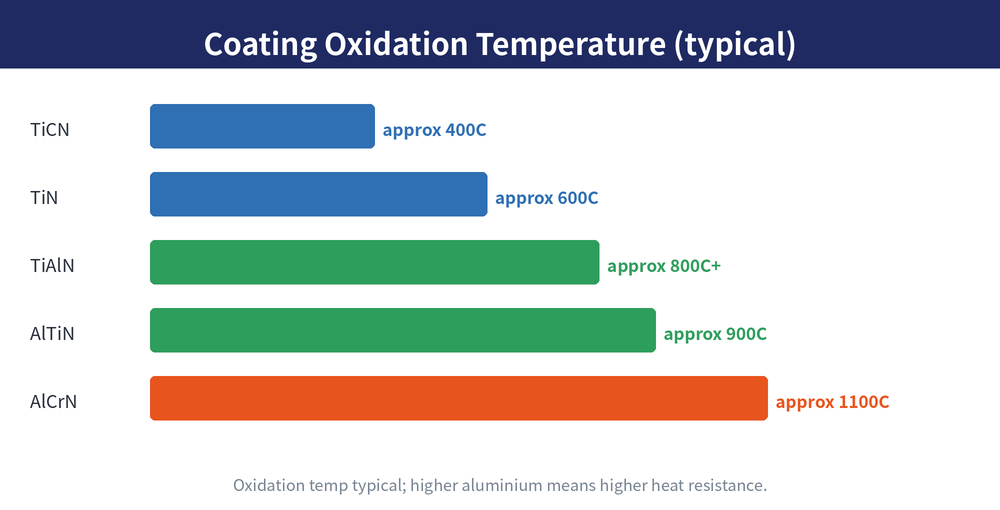
3. One through-line: more aluminium, more heat resistance
The fastest way to read the table above is to grab one through-line: the more aluminium in the coating, the more heat it takes. From TiAlN to AlTiN to AlCrN the aluminium content and oxidation temperature climb together, and the matching work moves from high speed toward dry cutting, difficult materials and high-temperature continuous cuts.
| Coating | Aluminium trend | Oxidation temp (typical) | Matching work |
|---|---|---|---|
| TiAlN | Medium | about 800°C and above | High speed, dry cutting |
| AlTiN | High | about 900°C | High-speed dry cutting, hard milling, hardened steel |
| AlCrN | Highest | about 1100°C | Difficult materials, heat-resistant alloys, high-temp continuous |
The other way round, low-temperature or sticky materials (aluminium and non-ferrous metals) do not follow the aluminium high-heat route but go toward a low-friction film (such as diamond-like carbon) to avoid built-up edge; for the exact match still refer to the comparison table in section 2.
4. A first read from colour, and reading wear
Colour is the quickest first clue: gold is usually TiN; grey-blue / blue-grey is common on TiCN or AlCrN; violet-black to black is common on TiAlN/AlTiN. But colour is only a first read — the same colour can differ between makers' formulas, so for the truth read the hardness and oxidation temperature figures in the catalogue.
The hidden upside of gold TiN: easy wear reading
TiN's gold is conspicuous, so once it wears through to the substrate colour you know the edge is degrading — handy for judging when to change or regrind the tool. Darker aluminium-bearing coatings take more heat, but their wear is not as obvious at a glance.
Colour is for a first read only and does not directly represent performance; the same colour can differ between makers, so the actual hardness and oxidation temperature follow the catalogue.
Last updated: 2026-10-25
5. Frequently Asked Questions (FAQ)
Q: Does coating colour directly represent performance?
No, colour is only for a first read. The same colour can vary a lot between makers' formulas, so the real hardness and oxidation temperature must come from the catalogue figures.
Q: Why do high-speed dry cutting jobs need aluminium-bearing coatings?
Because aluminium-bearing coatings (TiAlN, AlTiN, AlCrN) have high oxidation temperatures and even form a protective alumina layer at high heat, so they take the cutting heat that builds up in dry, high-speed cuts without failing quickly.
Q: TiCN tolerates less heat than TiN, so why still use it?
Because TiCN is harder than TiN, with lower friction and better wear resistance, it suits tapping and drilling where cutting temperature is modest but wear matters; its lower heat tolerance is only a limit in hot operations.
Q: If two coatings both say TiAlN, will they perform the same?
Not necessarily. Even labelled TiAlN, differences in the aluminium-to-titanium ratio, layer structure and process shift hardness and heat tolerance, so choose by each maker's catalogue values.
For the full reading guide on this topic, see Tool Life and Wear: A Complete Reading Guide.
This article is part of Tool Materials and Coatings: The Complete Guide - Separate Substrate From Coating, Then Work Back From the Workpiece; that guide shows how the whole topic fits together.









