
PVD vs CVD Coatings: Differences and How to Choose
A coating is not a contest of hardness — pick the wrong one and it either will not bond or will not last as long as you need. This guide helps you decide whether the cutter in your hand should take PVD or CVD: first whether the tool body tolerates the coating temperature, then whether the cut is continuous or interrupted. Which tool types and which operations each coating suits are both laid out, so you can match it yourself.
1. Where the two processes differ: temperature and thickness
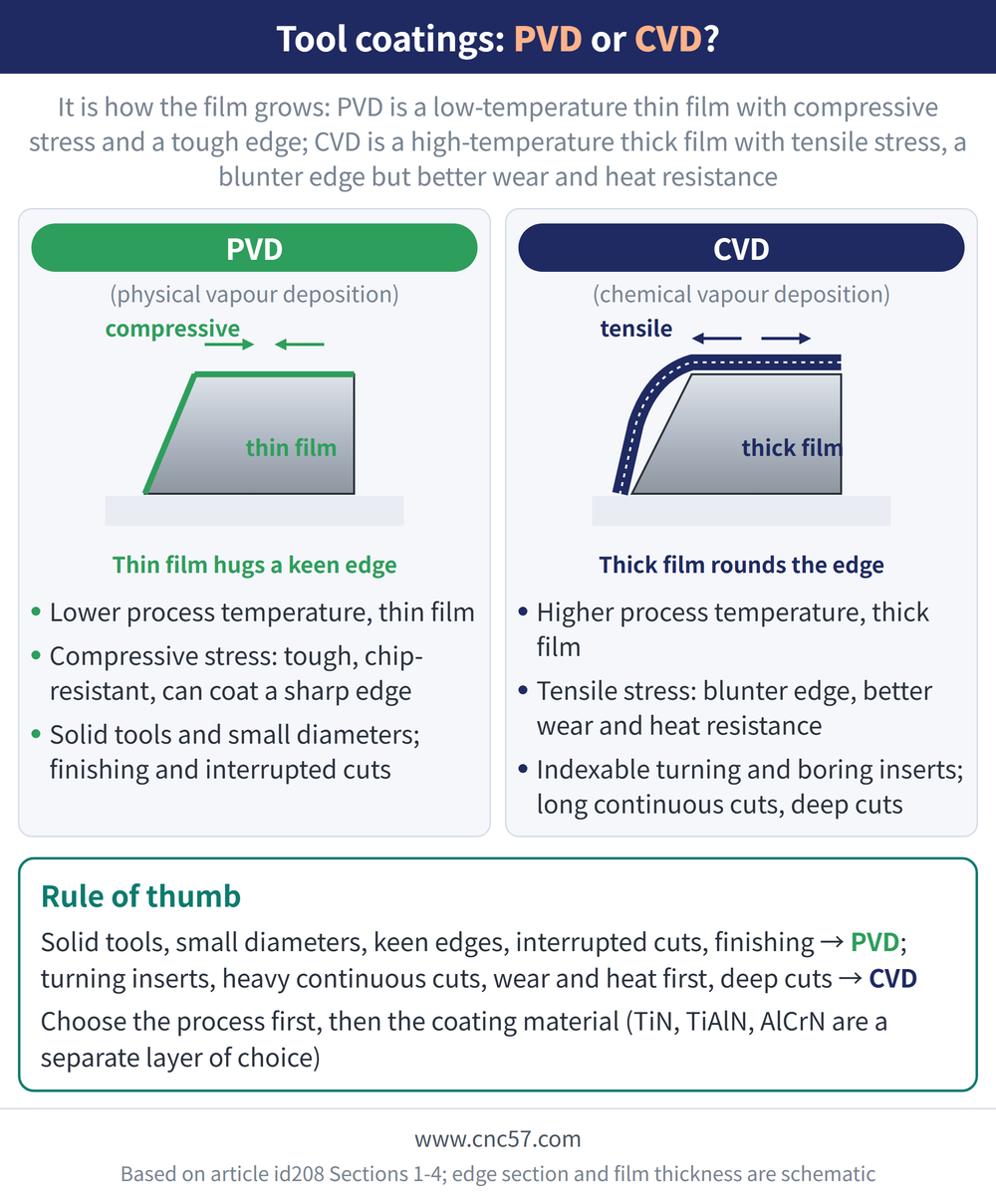
PVD (physical vapor deposition) runs at a lower process temperature with a thinner film; CVD (chemical vapor deposition) runs hotter with a thicker film. Between them sits medium-temperature CVD (MT-CVD), used to reduce high-temperature embrittlement.
| Process | Process temperature (typical) | Film thickness (typical) |
|---|---|---|
| PVD, physical vapor deposition | about 400–600°C | about 1–5µm |
| MT-CVD, medium-temperature CVD | about 700–900°C | between the two |
| CVD, chemical vapor deposition | about 800–1100°C | about 5–20µm |
The temperatures and thicknesses above are typical values in general; actual figures vary with the process recipe and coating system, so follow the catalogue or standard.
2. The key difference: residual stress drives edge behaviour
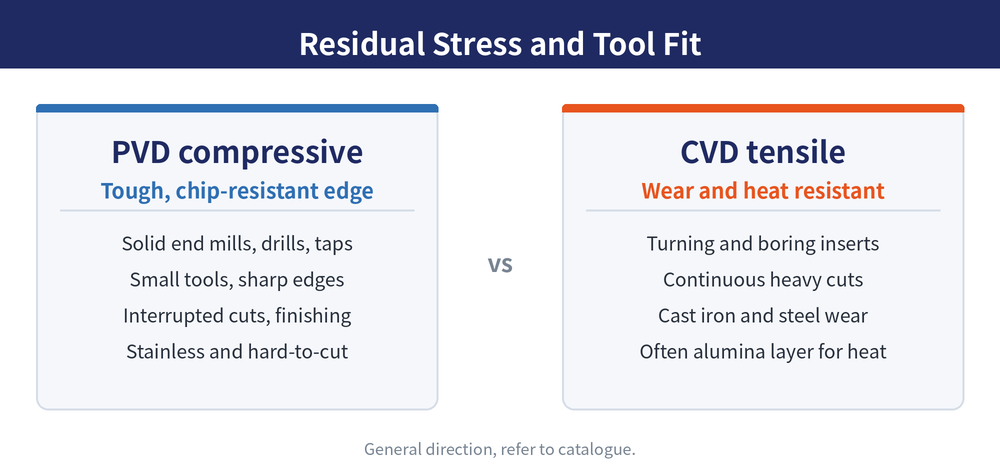
Process temperature does more than set film thickness; it sets the residual stress the coating holds after cooling, and that is what separates the two edges. PVD generally holds compressive stress, giving a tough, chip-resistant edge; CVD generally holds tensile stress, and its high-temperature process may form brittle phases at the interface, leaving a blunter edge.
| Comparison | PVD | CVD |
|---|---|---|
| Process temperature | lower (about 400–600°C) | higher (about 800–1100°C) |
| Film thickness | thinner (about 1–5µm) | thicker (about 5–20µm) |
| Residual stress | compressive | tensile (possible brittle phase at interface) |
| Edge sharpness | can hold a sharp edge | blunter, not for thin edges |
| Wear resistance | good | better |
| Heat resistance | good | better |
| Suited tools | solid tools, small-diameter tools, sharp edges | indexable inserts for turning and boring |
| Suited operations | finishing, interrupted cutting | long continuous cutting, large depth of cut |
The nature of the residual stress (compressive for PVD, tensile for CVD) is a general rule; actual values and interface phases vary with the process and coating system, so follow the catalogue or standard.
3. The strengths of each and where they fit
Turn the stress difference into shop-floor practice and each has a clear home. PVD, with the tough edge its compressive stress brings, leads on solid tools and interrupted cutting; CVD, often carrying an Al₂O₃ layer with good hot-oxidation resistance, leads on the long continuous cutting of turning inserts.
| Coating | Strength | Typical fit |
|---|---|---|
| PVD | tough, chip-resistant edge; can hold a sharp edge | solid end mills, drills, taps, small-diameter tools; finishing, interrupted cutting; stainless and hard-to-cut materials |
| CVD (often with Al₂O₃ layer) | wear and hot-oxidation resistance; thick film | indexable inserts for turning and boring; long continuous cutting of cast iron and steel, large depth of cut, wear-resistance first |
For insert-level coating charts, see the PVD insert coating chart and the CVD insert coating chart.
4. How to choose: match the tool and the operation
You do not have to memorise specifications; match the tool type and the operation and the direction is set.
| Your case | Suggested coating |
|---|---|
| Solid tools, small-diameter tools, sharp edges | PVD |
| Interrupted cutting, finishing | PVD |
| Turning inserts, continuous heavy cutting | CVD |
| Wear and heat resistance first, large depth of cut | CVD |
Pick the process first, then the coating material
PVD or CVD decides how the film grows and how the edge behaves; how you match coating materials such as TiN, TiCN, TiAlN, AlTiN and AlCrN is a separate layer of choice. For material-to-workpiece pairing, see common tool coatings explained.
5. Frequently Asked Questions (FAQ)
Q: Is PVD or CVD better?
Neither is absolutely better; they differ in process temperature and residual stress, so the tools and operations they suit differ too. Solid tools and interrupted cutting lean PVD, while turning inserts and continuous heavy cutting lean CVD.
Q: Why are small tools and solid end mills mostly PVD?
Because PVD runs at a low temperature with a thin film and compressive residual stress, so it keeps a sharp yet chip-resistant edge, ideal for small-diameter and solid tools; CVD's hot, thick film would leave a thin edge blunt and brittle.
Q: How do compressive and tensile residual stress affect the edge?
In general, compressive stress (PVD) makes the edge tougher and more chip-resistant, good for interrupted cutting; tensile stress (CVD) with a thick film gives strong wear and heat resistance but a blunter edge less suited to thin edges. Follow the catalogue or standard.
Q: Does a coated tool still have coating after regrinding?
The reground surface loses its coating and exposes the tungsten carbide substrate; to restore performance it needs recoating. For choosing the coating material, see the carbide insert coating chart.
Last updated: 2026-08-08
For the full reading guide on this topic, see Insert Selection: A Complete Reading Guide.
This article is part of Tool Materials and Coatings: The Complete Guide - Separate Substrate From Coating, Then Work Back From the Workpiece; that guide shows how the whole topic fits together.









