
Carbide Insert Coating Chart | ISO Grade Cross Reference Guide
A carbide insert coating chart is a key reference for CNC tool selection: by matching ISO classes (P, M, K, N, S) to brand grades you can quickly find equivalent inserts. Coating-and-material combinations directly affect wear resistance, heat resistance and stability. This guide covers carbide coating cross-references and application logic to help pick the best insert. For the ISO workpiece groups, see ISO Workpiece Material Classification.
What Is an Insert Coating Chart?
It supports cross-brand substitution, matching cutting conditions and extending tool life, based on three aspects.
| Purpose | Basis |
|---|---|
| Cross-brand substitution | ISO material class (P / M / K / N / S) |
| Matching cutting conditions | Tool material (carbide) |
| Extending tool life | Coating type (PVD / CVD) |
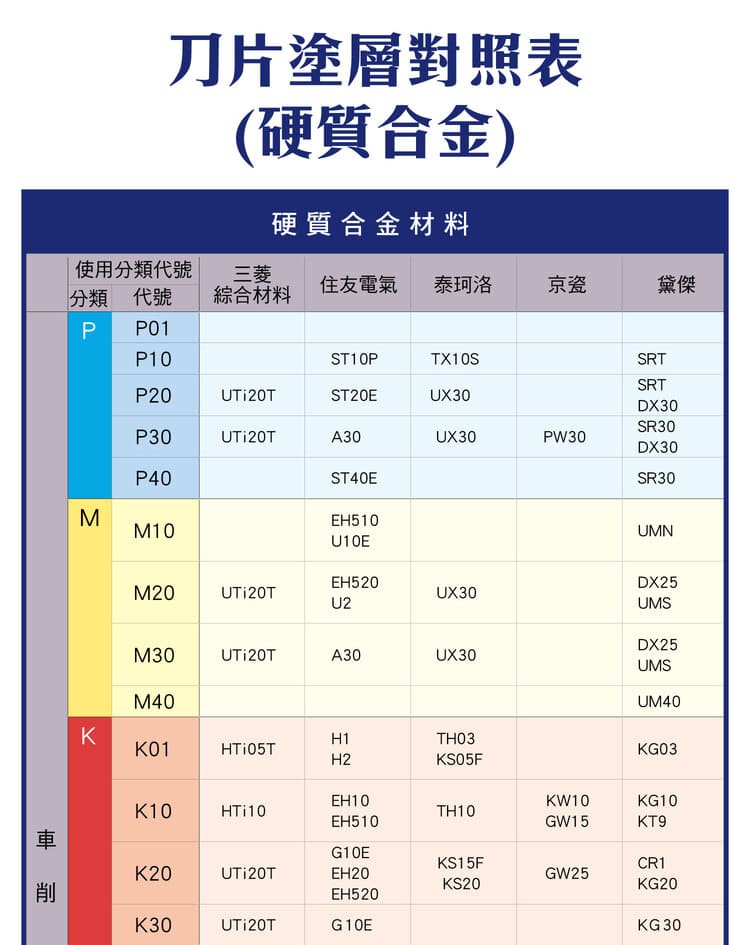
ISO Classes, Applications and Common Grades
By ISO group: material, traits and example insert grades for same-group substitution.
| ISO group | Material | Trait | Common grades (example) |
|---|---|---|---|
| P | Carbon / alloy steel | Stable cutting | UTi20T, ST20E, UX30, PW30, DX30, SR30 |
| M | Stainless steel | Gummy | EH520, UX30, DX25, UMS |
| K | Grey / ductile cast iron | High wear | HTi05T, KS15F, GW25, KG20 |
| N | Aluminum, copper | Low hardness, ductile | HTi10, KW10, CR1 |
| S | Titanium, superalloys | High-temp strength | RT9005, MT9015, SW10, FZ15 |
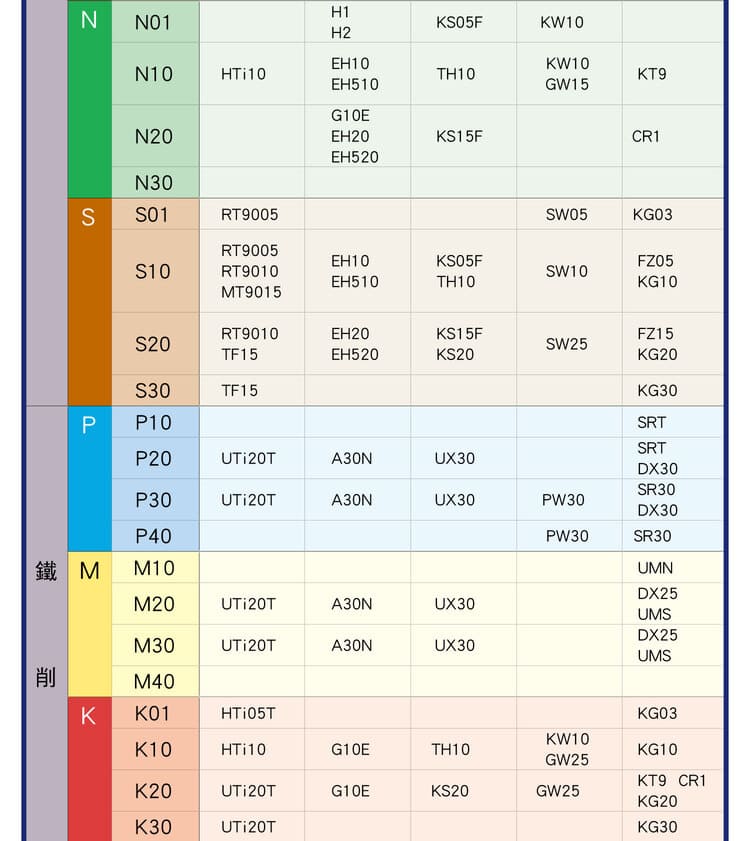
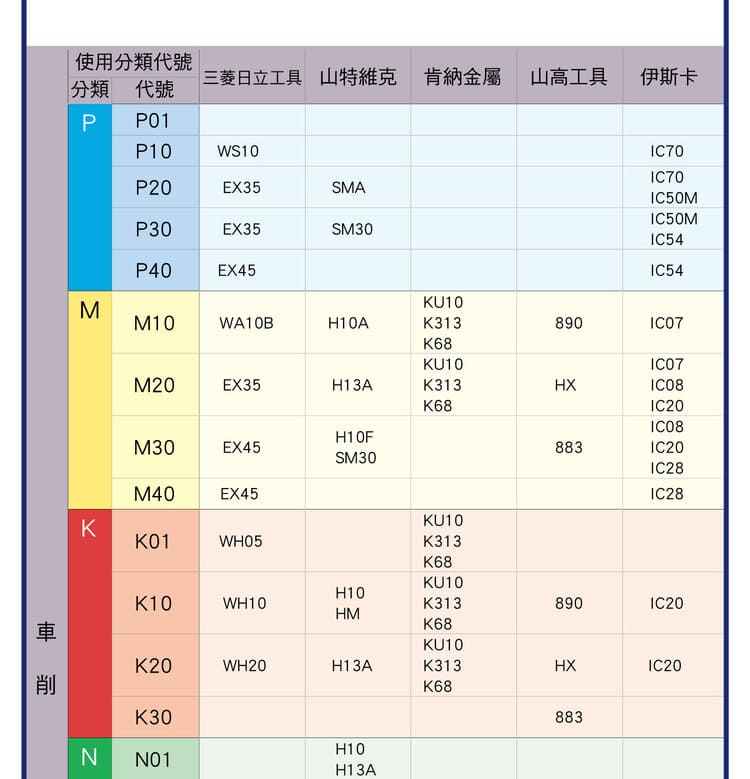
Brands Covered
The chart consolidates major tool brands; the same ISO class points to equivalent substitutes.
| Brand | Origin |
|---|---|
| Mitsubishi | Japan |
| Sumitomo | Japan |
| Kyocera | Japan |
| Sandvik | Sweden |
| Kennametal | USA |
| ISCAR | Israel |
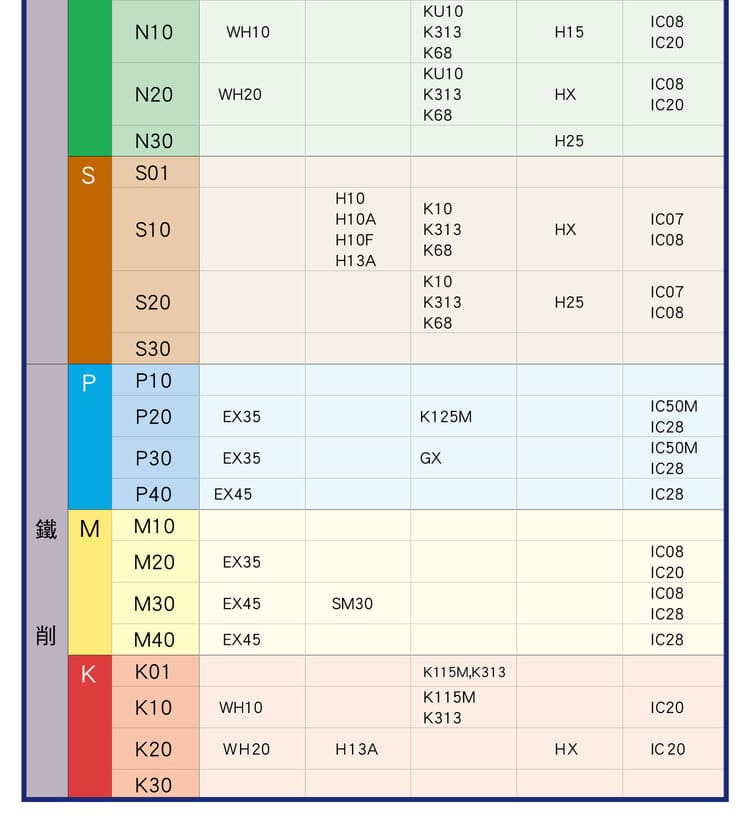
Why turning and milling inserts often carry different coatings, and how CVD and PVD differ in process temperature, film thickness and residual stress and which tool types and operations each suits, are covered in one place: PVD vs CVD Coatings: Differences and How to Choose.
For full per-brand grade lists by coating, see CVD Insert Coating Chart and PVD Insert Coating Chart.
Practical Insert Selection
| Scenario | Recommendation |
|---|---|
| High-speed | Continuous cutting: CVD coating (often with an Al₂O₃ layer, good hot-oxidation resistance); interrupted cutting: PVD (tough, chip-resistant edge) |
| Heavy cutting | CVD coating, better wear resistance |
| Finishing | Cermet or PVD |
| High-hardness materials | CBN or dedicated coating |
Three-step selection: Step 1 classify material (steel→P, stainless→M, cast iron→K); Step 2 assess conditions (roughing→a tougher grade, finishing→a more wear-resistant grade; within a group, the higher the number, the tougher); Step 3 choose coating (high temp→CVD, precision→PVD). Set actual parameters by machine and material hardness—see End Mill Cutting Conditions Guide.
※ Grades are common examples for same-ISO-group substitution reference only; verify exact equivalents and applicability against each brand's catalog.
FAQ
How do I use an insert coating chart?
Determine the ISO group from the workpiece (steel P, stainless M, cast iron K, non-ferrous N, heat-resistant S), then match brand grades within that group to find equivalent substitutes. Confirm against the maker's catalog.
What do numbers like P10 and P30 mean within an ISO group?
A higher number leans toward toughness and suits roughing; a lower number leans toward wear resistance and suits finishing. Find that number in the chart first, then read which grades each brand lists in the same row.
Are turning and milling insert coatings the same?
Usually different. Turning mostly uses CVD (wear and stability); milling mostly uses PVD (impact resistance), since milling is interrupted cutting with higher impact.
Which insert for high-hardness materials?
For hardened steel and other high-hardness materials, use CBN or dedicated coated inserts; ordinary steel uses carbide, and high-speed work uses coated inserts.
For the full reading guide on this topic, see Insert Selection: A Complete Reading Guide.
This article is part of Tool Materials and Coatings: The Complete Guide - Separate Substrate From Coating, Then Work Back From the Workpiece; that guide shows how the whole topic fits together.
Published: 2026-03-25 | Last updated: 2026-10-25









