
Tool Materials and Coatings: The Complete Guide - Separate Substrate From Coating, Then Work Back From the Workpiece
A catalogue entry for a cutter tells you three things: what the body is made of, what it is coated with, and a string of codes you cannot read. Each decides something different - the substrate decides whether it chips, the coating decides how it resists wear and heat, and the code is only a standard shorthand for the first two. These 24 articles follow that order, then turn around and work the other way: from the material you have to the tool you need.
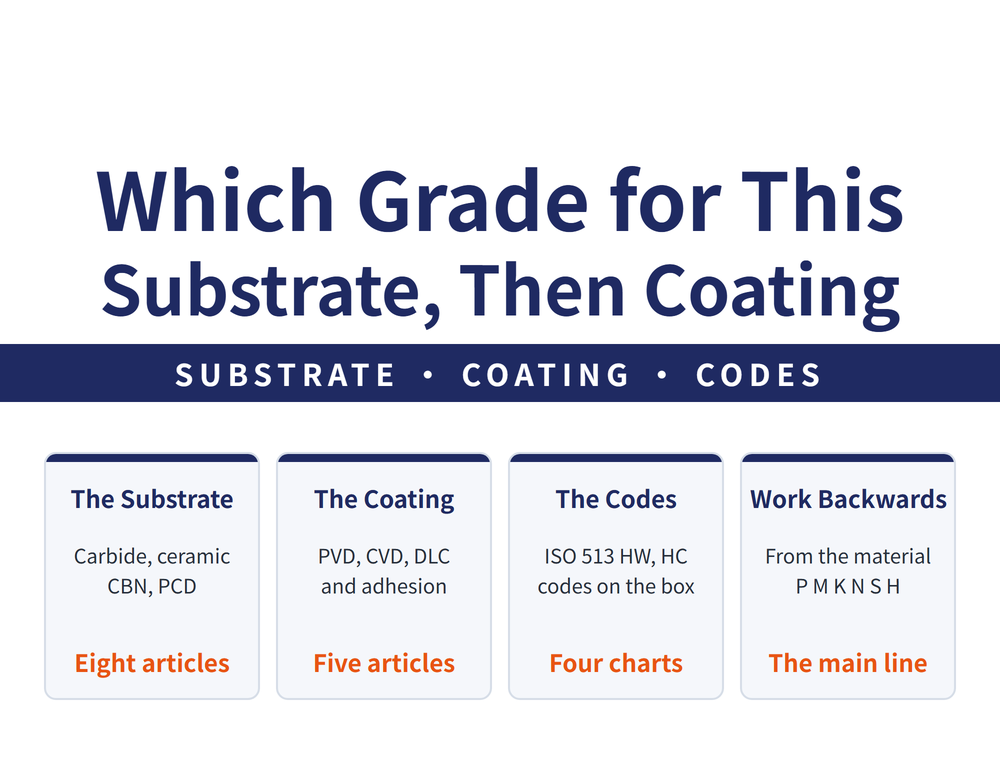
1. Three Separate Things: Substrate, Coating, Code
These get talked about together but they decide different things. Confuse them and no amount of catalogue reading will get you to a tool:
| What it is | What it decides | Section |
|---|---|---|
| Substrate (the body) | Whether it chips, how much shock it takes, how hard it can go | Section 2 (8 articles) |
| Coating (the outer layer) | Wear resistance, heat resistance, whether material sticks to it | Section 3 (5 articles) |
| Code | Nothing - it is only a standard shorthand for the two above | Section 4 (4 articles) |
The third row is worth pausing on: a code is not a specification, it is an abbreviation of one. Within the same ISO application group, actual formulations differ a lot between makers - the code narrows the field, it does not make the final choice for you.
2. Substrate: What the Body Is Made Of
From high-speed steel to PCD, substrates sit on a spectrum where harder means less tough. Where you land depends on whether you can afford for it to chip.
| Article | When to read it |
|---|---|
| Cutting Tool Materials Guide | The entry point. All five substrate families compared on one chart |
| Carbide Grades Decoded | The most-used substrate. Why the same cobalt content gives different toughness |
| HSS Grades Decoded | When you see SKH, M2 or powder-metallurgy HSS and want the difference |
| Carbide vs HSS End Mills | When either would do the job and you have to pick one |
| Ceramic Cutting Tool Guide | Choosing between alumina, SiAlON and whisker-reinforced ceramics |
| CBN and PCBN Tool Guide | Hard turning quenched steel, or machining cast iron |
| PCD and Diamond Coating Guide | Aluminium, non-ferrous metals and composites |
| Cermet Cutting Tool Guide | Finishing steel to a mirror surface |
One criterion gets overlooked when picking a substrate: the question is not which is hardest, but whether your machine and setup can support it. CBN and ceramics need stable conditions - on a machine short of rigidity they chip faster than carbide would.
3. Coating: The Outer Layer
A coating is only a few microns thick, yet it is often the reason tool life differs several-fold. What it cannot do is rescue the wrong substrate - once the body chips, the coating is irrelevant.
| Article | When to read it |
|---|---|
| PVD vs CVD Coatings | Read this first. How the two processes differ and what each suits |
| Common Tool Coatings Explained | When you see TiN, TiAlN or AlCrN and want the difference |
| Reading Coating Structure | Why thicker is not better, and what nano multilayers actually do |
| How to Use DLC Coating | Materials that stick badly, or when considering dry cutting |
| Before the Coating: Edge Preparation | When the same coating lasts very differently on different tools |
The last one is the hidden point of this section: coating failure is often not the coating but the edge underneath it. It is also why a reground tool that is re-coated does not necessarily perform like a new one.
4. Codes and Cross-Reference Charts
These four are lookup articles. You do not read them through - you open them with a catalogue or a quotation in front of you.
| Article | When to read it |
|---|---|
| How to Read Insert Material Codes | Read this first. What ISO 513's HW, HC, CA and DP actually mean |
| Carbide Insert Coating Chart | Mapping a grade to its ISO application group |
| CVD Insert Coating Chart | Finding an alternative CVD insert grade |
| PVD Insert Coating Chart | Finding an alternative PVD insert grade |
One limit to keep in mind: a chart tells you two grades belong to the same application group; it does not tell you they will last the same. Formulation differences between makers remain, so watch the first batch after any grade change.
5. Working Backwards: From Workpiece to Tool
The first three sections answer "what is this tool". In practice the more common question runs the other way: I have to cut this material, which tool do I pick. This section runs it backwards.
| Article | When to read it |
|---|---|
| Choosing Tool Material and Coating by Workpiece | The main table. What each of the six P-M-K-N-S-H groups needs |
| Cutting Tool Material Classification | Seeing P-M-K-N-S-H from the tool side rather than the material side |
| Choosing Tool Material by Tool Type | What end mills, drills, taps and reamers each want |
| Choosing Tool Materials for Dry Cutting | Taking the coolant away. Five requirements against seven materials |
| Tool Geometry for Dry Cutting | Once dry cutting is decided and the geometry has to be chosen |
If you are not even sure what the material is yet, start on the other line: Workpiece Materials: The Complete Guide begins with grade cross-references; identify the group there, then come back to this section. The two lines are the two ends of one decision.
6. After It Goes In: Wear and Regrinding
Choosing well is only the start. How a tool fails tells you whether the original choice was right.
| Article | When to read it |
|---|---|
| Ten Tool Wear Types | A tool has failed and you want to know if it was the choice or the use |
| Is Regrinding and Recoating Worth It? | Deciding whether to resharpen, re-coat, or replace |
For wear mechanisms in depth go to the Tool Life and Wear Complete Guide; for how to regrind and with what, the Tool Regrinding Complete Guide. This section only routes you to the right line.
7. Frequently Asked Questions (FAQ)
Q: Where should I start in these 24 articles?
It depends on the problem. To pick a tool for a particular material, jump straight to Choosing Tool Material and Coating by Workpiece in section 5 - that is the main table. To understand how the substrates differ first, start with the Cutting Tool Materials Guide in section 2. If you have a catalogue or quotation and the codes mean nothing, section 4. If a tool has failed and you want the reason, section 6. This line is deliberately not meant to be read front to back.
Q: If the coating is good enough, can I ignore the substrate?
No - they govern different failure modes. The coating handles surface wear and heat; the substrate handles whether the tool survives the force and the shock. Chipping in interrupted cuts, or a long-overhang holder snapping, are substrate and rigidity problems that no coating fixes. Conversely, rapid flank wear in a continuous cut, or material welding to the edge, is exactly what a coating is for. Work out which failure you actually have before deciding which side to change.
Q: Two grades sit in the same group on the chart. Can I swap them directly?
Treat them as candidates, not equivalents. An ISO application group says "this grade suits this kind of cutting", not that the formulations match - grain size, cobalt content, coating layers and thickness can all differ between makers within one group, so tool life and workable cutting data differ too. The practical approach is to use the chart to narrow it to two or three candidates, then watch the wear pattern on the first batch after switching, and only scale up once no new failure mode has appeared.
Q: How is this line different from the workpiece material category?
They run in opposite directions but meet at the same decision. This line starts from what the tool is made of and asks what it suits; the workpiece material category starts from what the part is and asks which tool to use. Picking a cutter needs both: identify the P-M-K-N-S-H group on the material line, then come to section 5 here to map it to a substrate and coating. The suggested order is material first, tool second - because the material is given and the tool is the part you can change.
Published: 2026-09-09 | Last updated: 2026-09-09









