UNJ Thread Guide: Aerospace Radius Root & SAE AS8879D
UNJ is a Unified thread standard designed for aerospace and high-strength use. Its defining feature is a radiused root that greatly reduces stress concentration and raises fatigue strength. With a 60° form and compliance to SAE AS8879D, it is widely used in aviation, defense and precision machinery. Compared with standard UN threads, UNJ offers clear advantages in crack resistance and durability for high-load, safety-critical applications.
1. What UNJ Is
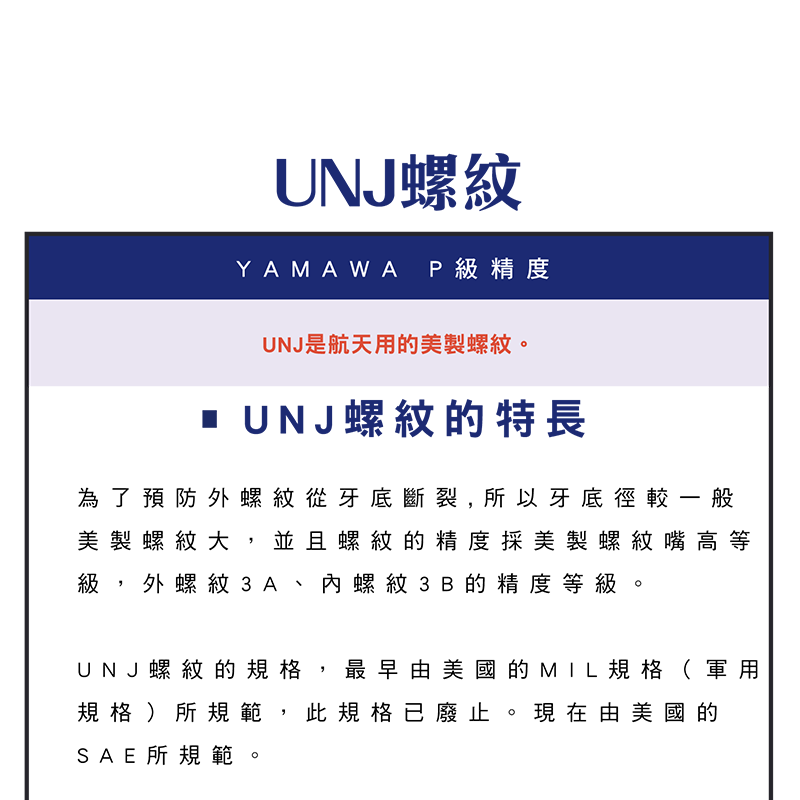
UNJ (Unified National Aerospace thread) is a Unified thread designed for high strength and fatigue life, mainly for aerospace and precision machinery. Key traits: compliance with SAE AS8879D, the same 60° form as UN, and a radiused root (Radius Root) that improves fatigue and crack resistance — safer and more durable than standard threads.
2. Design Features
| Item | Design |
|---|---|
| Thread angle | 60° (same as UN) |
| Root | Radiused transition, reduces stress concentration |
| Crest | Flat crest |
| Environment | High cyclic load, vibration and stress |
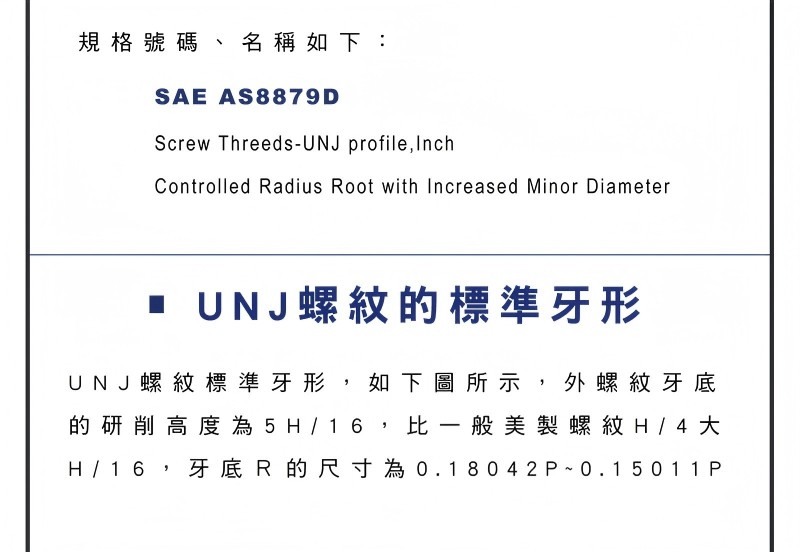
The key difference is the root design, not the thread angle; the radiused root effectively lowers crack initiation.
3. UNJ Standard Geometry
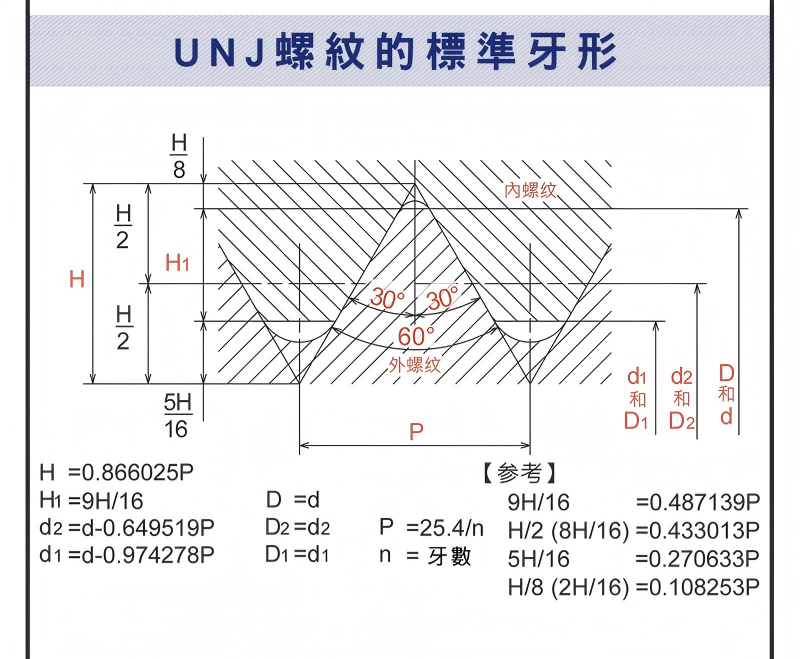
| Parameter | Relation |
|---|---|
| Pitch | P (base unit) |
| Fundamental height H | about 0.866025 × P |
| Working height H1 | about 5/8 × H |
| Root radius | Key strength source; spreads tensile and shear stress |
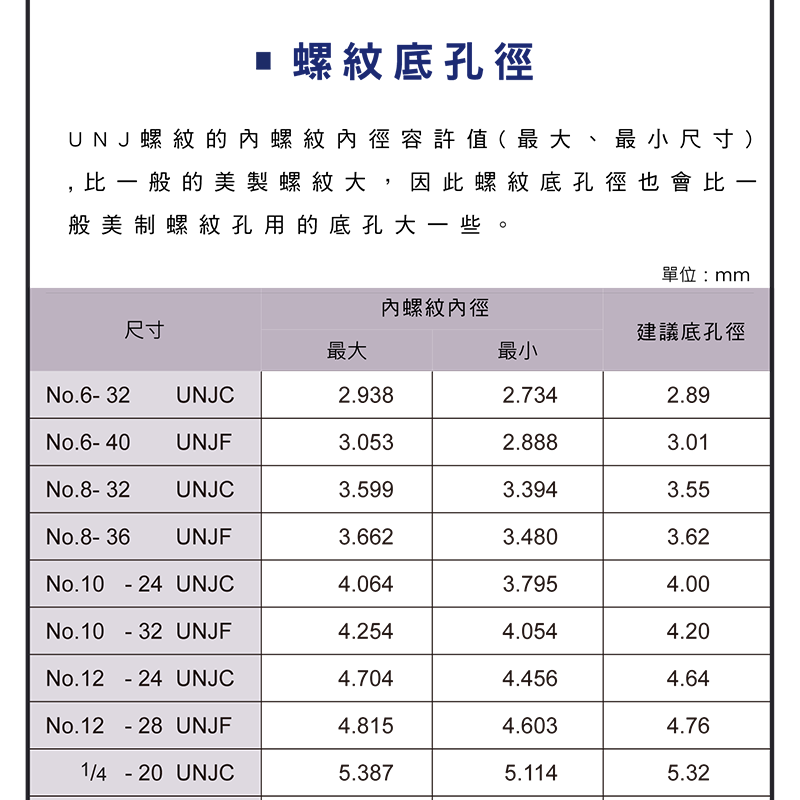
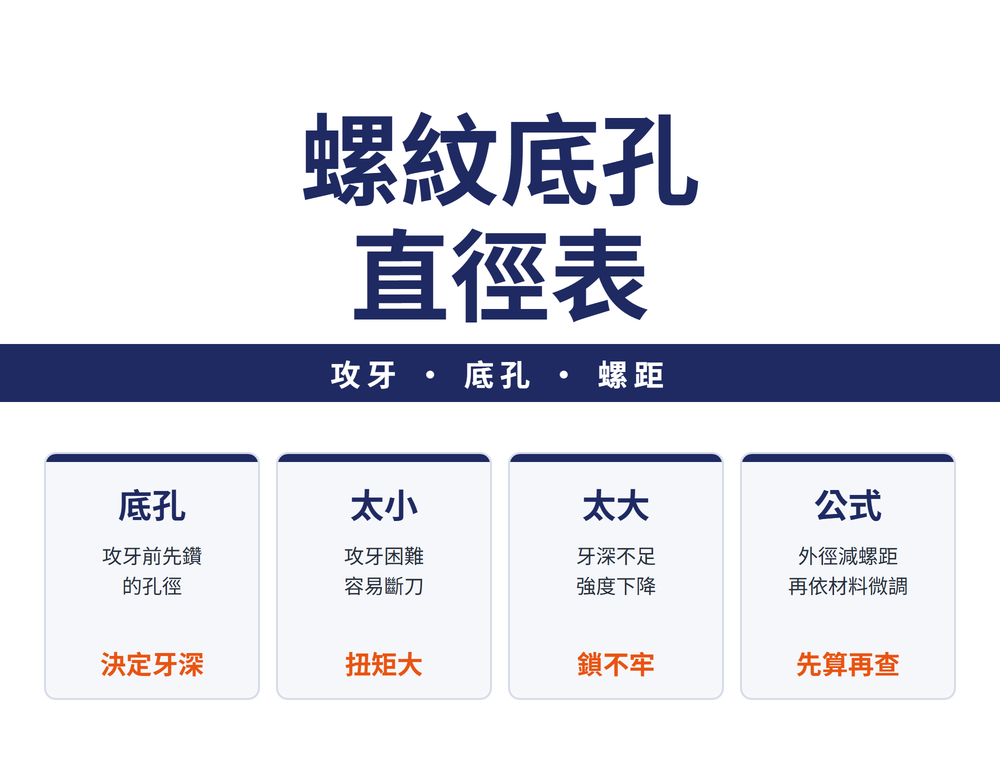
4. UNJ Pilot-Hole Sizes (Reference)
Too small → high tapping resistance and fast wear; too large → shallow thread and lower strength. Common specs (reference):
| Size | Suggested drill (reference) |
|---|---|
| No.6-32 UNJC | about 2.89 mm |
| No.8-32 UNJC | about 3.55 mm |
| 1/4-20 UNJC | about 5.32 mm (verify actual tolerance against the UNJ spec and gauges) |
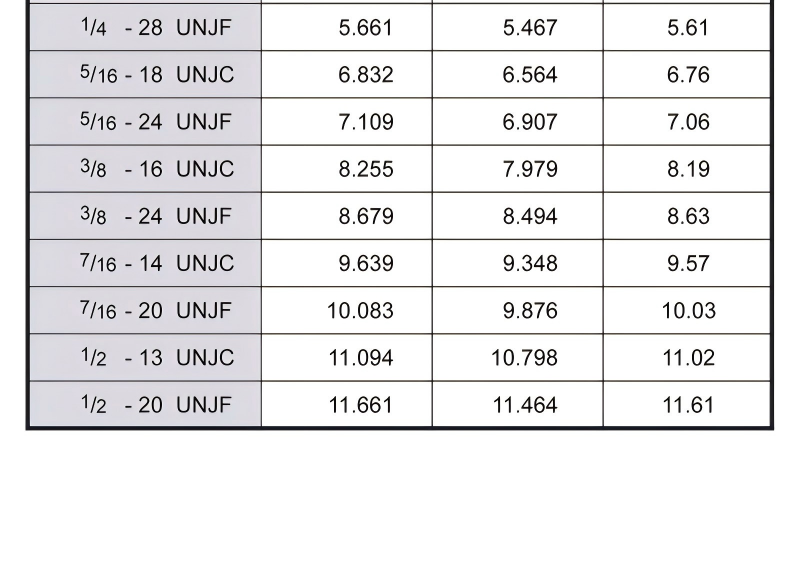
※ Drill sizes are reference values taken from the YAMAWA general catalog (Chinese edition), the same table as the maker figure above; the same sizes in that maker's English catalog are slightly smaller (2.85/3.50/5.30 mm), while the internal-thread minor diameters are identical in both. UNJ's radiused root is an external-thread feature; the internal thread can generally use a standard UN tap (with a larger pilot hole). Follow SAE AS8879D and the maker catalog for exact tolerance and gauging.
5. Applications and Notes
UNJ is widely used in aviation, defense and precision machinery under high load and strict safety. The radiused root is a feature of the UNJ external thread (bolt/screw). The UNJ internal thread has the same form as UN, so a standard UN tap can generally be used for the internal thread; the key is a larger pilot hole (minor diameter) than a standard UN. Whether to use a dedicated UNJ tap depends on tolerance and QA requirements; gauge per SAE AS8879D with UNJ gauges to ensure fatigue strength and interchangeability.
For forms see the Standard Thread Form Guide; for codes see the Thread Designation Chart; for US tolerance see the Unified Thread Tolerance Chart; for pilot holes see the Unified Tap Drill Chart.
FAQ
Q: How does UNJ differ from UN?
Both have a 60° form; the key difference is the root: the UNJ external thread uses a larger radius (Radius Root) to cut stress concentration and boost fatigue and crack resistance. This radius is an external-thread feature; the UNJ internal thread has the same form as UN and can generally be tapped with a standard UN tap (with a larger pilot hole).
Q: Must UNJ use a dedicated tap?
Not necessarily. The radiused root is a feature of the UNJ external thread. The UNJ internal thread has the same form as UN, so a standard UN tap can usually be used, with a larger pilot hole (minor diameter), then gauged to SAE AS8879D with UNJ gauges. Whether a dedicated UNJ tap is used depends on tolerance and QA needs, not on the thread form itself.
Q: Why does aerospace use UNJ?
Aerospace parts see high cyclic load and vibration, and the root is where cracks start. UNJ's radiused root spreads stress and raises fatigue life and safety margin, making it the standard choice in aviation and defense.
Q: Is the UNJ pilot hole the same as UN?
Close, but follow the UNJ spec. Because the root radius and tolerance differ, use the UNJ-specific spec and gauge; the figures here are reference — verify against SAE AS8879D and maker data.
For the full reading guide on this topic, see Thread Machining: A Complete Reading Guide.
Published: 2026-03-23 | Last updated: 2026-07-24