
Unified Tap Drill Chart: UNC/UNF/UNEF Engagement
The Unified (US) tap-drill chart (UNC, UNF, UNEF, UN) covers No.0 to 2 inches, giving internal minor diameter (D1) max/min and the recommended tap-drill size. For CNC tapping, machining and precision parts, it helps pick the right pilot-hole size quickly, avoiding tap breakage and weak threads — a key reference on the shop floor and in design.
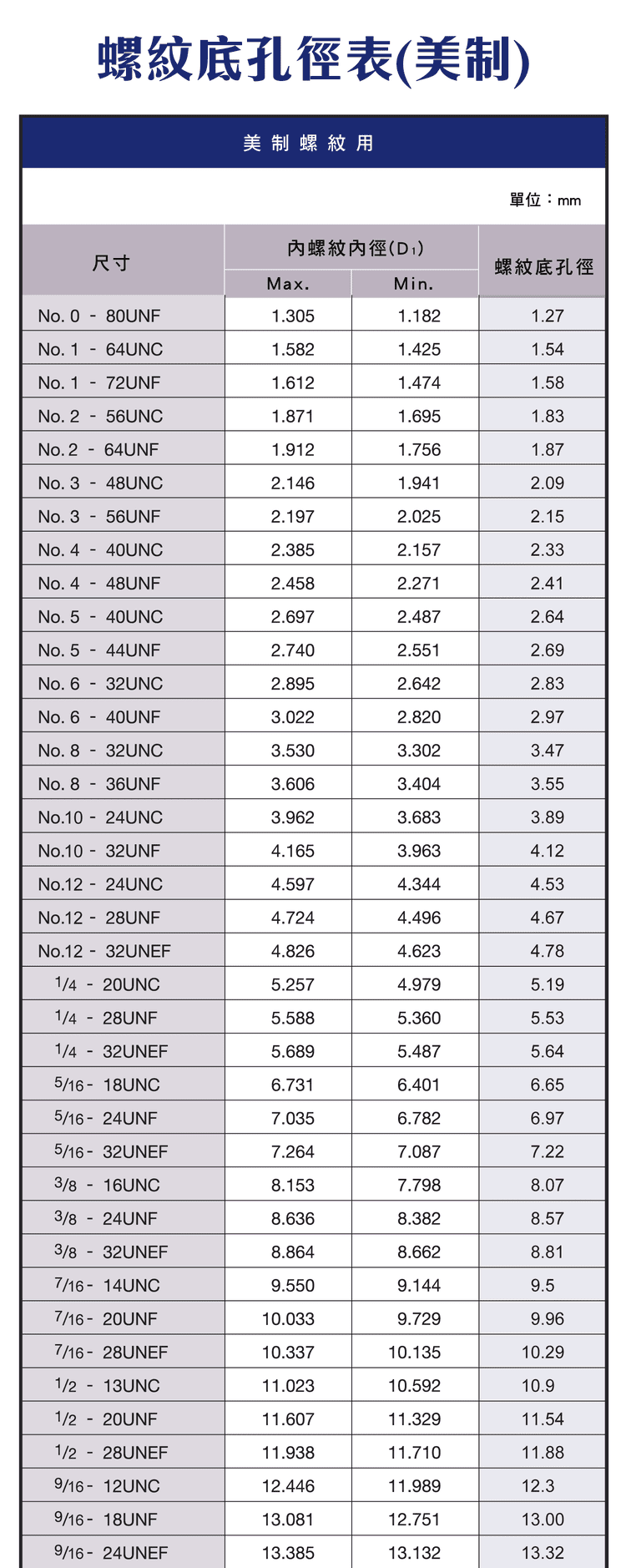
1. Minor Diameter (D1) and the Pilot Hole
The internal minor diameter (D1) is the smallest diameter after tapping, with a Max and Min value used to judge fit accuracy and control tolerance. The tap-drill size is close to the minor diameter and sets tapping difficulty and thread strength.
2. Common UNC Tap Drills
| Size | TPI | Tap drill |
|---|---|---|
| 1/4-20 | 20 | #7 (~5.1mm) |
| 5/16-18 | 18 | F (~6.5mm) |
| 3/8-16 | 16 | 5/16" (~7.9mm) |
| 1/2-13 | 13 | 27/64" (~10.7mm) |
※ Common UNC examples; full UNC/UNF/UNEF (No.0–2") and minor Max/Min per the original tables below.
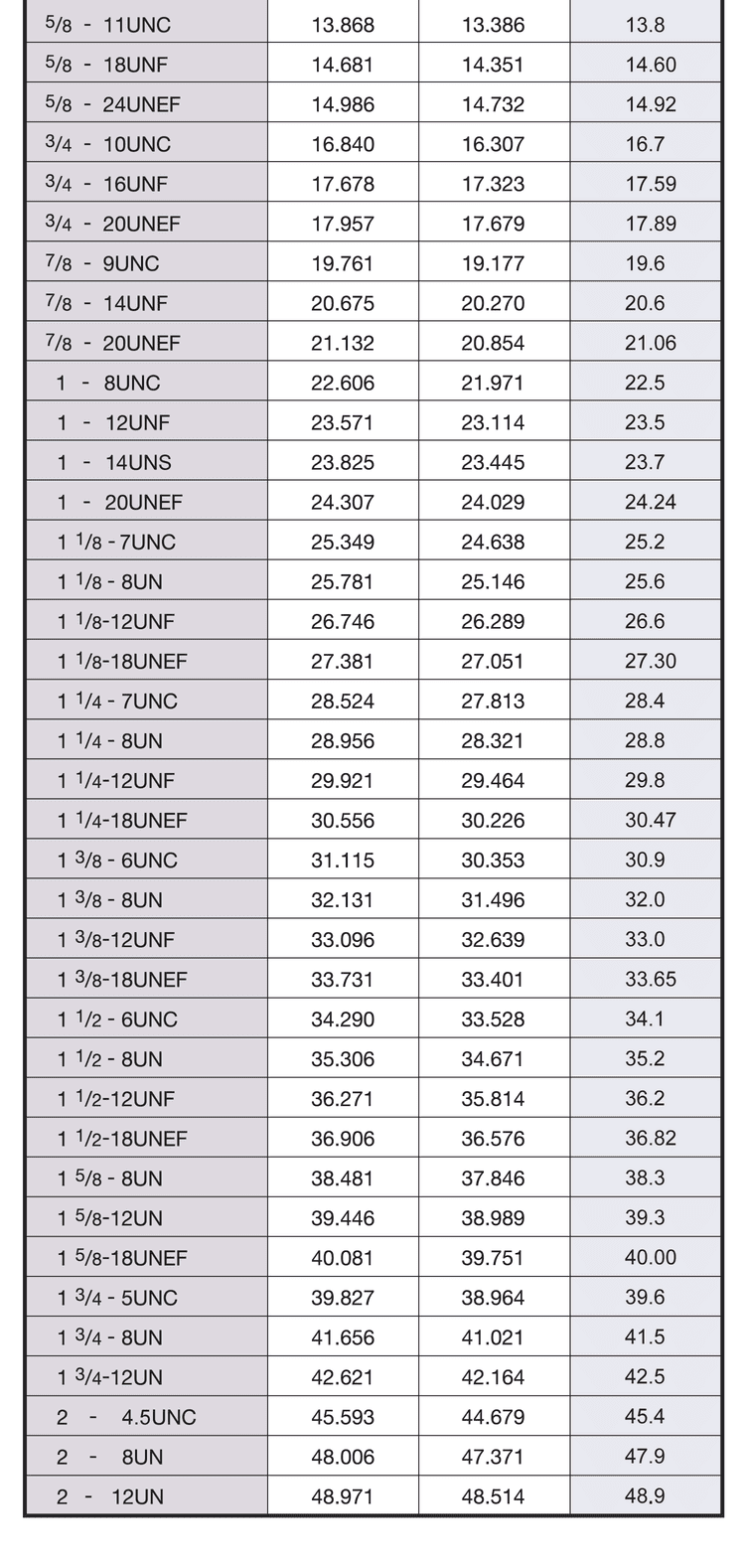
※ Full UNC/UNF/UNEF tap-drill charts above; values per the original tables.
3. Selection Principle (Engagement)
| Hole choice | Result |
|---|---|
| Smaller hole | Higher strength and engagement, but high torque and breakage risk |
| Larger hole | Smoother tapping, lower torque, but weaker thread |
| Recommended | About 60–75% engagement, balancing strength and stability |
4. UNC / UNF / UNEF Differences
| Series | Traits and hole |
|---|---|
| UNC (coarse) | Larger pitch, vibration-resistant, easier to machine; general structural parts |
| UNF (fine) | Finer pitch, high precision, usually a larger hole; precision assembly |
| UNEF (extra fine) | Very fine, high-strength locking; aerospace and precision equipment |
5. Common Problems and Fixes
| Problem | Cause | Fix |
|---|---|---|
| Tap breakage | Hole too small, poor evacuation | Enlarge hole, use cutting fluid |
| Loose thread | Hole too large | Reduce hole, use fine thread |
| Rough surface | Tool wear | Replace tap, optimize cutting conditions |
For US tolerance see the Unified Thread Tolerance Chart; for pitch/TPI see the Thread Size Chart; for metric and special pilot holes see the Metric Tap Drill Chart and Special Thread Tap Drill Chart.
FAQ
Q: What does 60–75% engagement mean?
Engagement is the proportion of thread depth actually in contact. About 60–75% balances strength and machinability: too high (hole too small) raises torque and breakage; too low (hole too large) weakens the thread. The tap drill is back-calculated from the target engagement.
Q: Same hole for UNC and UNF?
No. At the same major diameter, UNF (fine) has a smaller pitch and shallower thread, so the hole is usually larger than UNC (coarse). Confirm UNC/UNF/UNEF and TPI before choosing the hole.
Q: Which drill for 1/4-20 UNC?
Commonly #7 (~5.1mm). Adjust for material and target engagement — steel standard, stainless slightly larger, aluminium slightly smaller.
Q: What most often breaks a tap?
Usually a too-small hole plus poor chip evacuation. Enlarge to a suitable engagement, add cutting fluid, pick the right tap (spiral-point for through, spiral-flute for blind), and manage chip removal.
For the full reading guides on this topic, see Thread Machining: A Complete Reading Guide and Hole Accuracy: A Complete Reading Guide.
Published: 2026-03-24 | Last updated: 2026-07-25









