
Hole Accuracy: A Complete Reading Guide
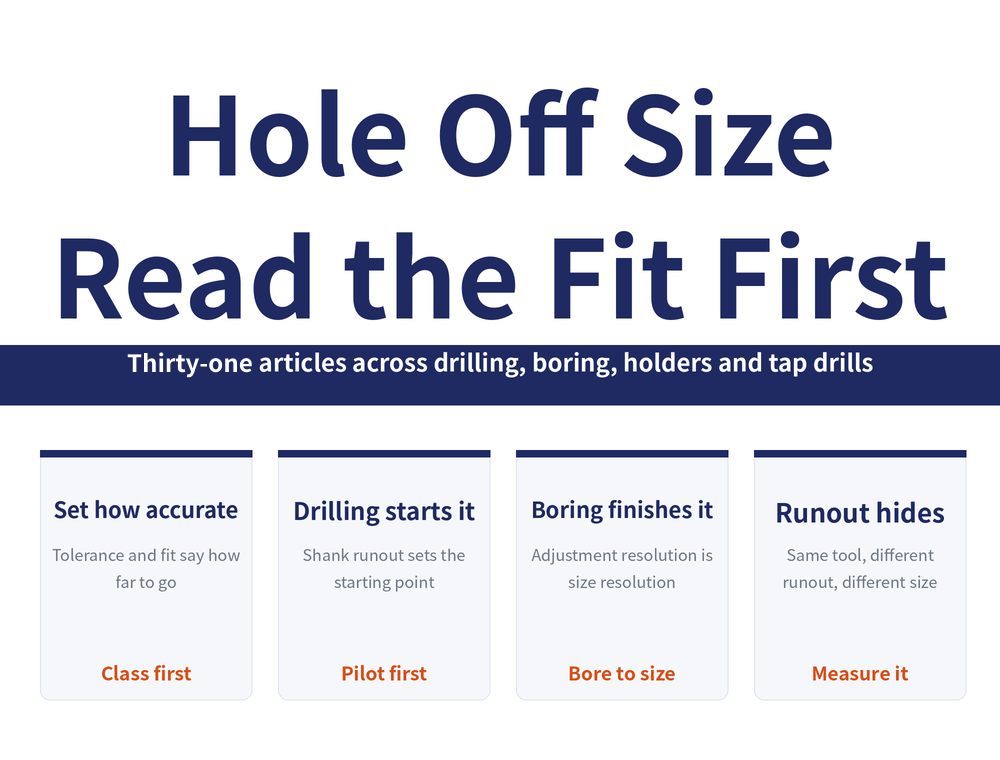
Making a hole accurate touches drilling, boring, holder runout and tap-drill size, and this site has 31 articles on it. This page is a reading guide. It does not repeat what those articles say; it answers one question: where is your hole off, and which article should you open first.
1. Start With Tolerance: The Language Accuracy Is Written In
State how accurate with tolerance and fit first, and only then is the target step clear.
| Article | When to open it |
|---|---|
| How to Improve Hole Accuracy | The main entry point: the drill-ream-bore path to accuracy |
| Tolerance and Fit Guide | How accurate is accurate enough? Start from the fit class |
| Hole Tolerance Chart | The chart to open when you need the tolerance value for a diameter |
| Geometric Tolerance Symbols Chart | How to read geometric tolerance symbols on a drawing |
2. Getting the Hole Right by Drilling
Drilling is the first step of a hole; shank runout and piloting decide whether it starts true.
| Article | When to open it |
|---|---|
| Drilling Troubleshooting Guide | Start here when the hole runs oversize or off-line |
| Straight-Shank Drill and Runout | Shank runout amplifies straight into hole-size error |
| Flat Drill Applications | For roundness and position, a flat drill often pilots first |
| Flat Drill Guide | For flat and inclined bottoms, read the flat drill first |
3. Deep Holes and High-Accuracy Holes
For deep and high-accuracy holes, choosing the method beats tuning the parameters.
| Article | When to open it |
|---|---|
| Deep-Hole Drilling Methods Overview | In deep holes, the method matters more than the parameters |
| Gun Drilling Guide | A gun drill holds straightness and size with its guide pads |
| 3-Flute Drill Guide | Three flutes give steadier roundness and size |
| Boring Basics and Methods | Getting a hole to its most accurate almost always means boring |
4. Boring: The Workhorse for Finishing a Hole
Getting a hole to its most accurate almost always means boring; the adjustment resolution is your size resolution.
| Article | When to open it |
|---|---|
| Fine Boring and Overhang | Fine-bore adjustment and the overhang rules decide it |
| Boring Bar and Head Selection | The head adjustment resolution is your hole-size resolution |
| Boring Bar Guide | Bar selection is the hardware base of hole accuracy |
| Rough Boring Tool Selection: Edges, Rake and Entering Angle | Roughing leaves an even allowance for finishing: edges, rake and entering angle |
| Choosing a Boring Cycle: How G76 and G85-G89 Differ | Cycles differ in whether the tip touches the finished bore wall on the way out |
| Boring on the Lathe: Setting Tool Angles and Why the Bore Grows or Shrinks | Bore grows or shrinks as it goes deeper: check the cutting edge angle first |
| Boring Troubleshooting: Vibration, Chips, Feed Marks and Power | Vibration, chips, feed marks and limited power, table by table |
| Boring Chip Control and Coolant: Internal Coolant, Chip Shape and Speed Limits | Blind and deep holes are hard to clear: internal coolant first, comma or spiral chips |
5. Runout and Clamping: The Hidden Variables
The same tool at different runout and clamping gives a different hole size. This is the most overlooked variable.
| Article | When to open it |
|---|---|
| Tool Runout (TIR) | Runout is the number-one hidden source of hole-size error |
| Collet System Comparison | The clamping method sets the floor on runout |
| ER Collet Spec and Torque | Wrong tightening torque and even a good collet runs out |
| Drilling Tool Holder Selection | Accurate drilling starts by cutting holder runout down |
| Tapping Tool Holder Selection | Synchronous and floating chucks affect hole-thread concentricity |
| Milling Tool Holder Selection | Milled-hole and interpolated accuracy also come back to the holder |
6. Tap Drill Size: Fixing the Hole Before Tapping
Fix the tap-drill size before tapping; half of a thread accuracy is set at the drilling step.
| Article | When to open it |
|---|---|
| Metric Tap Drill Size Chart | The metric tap-drill size to check before tapping |
| Unified Tap Drill Chart | Tap-drill and thread engagement for UNC and UNF |
| Special Thread Tap Drill Chart | STI, pipe and BSW tap-drill sizes here |
| Form Tap Drill Size Chart | Form-tap holes differ from cutting taps; do not reuse the wrong chart |
| Internal Thread Oversize Causes | If the thread gauges oversize, check the hole and runout together |
7. Frequently Asked Questions (FAQ)
Q: Does an H7 hole always need reaming or boring?
It depends on diameter and volume. Usually you drill with stock left, then ream or bore to size; How to Improve Hole Accuracy lays out the drill-ream-bore paths.
Q: Why does the hole keep coming out oversize?
Most often tool runout (TIR) and clamping. Measure runout, check the collet and tightening torque, then look at conditions. See Section 5.
Q: The tapped thread gauges oversize, is it the tap?
Not necessarily. Check the tap-drill size and runout first; an oversize or off-centre hole makes the thread gauge large. See Internal Thread Oversize Causes.
Q: How do drilling and boring differ on accuracy?
Drilling sets where the hole starts; boring brings size, roundness and position into tolerance. For the tightest results you almost always bore.
Published: 2026-08-11 | Last updated: 2026-10-23









