
Do You Need an End Mill With Back Taper: When It Pays and When It Is Wasted Money
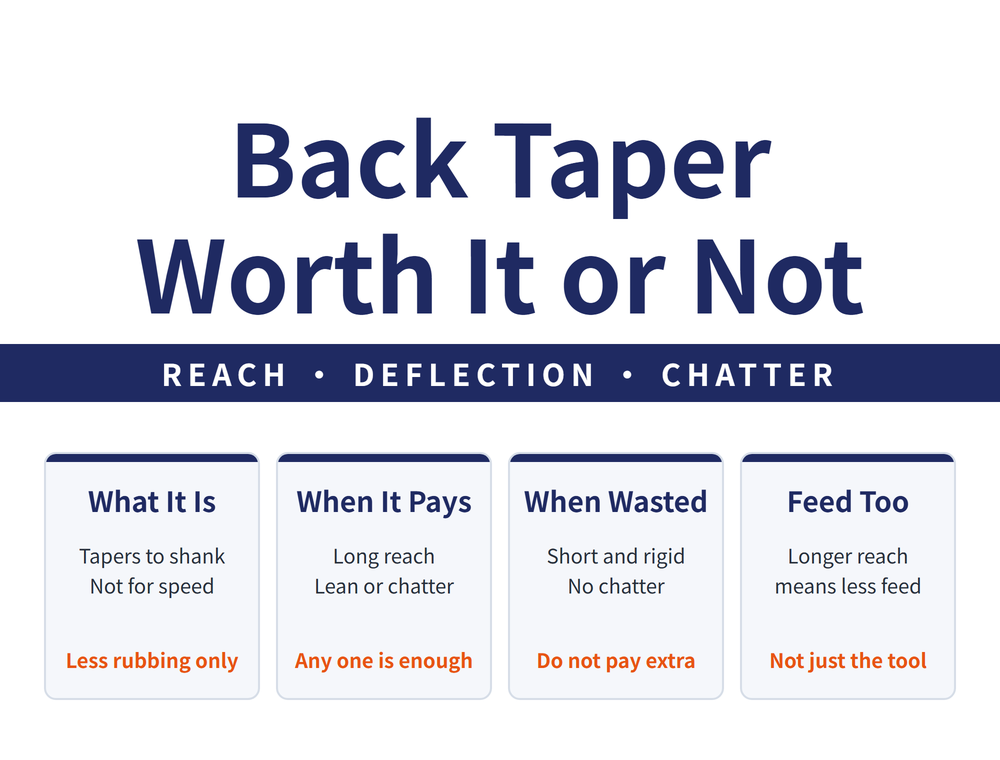
Back taper is a very slight reduction in diameter as the peripheral edge runs toward the shank. It usually sits in a single column of a spec sheet, which makes it easy to assume that having it is simply better. It solves exactly one problem: keeping the body of the cutter off the wall you have just machined. When the tool is short, rigid and stable, that problem does not exist and back taper is money you did not need to spend. When the tool reaches far, deflects, or chatters, it starts to earn its keep.
1. The short answer: one of three conditions is enough
Back taper is not a performance feature. It is an avoidance feature. It minimises the contact area between the cutter body and the finished wall, so it only has value where that contact causes trouble.
| Your situation | Is back taper worth it |
|---|---|
| Short reach, rigid setup, stable cut | No. The contact problem does not exist, so you are paying for a feature you never use |
| Radial cutting force visibly deflects the tool | Yes |
| Long overhang (deep pockets, deep cavities, long holders) | Yes |
| The cut chatters | Yes |
Any one of the three is enough; you do not need all of them. Equally, if none of them applies, do not pay for it.
2. What back taper actually is
Stand the end mill up and look along it. The peripheral cutting edge loses a very small amount of diameter as it runs from the tip toward the shank. That slight narrowing is back taper. The amount is small enough that you will not reliably see it by eye, which is why it normally lives only in one column of the spec sheet.
One thing worth separating: back taper and corner form are unrelated choices. Whether the corner is sharp, radiused or chamfered belongs to a different classification, and back taper combines freely with any of them. A corner radius (bull nose) end mill may have back taper, or it may not.
3. Why rubbing the wall is a problem
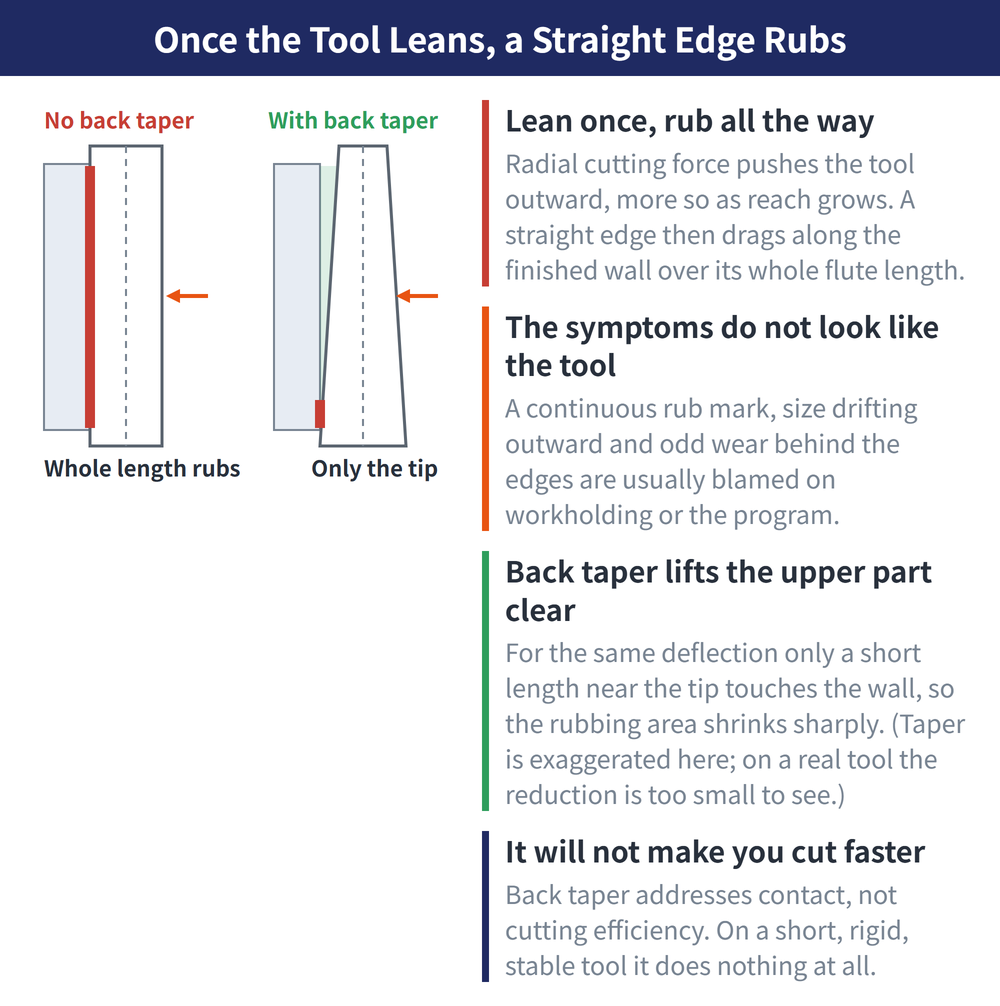
When you mill a wall, the tool is never perfectly upright. Radial cutting force pushes it outward slightly, and the longer the overhang the more obvious that becomes. Once the tool leans, a straight peripheral edge with no back taper drags along the wall you have just finished, over its whole flute length.
What you see is a continuous rub mark on the wall, size drifting outward, and unusual wear on the back of the cutting edges. None of those symptoms look like a tool problem, so they are often blamed on workholding or on the program. With back taper, the same amount of deflection only brings a short length near the tip into contact, and the rubbing area shrinks sharply.
4. Longer reach changes more than the tool
If long overhang is your reason for wanting back taper, there is a second thing to deal with: as reach grows, feed per tooth has to come down. Changing the tool but keeping the parameters puts the risk straight back.
One manufacturer publishes this as a two-step factor (per the ISCAR die and mould machining guide): up to three times the tool diameter of overhang, feed per tooth is not reduced; beyond three diameters, multiply it by 0.7. There is no further subdivision after that, so four diameters and ten diameters share the same 0.7.
🔴 That pair of numbers has a defined scope. It is one manufacturer's rule for its own exchangeable cutting heads, and it cannot be transferred to other tool types or brands. What does transfer is the shape of the rule: three diameters is a sensible point to stop and recalculate, and the correction is deliberately coarse and conservative rather than a precision tool. Use the figures published for the cutter actually in your hand.
Two related practical values from the same source: stock allowance for these heads is typically 0.01 to 0.2 times the tool diameter, and when such a head is used for face milling the axial depth of cut equals that allowance.
5. Two more spec columns that mislead people
End concavity: whether the end face dishes slightly inward. No concavity is what we call a flat end mill. This column is again independent of both corner form and back taper.
One statement here is worth keeping in full, because it changes how you read a spec sheet:
Even an end mill described as flat bottomed is made with a small concavity; a peripheral edge described as straight often carries a slight taper; and a sharp corner is not truly sharp on close inspection but lightly rounded or chamfered.
In other words, these names are categories, not geometric guarantees. So when a flat end mill leaves a floor that is not perfectly flat, that is usually not a fault in the tool; the small dish was always there. A genuinely flat surface comes from stepover and a finishing pass, not from tool selection alone.
6. Why small diameters have almost no round inserts
If you want a round insert cutter for small parts or small corner radii, you will find few options. The reason is not reluctance on the supplier side. There is a physical floor.
As the diameter of a round insert cutter shrinks, the screw holding the insert has to shrink with it. The tool becomes weaker and less productive, and below a certain point it can no longer practically be manufactured. Shrinking the insert radius does the same thing.
So the answer at small diameters is a change of construction, not a change of brand: solid carbide tools and exchangeable heads produce the same cutting profile and push that boundary outward. When a customer asks why small diameters mean solid or exchangeable heads, the answer is that the screw no longer fits, not that one is simply better.
Speed conversion is covered separately in 〔Effective Diameter for Ball Nose and Bull Nose Tools〕; roughing selection in 〔Which Cutter for High-Speed Roughing: Why the Round-Insert (Bull-Nose) Wins〕; the full picture of tool shapes in 〔End Mill Types and Features Explained〕.
7. FAQ
Q: How do I tell whether the tool in my hand has back taper?
Check the manufacturer spec sheet, which normally states the amount. It is hard to judge by eye because the reduction is small; measuring the diameter difference between the front and rear of the peripheral edge also works, but needs suitably accurate instruments. If the spec sheet does not state it, assume there is none rather than guessing from appearance.
Q: Is more back taper always better?
No. Back taper addresses body contact with the wall, not cutting efficiency. Increasing it will not make the tool cut faster, and it shortens the length of edge that can support the cut. On a short rigid tool it does nothing at all, so choosing it there is simply spending more.
Q: I have chatter. Will a tool with back taper fix it?
It will reduce the damage, but it treats the symptom. Back taper limits how much the tool rubs once it has deflected; the root cause of the vibration is still there. Start with rigidity, overhang and clamping, covered in 〔What Is Milling Chatter: Causes, Diagnosis and Suppression〕 and 〔Anti-Vibration Tool Holders: Chatter, Dynamic Vibration Absorbers & Setup〕.
Q: For tools with a larger corner radius, does feed need correcting again?
Chip thinning only needs considering once the corner radius is relatively large. One manufacturer gives a rule of thumb of 3 mm and above as large, with 2 mm as the boundary for an 8 mm diameter head; below that range the effect is not significant. The principle and the compensation calculation are in 〔What Is Chip Thinning: Principles and Feed-per-Tooth Compensation〕.
The overhang factor and corner radius thresholds quoted here are one manufacturer's rules for its own exchangeable heads and do not apply to every tool type or brand; select tools and set parameters against the data published for the cutter you are using.
Last updated: 2026-09-14









