
Effective Diameter for Ball Nose and Bull Nose Tools
The very tip of a ball nose end mill (a solid end mill with a hemispherical tip) runs at zero surface speed; the real cutting happens on a circle somewhere up the flank. At a shallow axial depth of cut, feeding the nominal tool diameter straight into the spindle speed formula gives a speed that is clearly too low, which leaves the actual cutting speed short and shows up as a poor surface and abnormal tool wear. This guide covers how to calculate the effective diameter Deff, how much it matters, and how to apply it in practice.
1. Why Nominal Diameter Gets Ball Nose Speeds Wrong
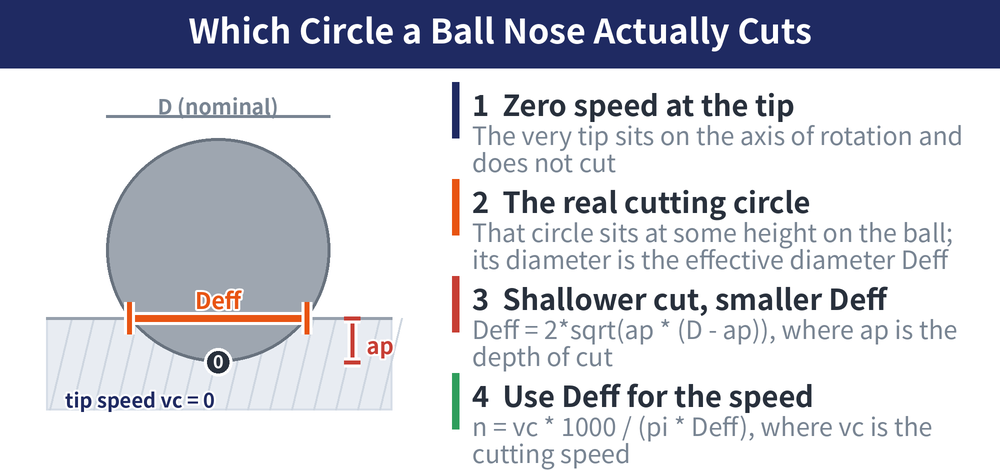
The tip of a ball nose tool sits on the axis of rotation, so its surface speed is zero. What actually cuts is the circle at whatever height the tool engages, and when ap (axial depth of cut, how deep the tool steps down each pass) is shallow, that circle is far smaller than the nominal diameter D.
Putting D straight into n = vc × 1000 ÷ (π × D) assumes the full outside diameter is cutting, so the calculated speed comes out clearly too low. The vc (cutting speed, the surface speed of the edge relative to the workpiece) then falls short of the intended value.
| Approach | Diameter used | Consequence |
|---|---|---|
| Nominal diameter used directly | D (outside diameter of the tool) | Spindle speed too low, so the real cutting speed never reaches the target |
| Effective diameter used | Deff (effective diameter, the diameter of the circle actually in contact) | Spindle speed matches the cutting speed the catalogue assumes |
| What a short cutting speed looks like | — | Rough surface, visible tool marks, abnormal edge wear and a tendency to built-up edge |
This is not a tool problem; it is the wrong diameter in the formula. For the full set of cutting condition conversions, see the End Mill Cutting Conditions Guide.
2. How to Calculate the Effective Diameter Deff
Deff is simply the diameter of the circle the pass really cuts on. For a ball nose tool it depends on where the axial depth lands on the sphere; for a bull nose end mill (corner radius end mill, whose tip carries a corner radius r) it depends on whether the depth exceeds that corner radius.
| What to calculate | Formula | Notes |
|---|---|---|
| Ball nose effective diameter (ap less than D/2) | Deff = 2 × √(ap × (D − ap)) | D is the nominal tool diameter; the shallower the depth, the smaller Deff |
| Ball nose effective diameter (ap of D/2 or more) | Deff = D | The largest circle of the sphere is already engaged, so the nominal diameter applies |
| Bull nose effective diameter (ap less than r) | Deff = 2 × √(ap × (2r − ap)) + (D − 2r) | r is the corner radius; beyond the radius the edge is still on diameter D |
| Spindle speed from Deff | n = vc × 1000 ÷ (π × Deff) | n is spindle speed in rpm; the formula is the usual one, with Deff replacing D |
The formulas are the industry-standard forms; take vc from the tool catalogue or a calculation tool rather than from memory.
In one line: get Deff from ap first, then substitute Deff for D to get n. The nominal diameter only equals the effective diameter once the depth of cut reaches the largest circle.
For a collected set of common machining formulas, see the Machining Formulas Cheat Sheet.
3. How Much Difference Does It Make
The size of the gap is set entirely by the axial depth of cut. The shallower ap is, the further Deff falls below D, and the higher the required spindle speed climbs.
Shallow finishing passes on curved surfaces show it most clearly; in deep roughing passes the gap has usually closed to the point where it can be ignored.
| Depth of cut situation | Deff relative to D | How to adjust the speed |
|---|---|---|
| Very shallow depth (surface finishing, rest machining) | Far below D | Raise it clearly; this is where the gap is largest |
| Medium depth (semi-finishing) | Below D, but the gap is closing | Still raise it, by less than in a shallow pass |
| Ball nose with ap at or beyond D/2 | Equal to D | No correction needed; use the nominal diameter |
| Bull nose with ap beyond the corner radius r | Equal to D | The whole radius is engaged and the peripheral edge is cutting |
| Tilted tool or a shifting 5-axis contact point | Depends on the contact point, not on ap alone | Take the contact diameter from CAM or the tool maker's calculation tool |
The table is a qualitative comparison and implies no particular ratio; work from the tool catalogue or a calculation tool — not measurements taken by this site.
Whether the cutting speed lands in the recommended band shows directly in the surface, as covered in Cutting Conditions vs Surface Finish.
4. Applying It in Practice
The order is fixed: pin down the ap for that operation, calculate Deff, and only then work out the spindle speed. Feed is a separate correction driven by chip thinning.
| Step | What to do | Watch out for |
|---|---|---|
| 1 | Establish the actual ap for that operation | The same tool has different ap values in roughing and finishing, so Deff differs and must be worked out separately |
| 2 | Apply the formula for the tool geometry to get Deff | A ball nose depends on ap against D/2, a bull nose on ap against r |
| 3 | Use Deff to calculate the spindle speed n | n = vc × 1000 ÷ (π × Deff); the result can be well above what D would have given |
| 4 | Correct the feed per tooth separately for chip thinning | Effective diameter fixes the speed only; feed is its own track, covered in Chip Thinning and Feed Compensation |
| 5 | Re-check the contact point for 5-axis work or a tilted tool | Tilting moves the contact to another height on the sphere, so Deff changes; follow CAM or the tool maker's calculation tool |
| 6 | Always take vc from the tool catalogue | It depends on the tool substrate, coating and workpiece material, so it should never be applied from memory |
The formulas are the industry-standard forms; take vc from the tool catalogue or a calculation tool rather than from memory.
Shallow-depth, high-feed roughing follows a different logic of its own — see High-Feed Milling (HFM): Principle, Tools and Applications.
Last updated: 2026-07-27
5. Frequently Asked Questions (FAQ)
Q: Does a ball nose tool always need the effective diameter for spindle speed?
Whenever the axial depth of cut is less than the tool radius, yes, otherwise the real cutting speed falls short. Once the depth reaches or passes the radius, the effective diameter equals the nominal diameter and D can be used directly.
Q: Does the same issue apply to bull nose tools?
It does, but only while the axial depth of cut stays below the corner radius r. Beyond r the peripheral edge is cutting and the effective diameter returns to the nominal diameter.
Q: What if the speed from the effective diameter exceeds the spindle limit?
Run at the highest speed the spindle allows and accept a cutting speed below the recommendation. The alternatives are a smaller tool diameter, or a slightly larger axial depth of cut so that the effective diameter grows.
Q: If the spindle speed changes, does the feed per tooth change too?
Yes. The effective diameter only corrects the speed, while the feed is also affected by chip thinning and needs its own compensation, as set out in Chip Thinning and Feed Compensation.
For the full reading guide on this topic, see Machining Calculation Reading Guide.
This article is part of End Mills: The Complete Guide - Know the Cutter, Choose It, Set the Conditions; Toolpaths Are Another Line; that guide shows how the whole topic fits together.