
How Much Does Hard Turning Actually Save: Twelve Quantified Cases
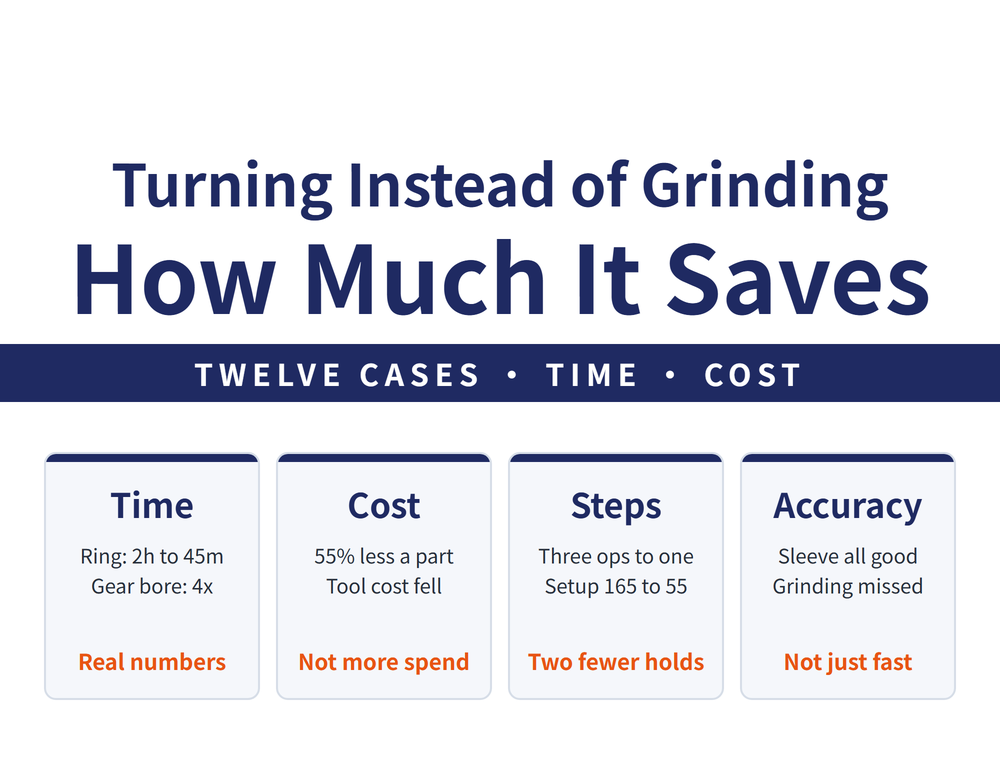
Whether hard turning pays is quickest to grasp from case figures: a bearing inner ring goes from 2 hours of grinding to 45 minutes of hard turning; a thin wall sleeve goes from 28 to 30 hours a piece to five times the throughput, with every form and position tolerance met while grinding had missed two; a gear bore goes from 100 pieces a shift to 400. This article gathers twelve quantified cases and explains one of the main reasons hard turning is still not widespread: the belief that the tooling costs too much, which is a textbook case of counting the wrong thing.
1. Time: The Most Visible Class of Benefit
| Case | Material / hardness | Benefit |
|---|---|---|
| Bearing inner ring φ285mm | GCr15, 60HRC, hard spots near 70HRC | Grinding took 2 hours, hard turning takes 45 minutes |
| Friction disc | 100Cr6, 60 to 62HRC | Machining time down 60% |
| Thin wall sleeve | Cr12MoV, 59 to 62HRC | Grinding took 28 to 30 hours a piece, throughput up 5 times |
| Gear bore | 20CrMnTi, carburised and hardened 60 to 62HRC | Grinding gave 100 a shift, hard turning gives 400 |
| Mill rolls, over ten companies | Chilled cast iron, hardened steel | Efficiency up 2 to 6 times, labour and power down 50% to 80% |
🔑 The thin wall sleeve case carries a point that often gets missed: hard turning met every form and position tolerance on the drawing, while grinding was out of tolerance in two places. So it was not only faster; in that case the accuracy was actually more stable.
2. Cost: More Than Converted Machine Hours
| Case | Cost benefit |
|---|---|
| Powder metallurgy gear blank, PCBN | Machining cost down 40%, cost per piece down 55%, Ra reaching 0.18μm |
| Synchroniser sleeve fork groove, CBN grooving | Machining cost about 32% to 50% of grinding; 200 to 300 parts per insert, and 70% to 80% of new tool life after regrinding |
| Mill rolls at one steel plant | Cutting speed up 3 times, saving over 400 yuan in power and labour and nearly 100 yuan in tooling per roll |
Note the last row: even the tooling spend went down, not up. That breaks the intuition that hard turning is expensive because it needs expensive tools.
3. Operations and Setups: The Ones That Disappear
This class of benefit is the easiest to leave out of the sum, because it never shows up in the cycle time of one piece.
| Case | Before | After switching to hard turning |
|---|---|---|
| Bearing taper face, 62HRC, CBN | 3 operations and 3 setups before finish grinding, 165 min setup, 19 min cutting | 1 operation, 1 setup before finish grinding, 55 min setup, 8 min cutting |
| Slurry pump liners and plates, Cr15Mo3, 63 to 67HRC | Included annealing and rehardening | Annealing and rehardening both removed; around 70% to 80% of the sector has adopted hard turning |
The bearing taper case repays a closer look: setup time fell from 165 minutes to 55, a bigger drop than the cutting time itself. In high mix low volume work, setup and adjustment are usually where the real cost sits.
4. Tool Life: The Gap Can Be Very Large
A diesel engine valve case, with cobalt based hardfacing on the inlet valve and chromium based on the exhaust valve at 50 to 60HRC: carbide inserts wore quickly and performed poorly, and after switching to PCBN,
tool life reached 50 to 100 times that of carbide; at 1600 r/min a single cutting edge machined 500 valves continuously at Ra below 0.4μm.
Conditions in that case: depth of cut 1 to 2mm, feed 0.1mm/r, cutting speed 200m/min.
Another example used cermet to turn 86CrMoV7 at 55 to 63HRC, with vc 60m/min, f 0.2mm/r and ap 0.8mm, giving a continuous cutting path of 15,000m on a single edge.
5. 🔴 If the Benefit Is So Clear, Why Is It Still Not Common
Gathering these numbers raises an obvious question: with benefits this clear, why is hard turning still not widely applied? The resistance comes mainly from three things:
| Reason | Explanation |
|---|---|
| Operators do not know the results | Nobody changes a process whose numbers they have never seen |
| Belief that the tooling costs too much | CBN and PCBN really are expensive per piece, but what they buy back is operations, setups, machine hours and energy |
| Insufficient study of the mechanisms | Too little published guidance for production, so there is no standard to follow when introducing it |
🔑 The second item is counting the wrong thing: looking only at the price of the tool, without asking what share of total cost it is or what it moves. Tooling is a single digit percentage of total machining cost, while the bulk sits in machine hours, labour and facility overhead, which is exactly what the cases above saved. For the full cost structure see [Machining Cost Structure: Tooling Is Only 3%, So Where Is the Real 15%].
As for whether your own machine can do it and how tooling and parameters should be matched, see [Hard Turning Guide: Replacing Grinding at HRC45–65].
6. Frequently Asked Questions (FAQ)
Q: Can these figures be quoted straight to a customer?
Not advisable. They are results for particular materials, hardnesses, equipment and batch sizes, not a general promise. The right use is to show the order of magnitude and the sources of the benefit, then recalculate with the customer's own conditions.
Q: Can hard turning replace grinding completely?
Most of these cases replace the operations ahead of finish grinding, or substitute directly where the accuracy is sufficient. Whether it replaces grinding outright depends on the final accuracy, the surface integrity required and workpiece rigidity, and has to be judged case by case.
Q: The tools cost so much, how do I convince purchasing?
Change the basis from unit price to cost per part. Among these cases one brought machining cost down to about a third of grinding and another saved on tooling as well, and the key in both was counting operations, setups and machine hours in.
Q: Why does one case give better accuracy than grinding?
In the thin wall sleeve case the key was fewer setups and therefore less accumulated distortion. Consolidating operations reduces locating error by itself, and that shows up most clearly on parts that lack rigidity.
The case figures here are measured results under the particular materials, equipment and batch conditions of each case, not general values. Reassess against your own parts, machines and volumes before adopting.
Last updated: 2026-09-14
For the full reading guide on this topic, see Turning: The Complete Guide.









