
Machining Cost Structure: Tooling Is Only 3%, So Where Is the Real 15%
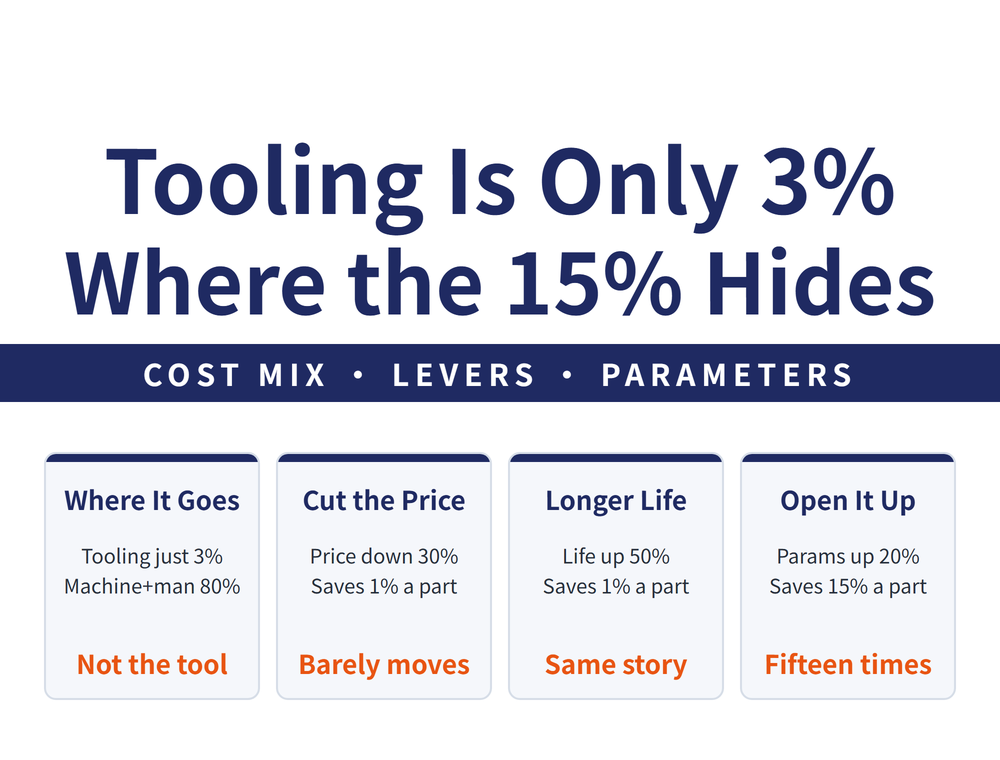
Cutting tools account for only about 3% of total machining cost, so cutting the tool price by 30% lowers cost per part by just 1%. Extending tool life by 50% gives the same 1%. What actually drops cost per part by 15% is raising the cutting parameters, and in that column the tool cost actually goes up. This guide uses a table you can verify cell by cell to show where the money really goes, how the three levers compare, and what the 15% depends on.
1. Where Your Machining Money Actually Goes
Start by breaking the cost apart. Following the machining economics section of the Sandvik technical training handbook, a typical metal cutting cost structure looks like this.
| Category | Item | Share |
|---|---|---|
| Variable cost (only while producing) | Cutting tools and consumables | 3% |
| Variable cost | Workpiece material | 17% |
| Fixed cost (there even when idle) | Machine tool and holders | 27% |
| Fixed cost | Labour | 31% |
| Fixed cost | Premises, administration and so on | 22% |
Tooling is 3%. The three fixed items - machine, labour and premises - add up to 80%, and they keep burning money even when nothing is being cut.
2. Why Tooling Matters Far More Than Its 3%
Because of a second number: across a working day, the machine is actually cutting only 24% of the time.
Cutting time = 60% x 50% x 80% = 24%
(the three layers strip out non-value time, part changes and other stoppages, and breakdowns plus tool changes and setting)
Put the two numbers together and you have the whole story: tooling costs you 3% of the money but decides what happens in that 24% of the time - and that 24% is the only part that creates value. When a tool breaks, chips or drifts out of size, what you lose is not the 3%; it is the only stretch of time that was earning.
3. Three Levers, Fifteen Times Apart
Take a concrete example: a shop spends $10,000 to make 1000 parts, so $10.00 per part. Here is what the three common cost reduction moves actually deliver.
| Item | Baseline | Tool price -30% | Tool life +50% | Parameters +20% |
|---|---|---|---|---|
| Variable - tooling | $0.30 | $0.21 | $0.20 | $0.45 (up) |
| Variable - material | $1.70 | $1.70 | $1.70 | $1.70 |
| Fixed - machine | $2.70 | $2.70 | $2.70 | $2.16 (down) |
| Fixed - labour | $3.10 | $3.10 | $3.10 | $2.48 (down) |
| Fixed - premises | $2.20 | $2.20 | $2.20 | $1.76 (down) |
| Cost per part | $10.00 | $9.91 | $9.90 | $8.55 |
| Saving | - | 1% | 1% | 15% |
Tool price is the easiest number to measure, which is why it takes all the discount pressure. The table says it plainly: a 30% price cut buys 1%, a 50% life gain buys 1%, and a 20% parameter increase buys 15%.
4. The Counter-Intuitive Cell: Tooling Gets Dearer, Total Cost Falls
Look at the first row of the "Parameters +20%" column: tooling goes from $0.30 to $0.45, an increase of 50%.
But the three fixed items in that same column each drop by 20% (all multiplied by 0.8), because the same quantity now takes less machine time. The net result is cost per part falling from $10.00 to $8.55.
The extra $0.15 spent on tooling bought back $1.60 of machine, labour and premises overhead.
This is the full arithmetic behind "paying more for tools is cheaper", not a sales line. It is also why unit price is the wrong basis for comparing tools. What matters is cost per unit of use: price divided by usable time. A tool priced at 100 that lasts 10 units (10 each) is dearer than one priced at 200 that lasts 40 units (5 each).
5. The 15% Has Conditions, So Do Not Promise It
Parameters only go up if the whole system can take it: machine rigidity, clamping stability, the quality of the tool itself, and the behaviour of the workpiece material. If any one of those falls short, raising parameters gives you chipping, chatter or parts out of size, and none of the 15% arrives.
That is where tool quality earns its keep: not by being cheap within the 3%, but by deciding whether you can collect the 15%. For setting conditions before you choose, see [End Mill Cutting Conditions Guide]; for matching tool material and coating to the workpiece, see [Cutting Tool Material Classification: P M K N S H Selection Guide].
One more caution about how this gets misused: the 15% comes from finishing the same quantity in less machine time, not from a tool discount. Do not turn "tools got cheaper" into "total cost will fall a lot". They are not the same thing.
For how far to push the parameters, see [How Fast to Run: The High Efficiency Range and Tool Life Factors]; for setting tool life so neither end wastes money, see [How Long Should Tool Life Be: Lowest Cost and Maximum Output Give Different Answers].
6. Why This Matters Right Now
According to the industry index quoted in the same handbook, operating costs and selling prices in manufacturing are both rising, but costs rise faster than prices. The widening area between the two lines is what is called the productivity gap.
There is an easy misreading here: it is not a scissors effect of rising costs and falling prices, it is a difference in the rate of increase. In other words, even if you raise prices every year, profit still gets eaten away unless efficiency rises alongside. The value of that 15% is not the money itself; it is that it is one of the few levers that can keep pace with cost inflation. To turn the machine time saved into the time allowed per part, see [Machine, Tooling and Time Standards: Selection, Cutting Data Order, Time Allowance].
7. Frequently Asked Questions (FAQ)
Q: If tooling is only 3%, should I just buy the cheapest?
The opposite. Tooling is a small share of the money but it governs stability and usable parameters during that 24% of cutting time. A cheap tool that will not let you run the parameters costs you the 15% column, far more than it saves.
Q: Do these percentages apply to my shop?
This is a typical structure for general metal cutting. Actual shares vary with industry, batch size and automation level. Recalculate with your own machine hour rate and tool consumption; the logic transfers, the numbers should be yours.
Q: Which parameter does "20% increase" refer to?
It means overall cutting efficiency raised by 20%, which can come from speed, feed, depth of cut or a combination. Which one to adjust and by how much depends on machine rigidity, tool specification and workpiece material.
Q: How do I explain to a buyer that the dearer tool is cheaper?
Do not argue about unit price. Move the discussion to cost per unit of use and to achievable parameters. Use this table: a 30% discount is worth 1%, while opening up the parameters is worth 15%, and the latter depends on tool quality holding up.
Cost structure and the three-lever comparison follow the machining economics section of the Sandvik technical training handbook. The percentages represent a typical general metal cutting structure; actual values vary by industry and batch size, so recalculate with your own machine hour rate before applying them.
Last updated: 2026-10-25
This article is part of Manufacturing Process: The Complete Guide - Set the Datum First, Then Sequence, Allowance and Dry Cutting; that guide shows how the whole topic fits together.









