
Choosing a Honing Head and Fluid: Bore Decides the Head, Material Decides the Fluid
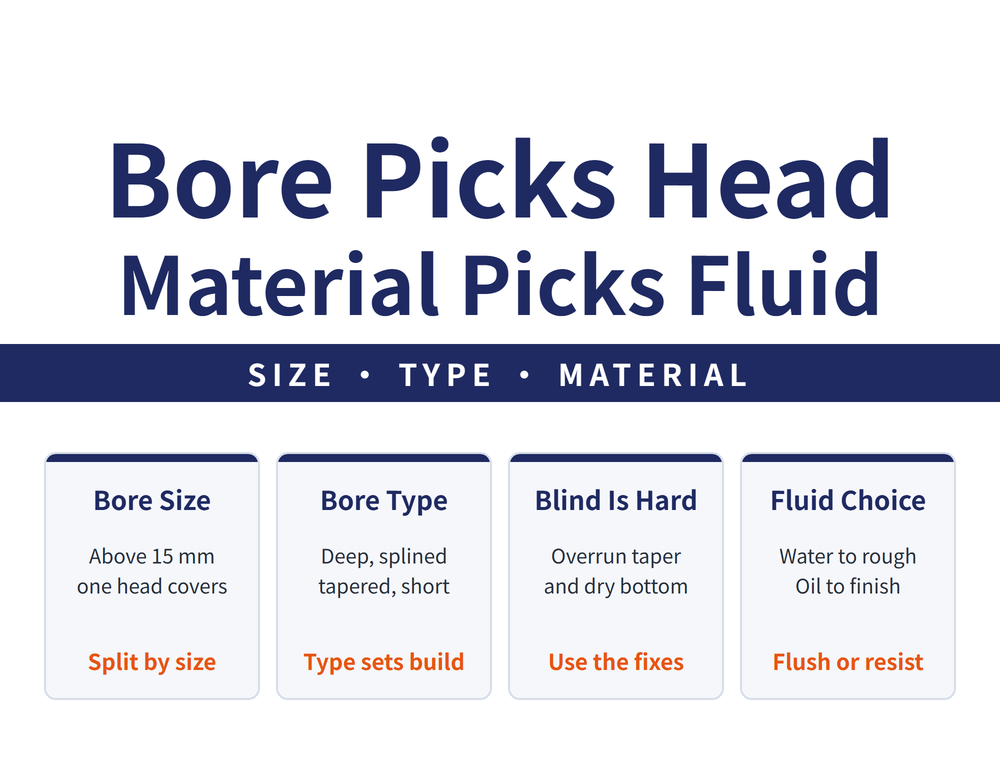
Choosing a honing head really comes down to two questions: how big the bore is and what shape it takes. Above 15 mm one general construction covers it; below that the heads split into four types. Deep, splined, tapered, short and interrupted bores each have a dedicated head, and blind bores are the hardest of the set. Fluid is a separate thread: roughing needs flushing, finishing needs resistance to welding, and the wrong choice does not just cost efficiency, it scratches the bore wall. This article covers both in one pass.
1. Bore size first: 15 mm is the first divide
Above 15 mm a single general construction is enough: body, stones, stone holders, springs, guide rails and an expanding cone. Two things are worth remembering. An odd number of stones is preferred because it resists vibration, though an even number also works. The head must retract to less than bore diameter, and at full expansion must reach at least final size plus the wear allowance of the stones.
Guide rails need to sit smaller than the bore yet larger than the retracted stone circle, and concentric with it. Only when all three hold does the head both enter and support properly.
2. Below 15 mm: four small bore head types
| Type | Suits | Construction |
|---|---|---|
| Plated superabrasive hone | The smallest bores | A steel rod plated with superabrasive; a set of rods in ascending diameter is used in sequence, each stroke removing only a few microns |
| Single stone head | High straightness demand | Two asymmetric guide rails plus one cutting stone; the wider rail takes the resultant force, the narrower one supports |
| Split bushing head | High straightness, interrupted surfaces | Cutting efficiency roughly 10% higher than an ordinary stone head |
| One-piece adjustable head | Volume production | A one-piece sleeve body plated with a layer of diamond grit; form error down to 0.5 μm and Ra to 0.2 μm |
The difference between these four is not which is better, but whether you need straightness, efficiency, or consistency across a large run.
3. Then bore type: five shapes, five dedicated heads
| Bore type | How the head is built | What to watch |
|---|---|---|
| Large bore | A raised collar supports the stone holders | Collar diameter sits close to bore size and carries the cutting force |
| Deep bore | Front and rear stone sets machine bottom and mouth separately | The two strokes must overlap and the diameters must be dressed to match |
| Splined bore | Narrow splines take a wide stone on a general head; wide splines need a dedicated head with angled stones | Usually done after hardening; speed should stay low to avoid slipping, with a cross hatch angle of about 30° |
| Tapered bore | A tapered mandrel and the body rotate together on a key | The mandrel itself does not stroke; taper accuracy comes entirely from the mandrel taper |
| Short bore (L/D<1) | Head and connecting rod are rigidly coupled | Stone length roughly equals or slightly exceeds bore length; overrun at each end is about 1/5 of stone length; the part sits in a floating fixture to hold axis to face squareness |
| Interrupted bore | Closely spaced bores take a long stone spanning three bore pitches | Widely spaced bores should not; select a stone length per section, matched in hardness and dressed to the same size |
Short bores also allow a practical shortcut: disc shaped parts can be stacked and honed together, which improves both throughput and accuracy over doing them one at a time.
4. 🔑 Blind bores are the hardest case
Blind bore honing carries three built-in difficulties that amplify each other:
① Cylindricity: unequal overrun at the two ends produces taper, and the shorter the relief groove, the worse the taper.
② Uneven stone wear: the leading end of the stone cuts more often than the trailing end, breaks down faster, and the bore bottom ends up under-cut.
③ Poor lubrication: fluid cannot reach the bottom of the bore properly.
Four countermeasures apply, singly or together:
| Countermeasure | How it works |
|---|---|
| Head with wear compensation | Stone wear is made up automatically by the mechanism, which allows a much narrower relief groove |
| Dwell at the bore bottom | The stone pauses 1 to 2 seconds automatically at reversal, or short strokes are applied to the end at set intervals; diamond stones are preferred |
| Long and short stone combination | The long stone hones the full length while a short stone expands only at the blind end |
| Modified stone construction | Narrow the trailing end, or use a stone harder at the entering end and softer elsewhere, to correct taper at the bottom |
🔴 There is also a machine side prerequisite: blind bore honing needs a machine with accurate reversal, with reversal error no greater than 0.5 mm. If the machine reverses inconsistently, all four countermeasures are cancelled out.
5. Fluid: flushing for roughing, anti-welding for finishing
Honing fluid comes as water based or oil based, and the logic is direct:
● Water based: good cooling and flushing, suited to roughing.
● Oil based: should carry a suitable sulphur content, which combines with iron in the swarf to form iron sulphide and resists welding and loading.
● Hard or brittle materials: a low viscosity fluid helps efficiency.
Two further rules are hard limits tied to the stone, not to the fluid alone:
🔴 With cubic boron nitride (CBN) stones, do not use a water based fluid, because CBN hydrolyses.
🔴 With resin bonded stones, do not use an alkaline cutting fluid.
For steel parts an extreme pressure emulsion also works, as does a mix of kerosene and extreme pressure cutting oil.
6. Four things about using the fluid
① Delivery: the fluid must enter the bore together with the head, at sufficient flow and with real flushing force. Pouring it at the bore mouth does not count as delivery.
② Filtration: the most under-rated item here. Dirty fluid loads the stones, tears the machined surface, and in bad cases jams the head. A combined magnetic separator and paper filter is advisable, holding contamination to 0.2 to 0.3 grams per litre.
🔴 A magnetic separator cannot remove anything non-magnetic, which means loose grit and other debris pass straight through. For high accuracy, low roughness work, paper filtration must be added; the magnetic drum alone is not enough.
③ Temperature: as temperature rises honing becomes prone to vibration, which shows directly in the result. High stock removal and high volume production need attention to cooling and tank capacity, holding working temperature around 25°C.
④ Matching the stone: see the two hard limits in the previous section.
What honing can and cannot do is covered in 〔What Honing Can and Cannot Do: How Five Finishing Processes Divide the Work〕; general fluid selection is in 〔Choosing a Grinding Fluid: Oil or Water Based, Five Types and EP Additives〕.
7. FAQ
Q: How many stones should the head carry?
An odd number is preferred because it resists vibration, though an even number works. The actual count and cross section follow bore diameter, with more stones as the bore grows. Softer workpiece materials take wider stones, harder ones narrower, and steel takes a narrower stone than cast iron.
Q: Will a blind bore always come out tapered?
Not always, but the tendency is built in. It comes from unequal overrun at the two ends, and the shorter the relief groove the worse it gets. Four countermeasures bring it down: a wear compensating head, a dwell at the bore bottom, a long and short stone combination, and a modified stone. All of them assume machine reversal error stays within 0.5 mm.
Q: Is plenty of fluid enough on its own?
No. Besides flow, the fluid has to enter the bore with the head to have any flushing effect, and it has to be filtered. Dirty fluid loads the stones, tears the surface and can jam the head. Magnetic separation only catches iron, so loose grit needs paper filtration.
Q: Can CBN stones run with a water based fluid?
No, because CBN hydrolyses. In the same way, resin bonded stones must not run with an alkaline cutting fluid. Both are hard limits rather than efficiency trade-offs.
Figures here are typical selection ranges. Actual values depend on bore size, material, stock allowance and machine condition, so verify on real test pieces.
Last updated: 2026-10-24
This article is part of Grinding Wheels and Machines: The Complete Guide - Reading the Wheel, Mounting It, Dressing It, and Tracing Defects; that guide shows how the whole topic fits together.









