
Fixing Plateau Honing Cross Hatch: Four Defects and the Bearing Area Ratio
Plateau honing does two things. Roughing presses in the cross hatch, then finishing shears the peaks between the hatch lines into short flat plateaus. The valleys hold oil and the plateaus carry load, and neither works without the other. When the hatch comes out wrong there is no need to re-tune everything: angle, depth, width and plateau each have their own causes. Identify which one failed, then follow that one line. This article gives a lookup table for the four defects plus a worked set of process parameters.
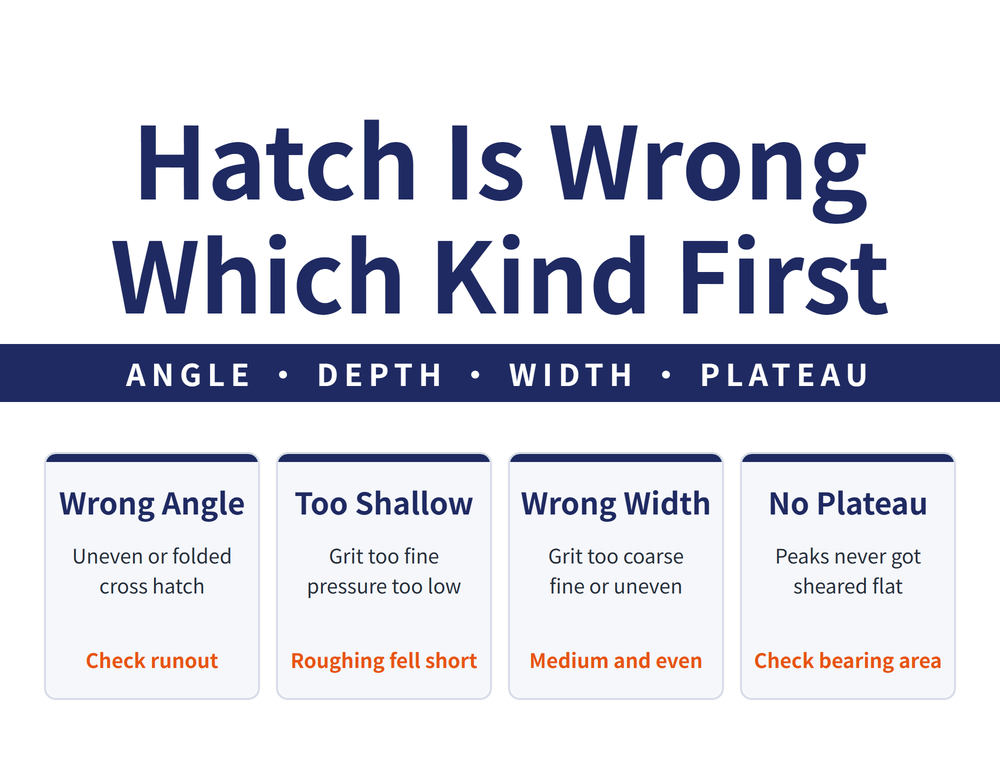
1. Decide which one is wrong
Plateau honing produces four common hatch defects whose causes barely overlap:
| Symptom | Where to look |
|---|---|
| Hatch asymmetric, uneven, angle too small, or folded | Runout in spindle and connecting rod, axial movement of the stones, stone hardness and width, ratio of circumferential to stroking speed |
| Hatch not deep enough | Roughing grit, honing pressure, stone hardness, finishing stock |
| Hatch width out of specification | Whether roughing grit is medium, whether grit is consistent, stone strength |
| No smooth plateau formed, or bearing area too small | Roughness after roughing, finishing grit, finishing time and pressure |
All four share one prerequisite: the mechanism has to be stable first. Until looseness and runout in the spindle system are removed, adjusting parameters achieves nothing.
2. 🔑 Roughing leaves the hatch, finishing shears the peaks
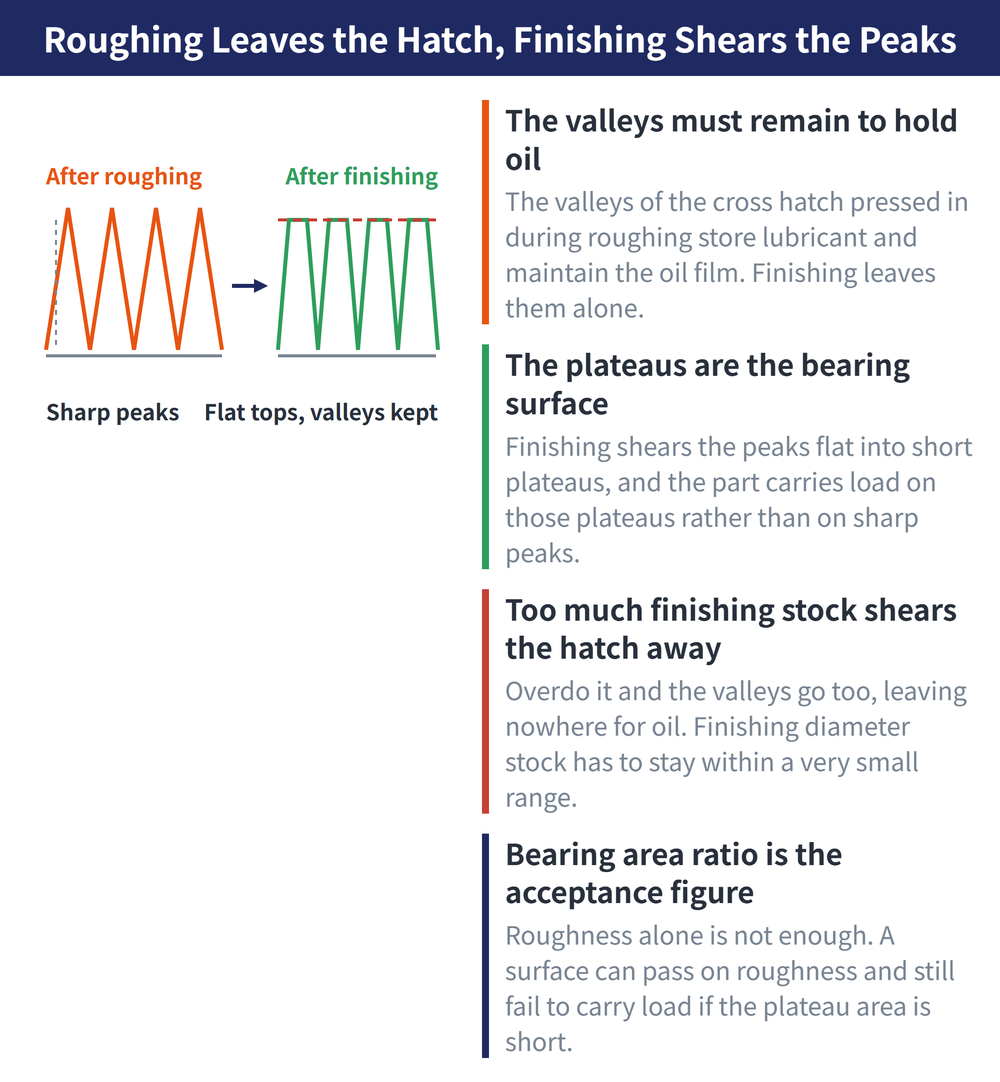
The name plateau honing comes from the fact that it removes only the peaks and leaves the valleys. After roughing presses in the cross hatch, the bore wall profile is a row of sharp peaks and valleys; finishing shears the peaks flat into short plateaus while the valleys stay exactly as they were.
Each has a job: the valleys store oil and maintain the film, the plateaus carry load. So finishing is not a case of the more the better. Too much finishing stock shears the hatch away along with the peaks, and then the oil has nowhere to sit.
3. Wrong hatch angle: runout first, speed ratio second
An asymmetric, uneven, shallow-angled or folded hatch has three causes, and the order matters:
① Mechanism: looseness or serious runout in the connecting rod or spindle system, or axial movement between head and stones. Remove the looseness and runout, align to the bore, and take the axial clearance out of the head.
② Stones: uneven hardness or structure, or stones so wide that the surface loads easily. Check hardness stone by stone and choose narrow, free-cutting stones (narrow slotted diamond stones are better still).
③ Speed: honing speed not chosen against the required cross hatch angle, with a slow stroke against a fast spindle. Work backwards from the angle θ to circumferential and stroking speed.
4. Hatch depth and width: two grit requirements
Insufficient depth means roughing did not cut enough, or finishing cut too much: roughing grit too fine, pressure too low, or stones so hard they load; or too much stock removed in finishing.
Figures you can apply directly: roughing grit no finer than 120#; honing pressure p ≥ 8×10⁵ Pa; choose free-cutting stones of suitable hardness and open structure; finishing stock ≤5 μm. Those together preserve a hatch depth of 4 to 6 μm.
Width out of specification comes from grit that is wrong or inconsistent: too coarse, too fine, uneven with coarse particles mixed in, or stones weak enough to break up. Choose medium grit (100# to 120#), select for consistency, and use strong diamond stones, which holds hatch width at 40 to 70 μm.
5. No plateau formed: bearing area ratio is the acceptance figure
If the surface carries no smooth plateaus, or the bearing area is too small, the causes are that the surface after honing is too rough and that finishing failed to shear the peaks off, because the finishing grit was too coarse, the time too short or the pressure too low.
Four figures to work to: roughness after roughing should reach Ra 1.6 μm; finishing grit no coarser than W40; finishing time ≥10 seconds, or raise honing pressure to (2 to 3)×10⁵ Pa. An acceptable plateau reads Ra 0.5 to 1.5 μm with a bearing area ratio of 50% to 80%.
🔴 The bearing area ratio, not roughness, is what this operation is really accepted on. A surface can pass on roughness and still fail to carry load if the bearing area is short.
6. A worked set of process parameters
The set below is a starting point for comparison, not a universal specification. Different bores, materials and machines all need re-testing:
| Stage | Stone | Pressure | Speed / stock / time | Fluid | Roughness target |
|---|---|---|---|---|---|
| Roughing | Synthetic diamond | - | Circumferential 52 m/min, stroking 30 m/min, hatch angle 60° | 90% kerosene plus sulphurised mineral oil | Ra 1.25-2.0 μm |
| Finishing | Fine grit green silicon carbide | (2-3)×10⁵ Pa | Diameter stock 4-6 μm, time 8-15 s | As above | Ra 0.5-1.5 μm |
The plateau honing head itself, with separate roughing and finishing stone sets, twin feed cylinders and pneumatic gauging for automatic changeover, is covered in 〔Choosing a Honing Head and Fluid〕; other honing defects are in 〔Diagnosing Honing Defects: Roundness, Cylindricity, Size and Scratching〕.
7. FAQ
Q: What causes a folded hatch?
Usually the mechanism rather than the parameters. Looseness or serious runout in the connecting rod or spindle system, or axial movement between head and stones, all fold the hatch. Remove the looseness and runout and align to the bore before revisiting the speed ratio.
Q: Is longer finishing always better?
No. Finishing exists to shear the peaks, not to remove the hatch. Too much finishing stock takes the hatch with it, and once the valleys are gone the surface cannot hold oil. Keep stock within 5 μm and time above 10 seconds without extending it indefinitely.
Q: Does passing on roughness mean the plateau is acceptable?
No. The real acceptance figure for this operation is bearing area ratio, with 50% to 80% as the acceptable range. A surface can meet the roughness figure and still fail to carry load.
Q: How do I choose roughing grit?
No finer than 120#, and consistent and strong. Too fine leaves the hatch too shallow, while too coarse, or coarse particles mixed in, puts the hatch width out of specification.
Parameters here are worked examples and typical ranges for one specific process, not a universal specification. Bore, material and machine conditions differ, so verify on real test pieces.
Last updated: 2026-10-24
This article is part of Grinding Wheels and Machines: The Complete Guide - Reading the Wheel, Mounting It, Dressing It, and Tracing Defects; that guide shows how the whole topic fits together.









