
Choosing Superabrasive Honing Stones, and External, Flat and Ultrasonic Honing
Honing is not limited to bores. External surfaces and flat faces are both workable, and abrasive and form are two independent choices. The abrasive follows how tough the workpiece is, with diamond and CBN falling on opposite sides. The form follows the shape of the part, since a slender shaft and a flat face need different approaches. This article covers superabrasive stone selection, bond and concentration, and the external twin wheel, flat and ultrasonic forms in one pass.
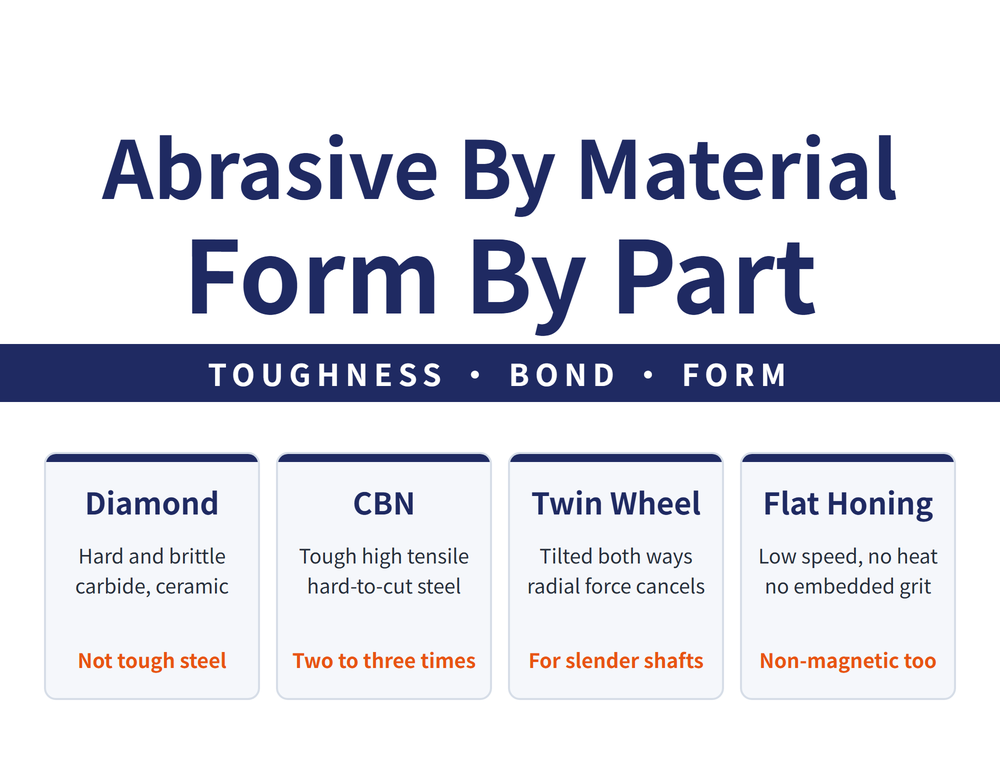
1. Diamond or CBN: the line is workpiece toughness
The two superabrasive stones barely overlap in application, and one criterion settles it: how tough the workpiece is.
| Abrasive | Suits | Does not suit |
|---|---|---|
| Synthetic diamond stones | Hard, brittle materials such as carbide, glass and ceramics; ordinary steels and non-ferrous metals also work | 🔴 Tough, high strength, gummy steels |
| Cubic boron nitride (CBN) stones | Tough, high strength steels, high alloy steels, heat resistant alloys, high speed steels and stainless steels; ordinary steels, copper and aluminium alloys also give good results | - |
On difficult-to-machine materials, CBN cuts 2 to 3 times more efficiently than synthetic diamond. So on a tough steel the answer is not that diamond is harder and therefore better. That is precisely where it should not be used.
2. Bond and concentration: four options, four roles
| Bond | Code | Concentration | Application |
|---|---|---|---|
| Resin | B | 25-50% | Low roughness honing (finishing and polishing passes) |
| Vitrified | V | 75% | Good self-sharpening and high efficiency, for roughing and semi-finishing |
| Bronze | Q | 100-150% | High strength and wear resistance but weaker self-sharpening, for roughing hard, brittle or tough materials |
| Electroplated metal | D | 200% | Formed stones and small bore hones; efficient but short lived |
Use the table by fixing the operation first, then the bond: roughing points at vitrified or bronze, finishing and polishing at resin, and electroplated is for small bores and formed stones. Higher concentration is not simply better. The 200% of an electroplated stone buys efficiency at the cost of life.
3. External twin wheel honing: the answer for slender shafts
Two honing wheels dressed to a hyperbolic profile are mounted tilted in opposite directions and pressed against the workpiece by spring force. The workpiece drives the wheels, which also traverse along its axis. The wheel axes cross the work axis at an angle, and the resulting sliding velocity does the cutting.
🔑 Why it suits slender shafts: because the two wheels are tilted in opposite directions, the radial force components cancel, so the part is not pushed out of line. Finishing piston rods and similar parts is exactly its territory, and a horizontal lathe can be converted to do it.
It has a clear limit: it corrects straightness error along the external profile, but cannot correct roundness or positional error. Roughness typically reaches Ra 0.025 μm, and because the contact area is small and loose grit is carried away by the fluid, the roughness value stays stable.
| Parameter | Value |
|---|---|
| Mounting angle | 27° to 35° |
| Workpiece speed | 60 to 65 m/min |
| Wheel axial traverse speed | Roughing 0.16-0.33 m/min, finishing 0.04-0.08 m/min |
| Axial feed per revolution | No more than 60% of wheel width, or a helical pattern appears |
| Wheel pressure | Spring adjusted, typically 50 to 200 N |
| Stock allowance | 0.01 to 0.03 mm, taking the larger value on longer parts |
4. Flat honing: low speed, no heat damage, no embedded grit
Flat honing is a special form of low speed surface grinding. The honing plate runs at less than a tenth of the surface speed of a surface grinding wheel. Double sided machines work two parallel faces at once, single sided machines one face at a time.
Its territory is specific: non-magnetic materials, and parts where thermal damage is not acceptable. Those two are exactly what a surface grinder handles poorly.
Typical results: roughness from Ra 2.5 μm before machining to Ra 0.2 μm after; parallelism better than 5/100000 and flatness better than 2 μm across the two faces; no thermal damage, edge break-down or embedded grit, with consistent sizing.
Against flat lapping, its advantages are a higher degree of automation, less manual effort and suitability for batch production, plus no strict demand on pre-machining accuracy or roughness, and no lapping compound left on the surface afterwards.
5. Grit and hardness for flat honing
Grit sets the achievable roughness directly (Ra, μm):
| Plate grit | On steel | On cast iron, bronze, aluminium alloys |
|---|---|---|
| 120#-150# | 0.8 | 1.6 |
| 150#-240# | 0.4 | 0.8 |
| 240#-W40 | 0.2 | 0.4 |
| W40-W28 | 0.1 | 0.2 |
| Finer than W20 | Below 0.05 | Below 0.1 |
Abrasive hardness is then selected inversely against workpiece hardness:
| Workpiece HRC | >60 | 58-60 | 52-57 | 45-51 | 34-44 | <34 |
|---|---|---|---|---|---|---|
| Abrasive hardness code | F, G | G, H | I, K | L, M, N | P, Q | R, S, T |
Four selection rules: the finer the grit, the softer the abrasive; the harder the workpiece, the softer the abrasive; the larger the honed area, the softer the choice; and diamond or CBN plates sit between codes M and S.
6. Ultrasonic vibration honing: why force and heat drop
Ultrasonic vibration machining is a form of pulse cutting: the abrasive edge leaves and re-contacts the workpiece cyclically, with speed changing in both magnitude and direction. By frequency, above 16000 Hz counts as ultrasonic vibration machining, the boundary being the range audible to the human ear.
The effect comes from one specific mechanism, a sharp fall in the friction coefficient:
| Workpiece material | With ultrasonic vibration | Without vibration |
|---|---|---|
| Aluminium | 0.02 | 0.18 |
| Brass | 0.03 | 0.25 |
| Carbon steel | 0.02 | 0.22 |
The friction coefficient falls to roughly one tenth of conventional cutting, so cutting force falls to 1/2 to 1/10 of conventional (around 1/3 in grinding), and more so on highly plastic materials. A measured case: with radial ultrasonic vibration on a diamond wheel, the horizontal force component fell by 30% to 40% on fused silica and 60% to 70% on stainless steel.
With force down, heat follows. Elastic and plastic deformation and contact friction both reduce, and because force and heat appear as pulses, the mean grinding heat falls substantially.
The principle and capability of bore honing is in 〔What Honing Can and Cannot Do〕; stone and fluid selection is in 〔Choosing a Honing Head and Fluid〕.
7. FAQ
Q: Diamond is harder than CBN, so why not use diamond throughout?
Hardness is not the only criterion. Synthetic diamond does not suit tough, high strength, gummy steels; those call for CBN, which also cuts 2 to 3 times more efficiently there. The criterion is workpiece toughness, not abrasive hardness.
Q: Can external twin wheel honing correct roundness?
No. It corrects straightness error along the external profile but cannot correct roundness or positional error. Its real value is that the radial force components cancel, so a slender shaft is not pushed out of line.
Q: How does flat honing differ from flat lapping?
The honing plate runs at less than a tenth of a surface grinding wheel, so there is no thermal damage, edge break-down or embedded grit, which suits non-magnetic materials and parts that cannot take heat. It is also more automated, undemanding on pre-machining accuracy, and leaves no compound on the surface.
Q: Should a harder workpiece take a harder abrasive?
The opposite. The harder the workpiece, the softer the abrasive should be. The same applies as grit gets finer, and as the honed area gets larger.
Figures here are typical ranges and depend on workpiece material, size and machine condition. Verify on real test pieces before fixing parameters.
Last updated: 2026-10-24
This article is part of Grinding Wheels and Machines: The Complete Guide - Reading the Wheel, Mounting It, Dressing It, and Tracing Defects; that guide shows how the whole topic fits together.









