
How Long Should Tool Life Be: Lowest Cost and Maximum Output Give Different Answers
"How long should this tool last" has no single answer, because it depends on whether you want the lowest cost or the fastest output. Those two goals produce two different life values, and the minimum cost life is always longer than the maximum production life. Set it too long and you are forced into small parameters that slow output; set it too short and tool changing and regrinding eat the gain. This guide covers how each is calculated, when to choose which, and typical life ranges by tool type.
1. Both Too Long and Too Short Lose Money
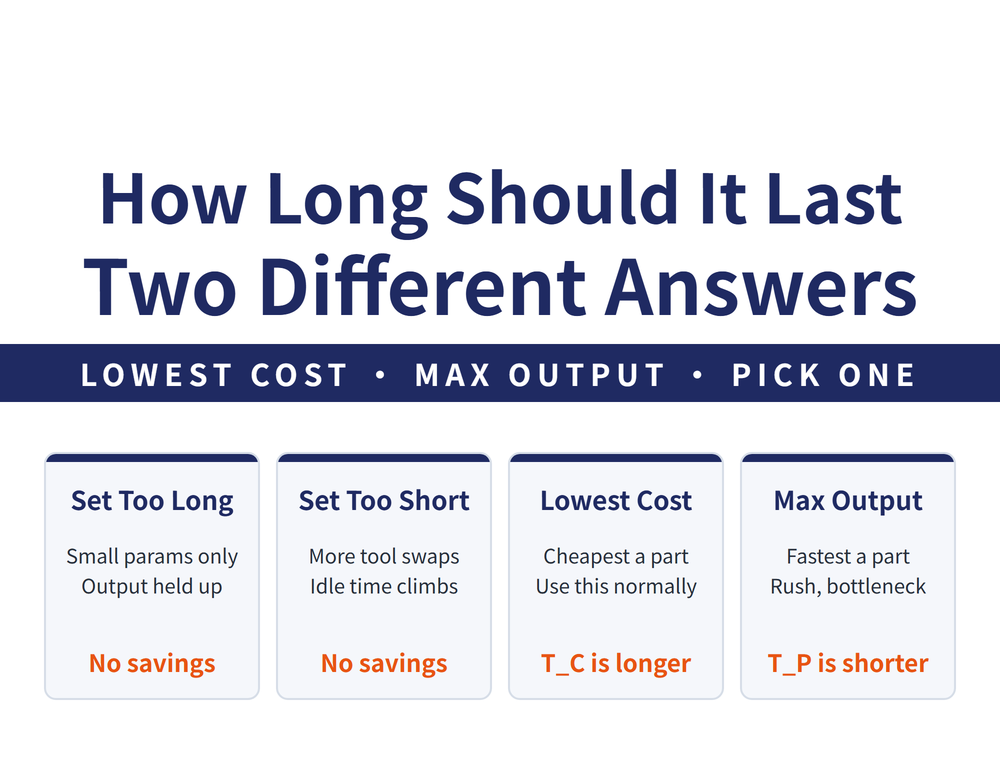
Longer tool life is not automatically better. Set the life too high and you can only select smaller cutting data, which means lower productivity and higher machining cost. Set it too low and the auxiliary time and cost of tool changing and regrinding go up, which again fails to raise productivity or cut cost.
So tool life needs a sensible value. In production the usual choice is minimum production cost life, switching to maximum production rate life only when needed.
2. Minimum Production Cost Life T_C: Cheapest per Part
Set on the principle of minimum cost per operation. With the other cutting conditions fixed, production cost depends on life: too high or too low both push cost up, and the minimum point in between corresponds to T_C.
T_C = (1 - m) / m x ( t_ct + C_t / M ) (minutes)
| Symbol | What it means |
|---|---|
| m | Exponent for the effect of cutting speed on tool life |
| t_ct | Time for one tool change (minutes) |
| C_t | Tool cost, including regrinding and tool depreciation |
| M | Shop overhead carried by this operation per unit time, including wages and machine tool depreciation |
3. Maximum Production Rate Life T_P: Fastest per Part
Set on the principle of shortest time per operation. Time per part also rises whether life is too high or too low, and the minimum point corresponds to T_P.
T_P = (1 - m) / m x t_ct (minutes)
Put the two formulas side by side and it is obvious: T_P is missing the C_t / M term, so T_C is always greater than T_P.
4. Two Different Answers, So Which One
Because T_C > T_P, the minimum cost life permits lower cutting data than the maximum output life. In other words: chasing lowest cost means running more conservatively, chasing fastest output means running harder but paying more per part.
Use T_C normally. When the production schedule is urgent, or when the line has an unbalanced weak link (one station holding up everything), switch that station to T_P - trading a higher cost per part for throughput to open the bottleneck.
5. When to Set Life High and When to Set It Low
| Situation | Set life | Why |
|---|---|---|
| Expensive tools (complex tooling) | Higher | C_t is large, so you need more use to justify it |
| Cheap tools (indexable) | Lower | C_t/M shrinks, T_C approaches T_P, no need to push it |
| Complex tool changing and setting (multi-tool, combination, automatic machines and lines) | Higher | t_ct is large, each change is expensive |
| High shop overhead carried by the operation | Lower | M is large, machine time costs more than tooling, so let it run fast |
One point is often misread here: indexable tools should be given a shorter life than brazed tools, not because they are less durable, but because changing an edge is quick and cheap, so pushing them to the limit does not pay.
6. Typical Life Ranges by Tool Type
The following are common reference ranges. Actual values should be calculated with the formulas above and your own conditions, or taken from the tool manufacturer data.
| Tool type | Reference life range |
|---|---|
| HSS turning tool | 30 to 60 minutes |
| HSS drill | 80 to 120 minutes |
| Brazed carbide turning tool | 30 to 60 minutes |
| Indexable carbide turning tool | 15 to 45 minutes |
| Carbide face mill | 120 to 180 minutes |
| Gear cutting tools | 200 to 300 minutes |
| Multi-tool, combination, automatic machines and lines | 240 to 480 minutes |
Once life is set, the next question is how fast to run so you stay in the profitable band - see [How Fast to Run: The High Efficiency Range and Tool Life Factors]. For why a small tooling share is still worth caring about, see [Machining Cost Structure: Tooling Is Only 3%, So Where Is the Real 15%].
7. Frequently Asked Questions (FAQ)
Q: How far apart are T_C and T_P in practice?
The gap depends on C_t/M, the ratio of tool cost to machine hour overhead. Cheaper tools and dearer machine time bring them closer; complex tooling with cheap machine time pushes them apart.
Q: I do not have an m value, so how do I use the formula?
m is the exponent for the effect of cutting speed on life, usually taken from tool manufacturer data or regressed from trial cutting. If you cannot get it, start from the reference ranges in section 6 and adjust based on observed wear.
Q: Does a shorter life for indexable tools mean wasting inserts?
No. When indexing is quick and cheap, the money saved by pushing an insert to its limit is usually smaller than the machine time lost by reducing parameters. You are optimising total cost, not insert count.
Q: For a rush order, should the whole shop switch to T_P?
Not recommended. T_P buys throughput with a higher cost per part, which only makes sense at the bottleneck. Changing non-bottleneck stations will not speed up the line, it will only cost more.
The tabulated life values are common reference ranges. Actual values should be calculated from the formulas using your own tool change time, tool cost and machine hour rate, or taken from the tool manufacturer data.
Last updated: 2026-10-25
This article is part of Manufacturing Process: The Complete Guide - Set the Datum First, Then Sequence, Allowance and Dry Cutting; that guide shows how the whole topic fits together.









