
Tungsten Prices Are Surging — How Do Machine Shops Defend Tooling Costs? 2025–2026 Market Intel
Any shop buying carbide (tungsten carbide) end mills, turning tools or drills lately has surely felt it: prices keep jumping. The cause is the surging raw-material price of tungsten — the "teeth of industry" — which is feeding straight through to downstream tooling. This article uses the latest figures to explain what happened and how machine shops can defend their tooling costs. Data period: January 2025 to June 2026; later developments are noted at the end under "Later developments".
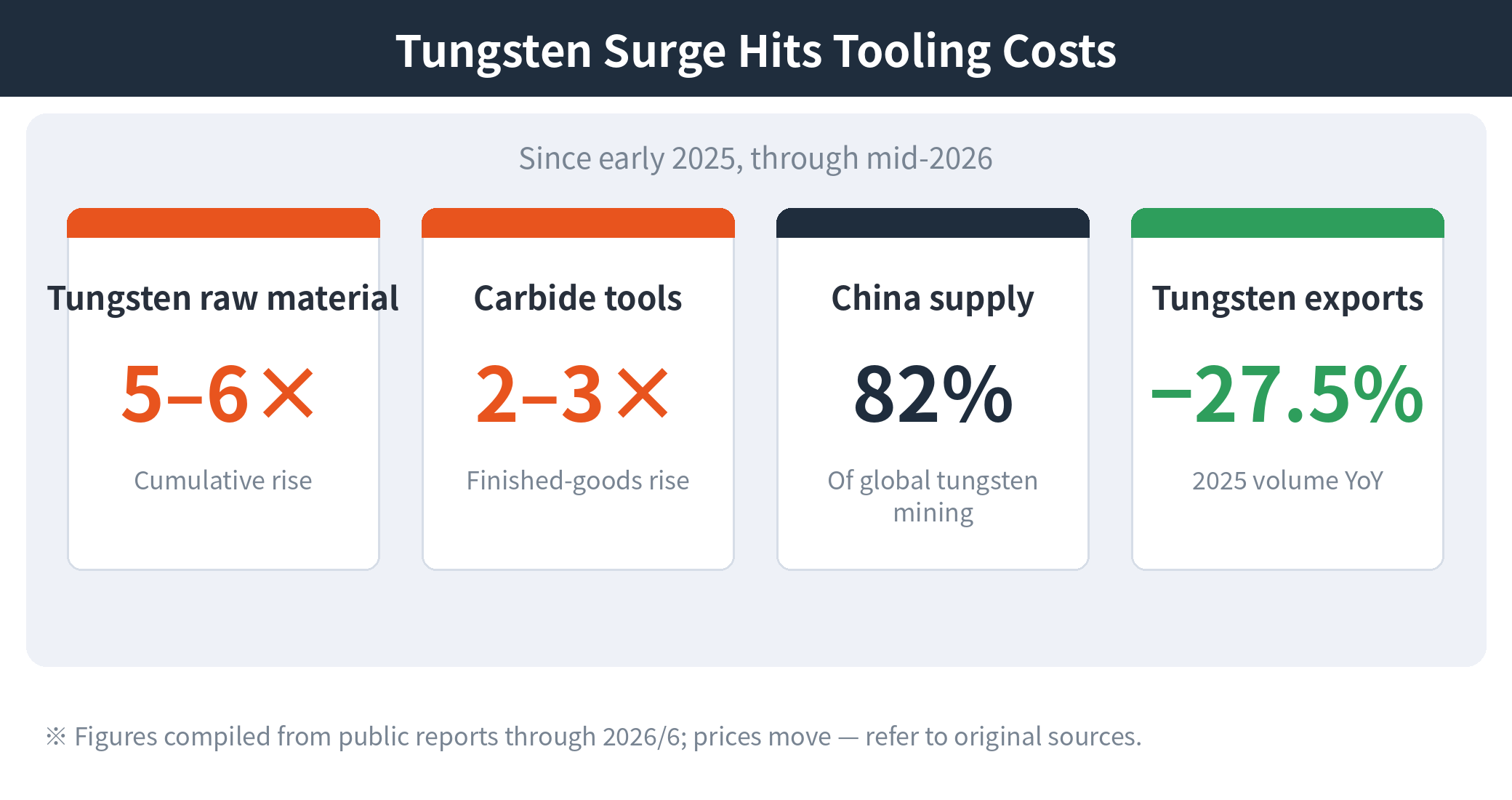
What happened to tungsten prices? (as of mid-2026)
| Item | Description |
|---|---|
| Tungsten raw material | up about 5–6x cumulatively since early 2025 (multiple media report one-year gains above 5x, with some indicators exceeding 557%), and still climbing into 2026. |
| Carbide tooling | the raw-material increase has fully passed through downstream, with many tool makers issuing price-increase notices one after another; finished carbide tools have broadly risen. |
| Concentrated supply | China controls about 82% of the world's tungsten ore supply and imposed export controls on tungsten products starting in 2025, with tungsten product exports down about 27.5% year on year that year. |
Why is it rising?
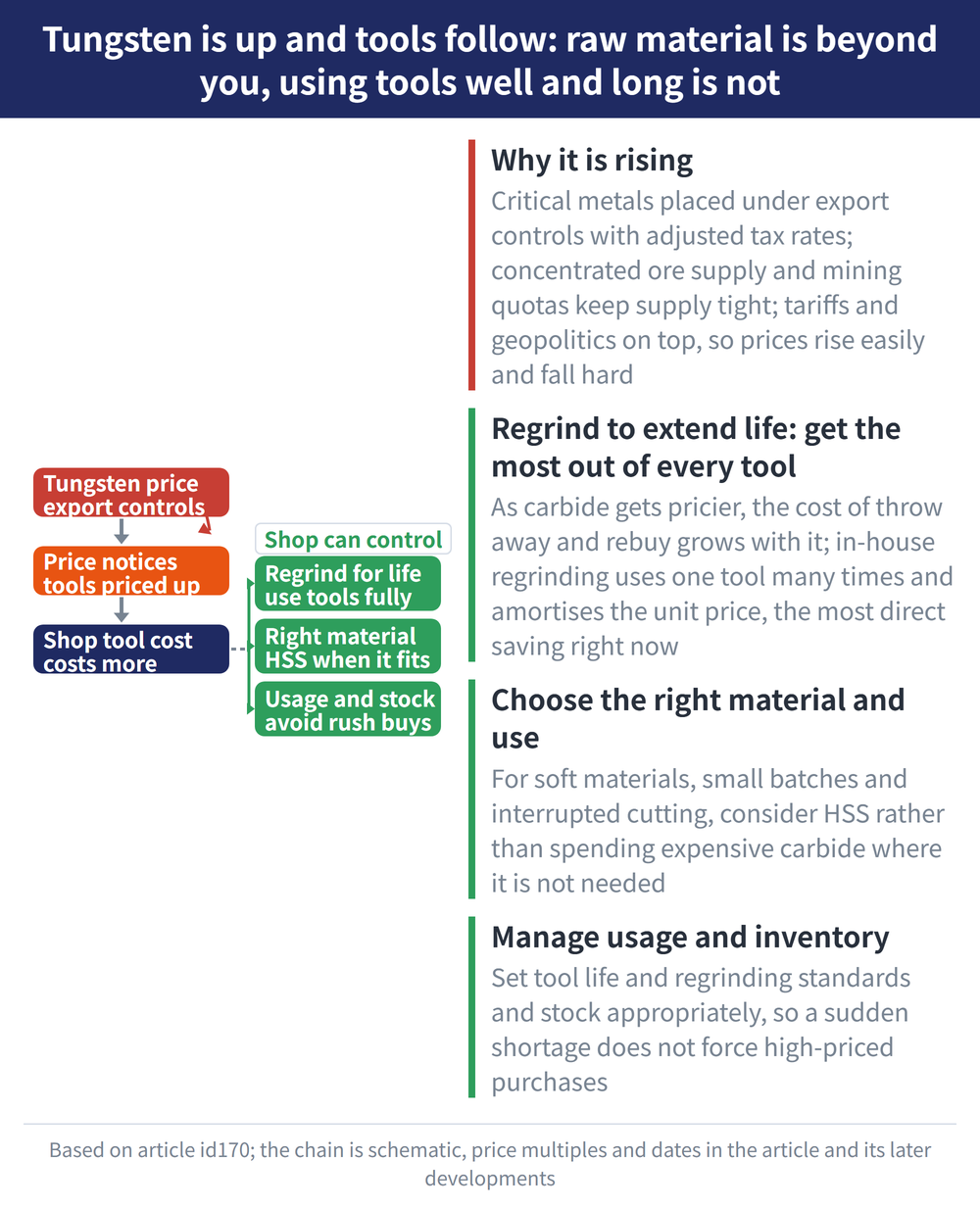
There are three main causes: ① since 2025 China has placed tungsten and other critical metals under export controls and adjusted export tax rates; ② China already controls most of the world's tungsten ore and enforces mining quota controls, keeping supply tight; ③ added to this are U.S.–China tariffs and geopolitics, with capital pushing the market up, so the short term is "easy to rise, hard to fall." The industry broadly believes that even if supply eases later, the price center will be hard to return to pre-2025 levels.
The impact on machine shops
The most direct effect is rising tool purchasing costs: the same carbide end mill costs more today, and future quotes may climb further. For CNC and mold shops that "use a lot of tools and also quote to customers," this is a cost pressure that can't be ignored.
Three ways to defend tooling costs
- Regrind to extend life — get the most out of every tool: as carbide gets pricier, the cost of "throw away and rebuy" grows with it, so in-house regrinding — using one tool many times to amortize the unit price — is the most direct way to save right now (see "In-house Regrinding vs. Outsourced Grinding vs. Buying New — Which Is Cheapest?").
- Choose the right material and use: not every job requires carbide; for soft materials, small batches and interrupted cutting, consider HSS to avoid "using a sledgehammer to crack a nut" with expensive carbide (see "Carbide vs. HSS End Mills — How to Choose?").
- Manage usage and inventory: establish tool life and regrinding standards and stock appropriately to avoid being forced into high-priced purchases during sudden shortages.
In short: you can't stop raw-material prices from rising, but "using tools well and using them long" is something the shop can control.
Later developments (note added September 2026)
The body of this article was written in mid-2026. What follows records direction and dates only; no figures are restated:
| Change | Detail and source |
|---|---|
| From January 2026, China tightened tungsten export controls toward Japan | (dual-use items including tungsten carbide and high-purity tungsten powder; Taiwan International Trade Administration notice, Economic Daily News, May 2026). Japanese tungsten product supply tightened and the global hard-metal chain tightened again. |
| From April 2026, Chinese tungsten powder quotes stopped climbing and moved sideways | (mainland market pricing, Sina Finance, April 2026) - a raw-material signal; finished-tool prices usually lag raw material by months. |
| In August 2026, the Taiwan side was still at high prices with shortages | : carbide raw material stayed high, several grades were out of stock, and tool makers kept issuing price-increase notices (Commercial Times, 19 August 2026). For machine shops, the three measures in this article - regrind, choose the right material, manage usage - still apply. |
FAQ
Why are tungsten prices rising so much?
China controls about 82% of world tungsten ore supply and, since 2025, has imposed export controls and adjusted tax rates; combined with tariffs and geopolitics, supply is tight and prices are easy to rise, hard to fall in the short term — and this passes through to carbide tooling.
Carbide tools cost more — how can a shop save?
The most effective is in-house regrinding to extend life — using one tool many times to amortize the unit price; next, choose the right material by workpiece (HSS for soft materials) and manage tool life and inventory to avoid high-priced emergency purchases.
Is regrinding really worth it?
Taking a new carbide end mill at about NT$500–2,000 and a regrind cost of under NT$100, one tool can be reground many times, greatly amortizing the cost per edge. The more expensive carbide gets, the more obvious the benefit of regrinding.
Besides regrinding, what else can reduce tungsten (carbide) usage?
Options include: extending tool life through cutting conditions and coatings; substituting HSS or cobalt HSS on non-critical operations; standardizing tool types to improve regrind and inventory efficiency; and negotiating long-term price-locked contracts to spread tungsten-price risk.
* Figures in this article are compiled from public reports as of June 2026 (last checked: 5 October 2026; see “Later developments”). Tungsten prices and tool quotes move with the market; please refer to the latest original sources and supplier quotes.
For the full reading guide on this topic, see Tool Life and Wear: A Complete Reading Guide.
Further reading
| Item |
|---|
| In-house Regrinding vs. Outsourced Grinding vs. Buying New — Which Is Cheapest? |
| Carbide vs. HSS End Mills — How to Choose? |
| When to Regrind an End Mill? 5 Signs and the Correct Process |
Get the most out of your carbide tools: End Mill Grinder (Made in Taiwan · 1-year warranty · 2 on-site training sessions) — fits Φ3–20mm, regrinds carbide / HSS / parting tools, grind and run in-house. Online inquiries welcome.
Published: 2026-04-12 | Last updated: 2026-08-08









