
Carbide vs. HSS End Mills — How to Choose? Material Properties, Applications & Regrinding Guide
When choosing an end mill, the first thing to decide is the material: carbide or HSS (high-speed steel)? The choice runs all the way through machining speed, tool life and cost per part, which is why it is not a question of "can it work," but of "does it pay, and is quality stable." This guide settles it on three things — workpiece, operation and budget — and shows how far regrinding spreads the cost.
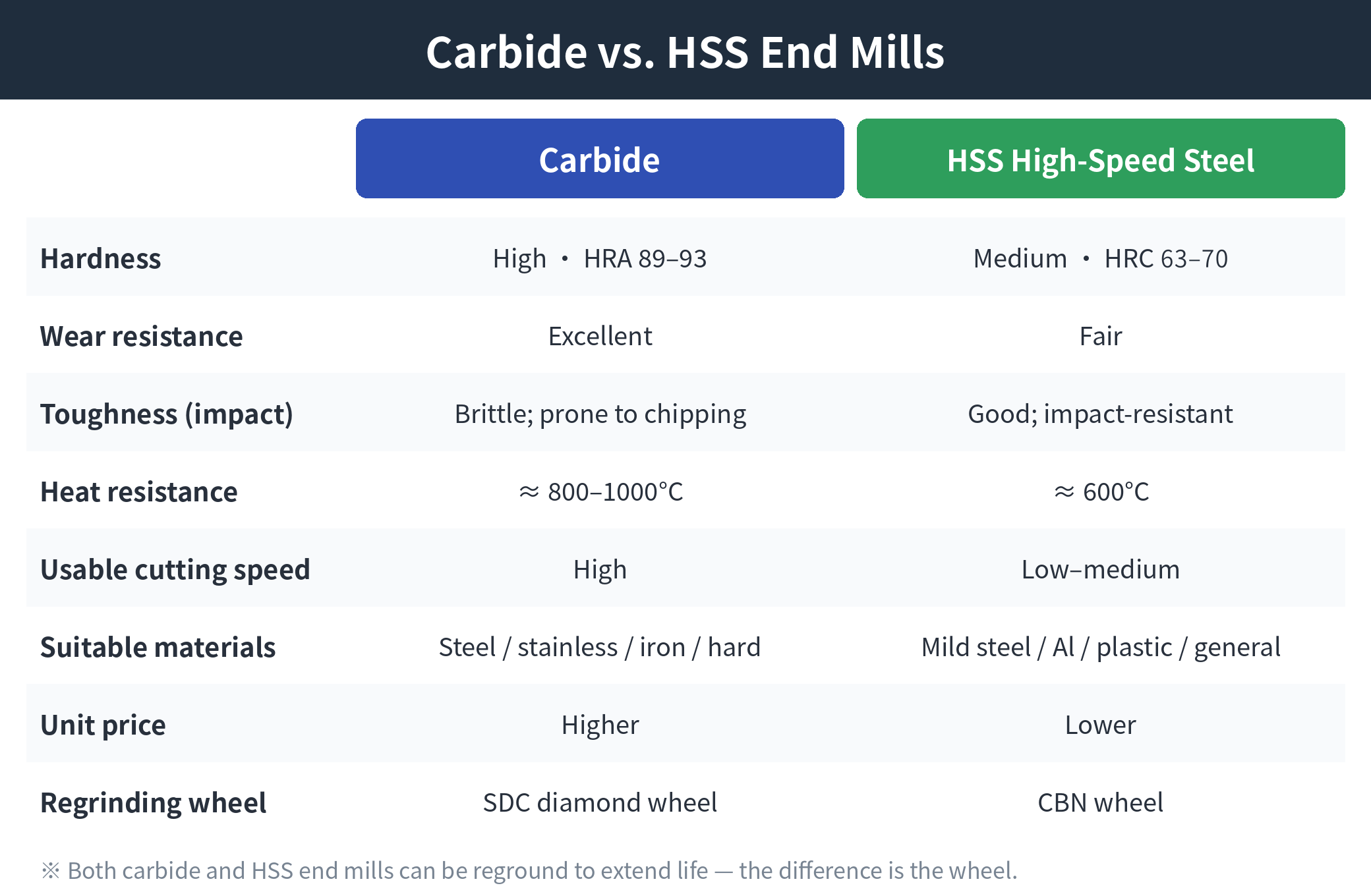
Carbide vs. HSS at a glance
| Item | Carbide | HSS (high-speed steel) |
|---|---|---|
| Hardness | High (about HRA 89–93) | Medium (the tool itself, about HRC 63–70) |
| Wear resistance | Excellent | Average |
| Toughness (impact) | More brittle, prone to chipping | Good, impact-resistant |
| Heat resistance (red hardness) | About 800–1000°C | About 600°C |
| Usable cutting speed | High | Low–medium |
| Suitable materials | Steel, stainless, cast iron, hard materials | Mild steel, aluminum, plastics, general materials |
| Unit price | Higher | Lower |
| Regrinding wheel | SDC diamond wheel | CBN wheel |
Carbide end mills: high hardness and speed, but more brittle
Carbide is made by sintering tungsten carbide with cobalt. It is hard, wear-resistant and heat-resistant (good red hardness), holding its edge at high spindle speeds and cutting speeds, and is suited to machining steel, stainless steel, cast iron and harder materials — the mainstay for molds and precision work. The trade-off is that it is more brittle and prone to impact and chipping, and is more sensitive to machine rigidity, clamping stability and cutting conditions; its unit price is also higher than HSS. In recent years tungsten raw-material prices have surged, raising carbide tool purchasing costs noticeably (see "Tungsten Prices Are Surging — How Do Machine Shops Defend Tooling Costs?"), which makes "regrinding carbide tools to extend their life" all the more important.
HSS end mills: tough, cheap and easy to use
HSS is tough and impact-resistant, not as prone to chipping as carbide, and low in unit price, suited to mild steel, aluminum, copper, plastics and other general materials, as well as interrupted cutting and setups with lower rigidity or lower spindle speeds. The downside is weaker heat and wear resistance: at high cutting speeds the edge dulls quickly, and efficiency lags carbide.
How to choose? Look at three things
| Item | Description |
|---|---|
| Workpiece material | for hard materials (steel, stainless, cast iron) prefer carbide; for soft materials (aluminum, plastics, mild steel) HSS is usually enough. |
| Operation and machine | for high speed, high efficiency and fine surface quality → carbide; for interrupted cutting, heavy impact or insufficient machine rigidity → HSS is less prone to chipping. |
| Volume and budget | for large, long-running production, carbide's high wear resistance amortizes the unit price; for small batches, trials or general use, HSS is more cost-effective. |
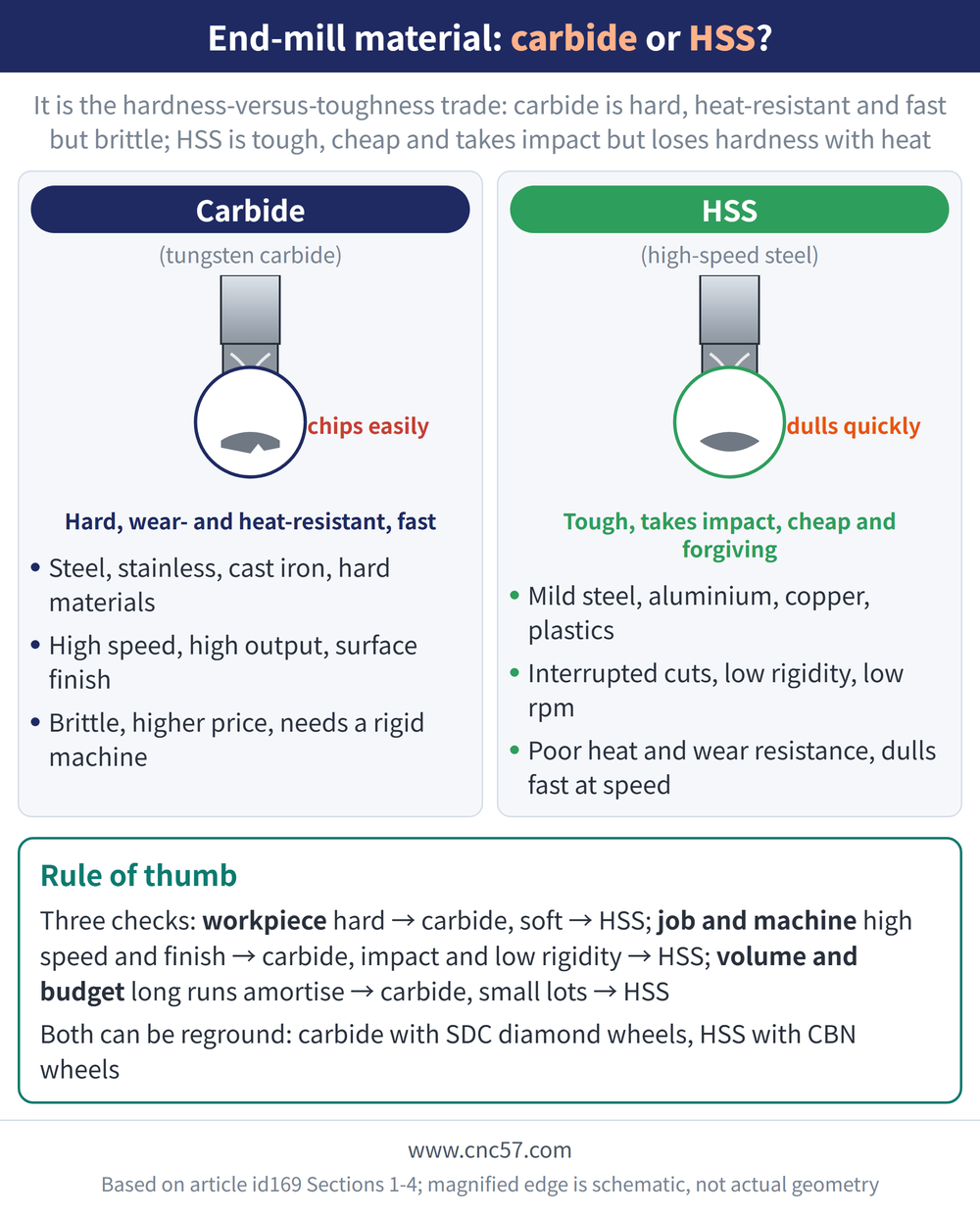
Either way, both can "regrind to extend life"
Both carbide and HSS end mills can be reground when dull — only the wheel differs: SDC diamond wheel for carbide, CBN wheel for HSS. Regrinding one tool many times amortizes the unit price to a very low level — especially now that carbide tools have risen sharply, in-house regrinding is key to cost control. For how to tell when to regrind and how the process works, see "When to Regrind an End Mill? 5 Signs and the Correct Process."
FAQ
For machining stainless steel, should I use carbide or HSS end mills?
Carbide is recommended. Stainless work-hardens easily and demands high wear and heat resistance; carbide's red hardness and wear resistance handle it better. Pair it with appropriate cutting speed and coolant, and avoid pausing the cut midway.
Carbide end mills cost more — are they always better?
Not necessarily. Carbide is efficient and amortizes its price on hard materials and high-volume production; but for soft materials, small batches, interrupted cutting or low machine rigidity, HSS — tough and cheap — is often the better value. Choose by workpiece and volume.
Is regrinding the same for carbide and HSS end mills?
The process is similar but the wheel differs: SDC diamond wheel for carbide, CBN wheel for HSS. Carbide fears overheating and chipping, HSS fears burn/annealing — control temperature when grinding either.
On a tight budget for small batches, how do you choose between carbide and HSS?
For small batches, price-sensitive jobs at moderate speeds, HSS toughness and low cost usually win; for hard materials, high finish and efficiency, or long repeated use, carbide life and speed advantages more easily offset the price gap.
For the full reading guide on this topic, see Tool Life and Wear: A Complete Reading Guide.
This article is part of Tool Materials and Coatings: The Complete Guide - Separate Substrate From Coating, Then Work Back From the Workpiece; that guide shows how the whole topic fits together.
Further reading
| Item |
|---|
| When to Regrind an End Mill? 5 Signs and the Correct Process |
| Tungsten Prices Are Surging — How Do Machine Shops Defend Tooling Costs? |
| End Mill Types and Features Explained |
Looking to buy: both carbide and HSS end mills can be reground to extend their life. Take a look at the End Mill Grinder (Made in Taiwan · 1-year warranty · 2 on-site training sessions) — fits Φ3–20mm, regrinds carbide / HSS / parting tools. Online inquiries welcome.
Published: 2026-06-22 | Last updated: 2026-10-25









