
3-Flute Drill Guide: Precision Holes & 60HRC Hard Machining
A 3-flute drill distributes cutting force across three edges, raising feed capability and hole-wall stability, and holding long life and high accuracy even in 60HRC material. With optimized geometry and a wear-resistant coating, it delivers high-speed no-peck drilling and excellent roundness while lowering wear and diameter variation. This guide covers the working principle, hard-material and precision capability, deep-hole performance and cutting conditions as a reference for precision holes and high-volume production.
1. Working Principle
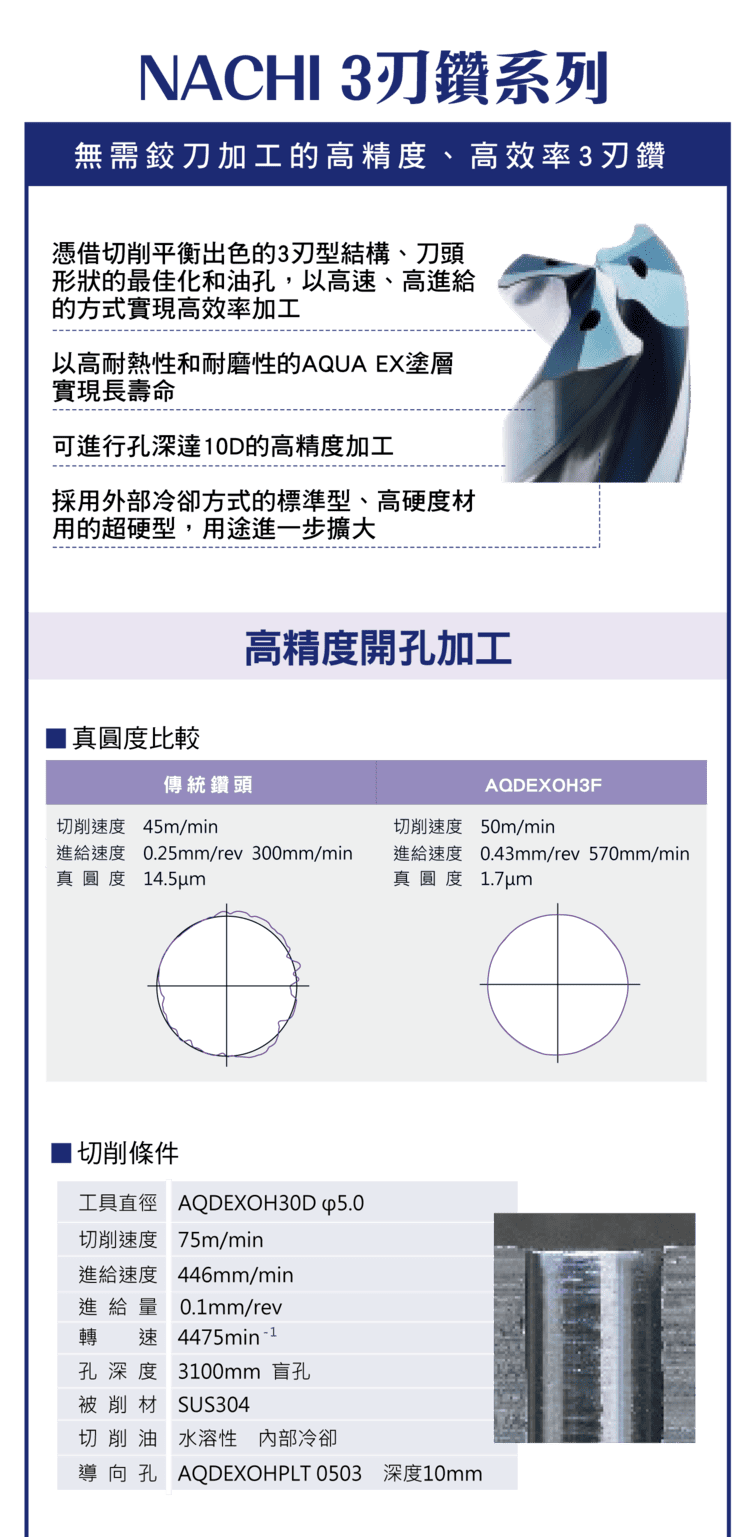
The three-edge structure distributes cutting force and raises stability, so feed can be higher, vibration lower and hole quality better — an efficiency and accuracy edge over conventional 2-flute drills.
2. Hard-Material Capability (Manufacturer Example)
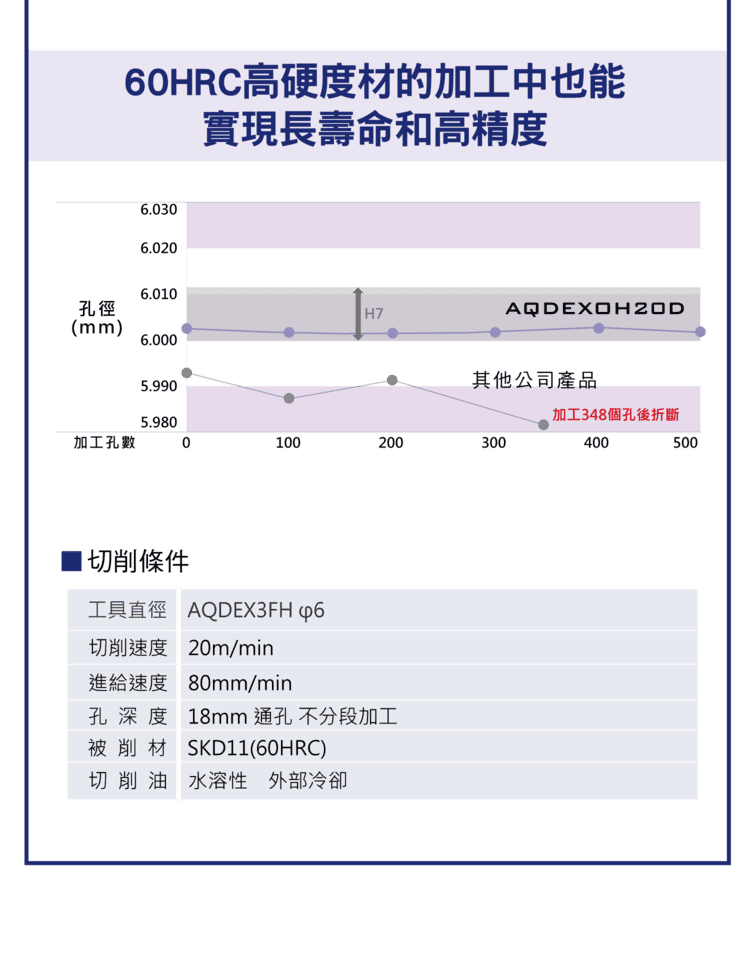
As a manufacturer example, a 3-flute drill (AQDEX3FH) can machine SKD11 (~60HRC) while holding diameter accuracy. The table below lists three separate, independent tests from the manufacturer catalogue — work material, tool model and cutting conditions all differ between them:
| Test case (three independent tests) | Conventional / competitor tool | 3-flute drill (mfr. example) |
|---|---|---|
| Hard-material drilling (SKD11, ~60HRC) | breaks after ~348 holes | hole diameter held within H7 |
| Roundness (SUS304) | approx. 14.5 μm | approx. 1.7 μm |
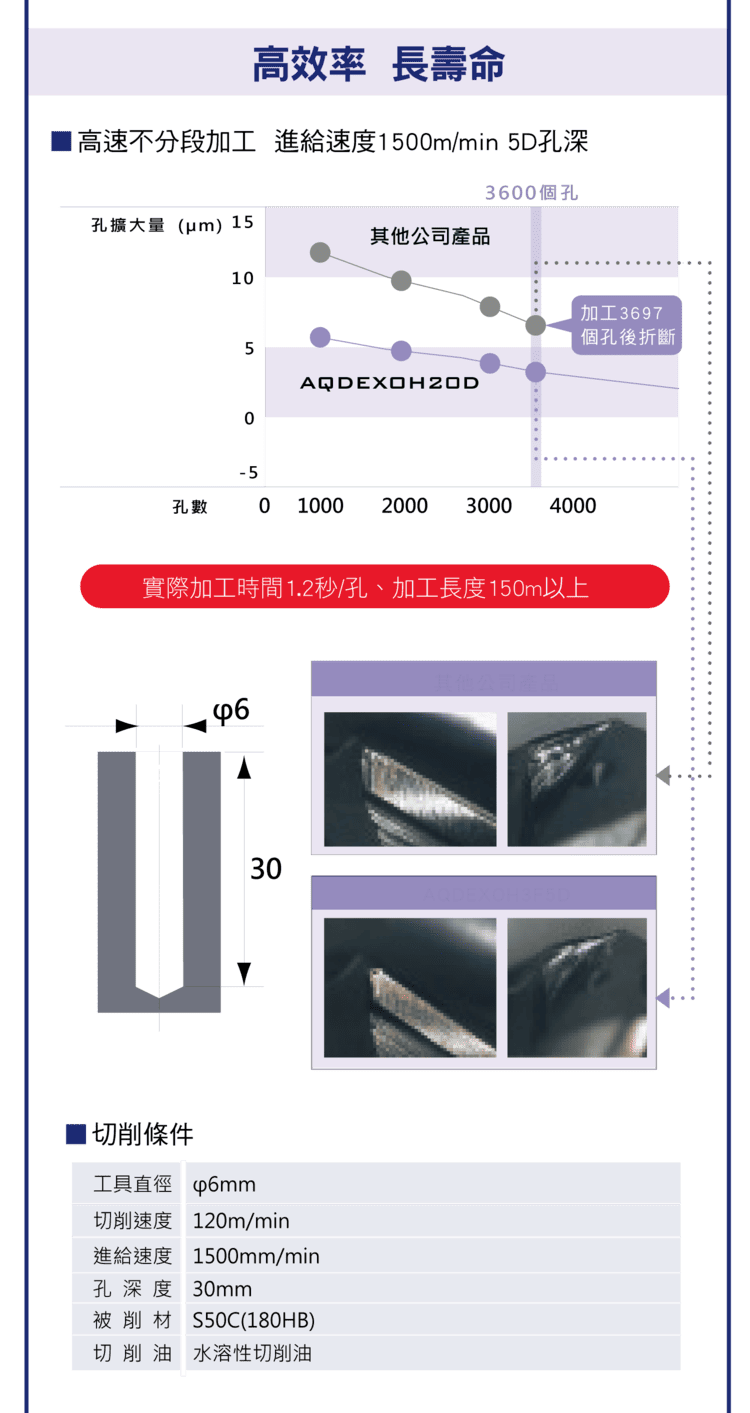
| High-speed non-peck drilling (S50C, 180HB) | breaks after ~3,697 holes | 3,600 holes with hole enlargement held stable |
※ The three rows above are taken from the NACHI catalogue "Carbide Drills", p.13–14. They are three independent tests with different work materials, tool models and cutting conditions, and must not be converted into one another or combined into a single comparison. The hard-material test used AQDEX3FH φ6 (20 m/min, 80 mm/min, 18 mm through hole, non-peck); the roundness and high-speed tests used the AQDEXOH3F series. In the high-speed test the catalogue chart compares hole-enlargement stability, not tool life. Actual results vary with tool, machine and conditions.
3. Hole Accuracy and Roundness
The 3-flute drill's roundness is markedly better than a conventional drill (mfr. example ~1.7 μm vs 14.5 μm), with good wall quality that raises dimensional accuracy and reduces secondary work.
4. High-Speed Machining and Efficiency (Manufacturer Example)
The 3-flute drill runs high-speed without pecking and offers high feed; a manufacturer example reaches about 1500 mm/min and ~1.2 s per hole, helping raise output and cut cost.
5. Deep-Hole Capability (10D)
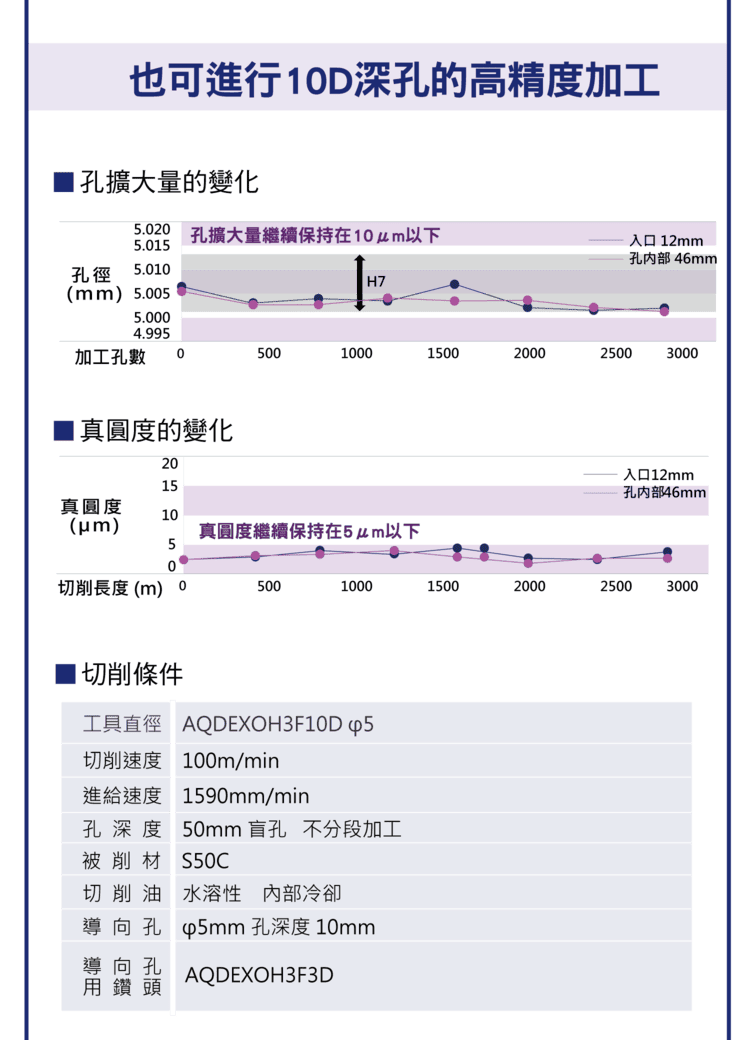
It can drill 10D deep without pecking (maker’s test condition: a ø5, 10 mm-deep guide hole is drilled first with a short drill, then the 50 mm blind hole in one pass); a manufacturer example holds diameter growth within 10 μm and roundness within 5 μm for stable deep-hole quality. For deep-hole evacuation and guiding, see the Deep Hole Drill Guide.
6. Cutting Conditions and Applications (Reference)
| Item | Reference |
|---|---|
| Cutting speed | approx. 20–120 m/min |
| Feed rate | approx. 80–1500 mm/min |
| Hole depth | approx. 18–50 mm |
| Materials | SKD11 (60HRC), S50C, SUS304 |
| Coolant | Water-soluble (internal or external) |
※ Base working parameters on the Drilling Parameters Guide or the maker's catalog rather than copying them.
7. Evacuation and Use Cases
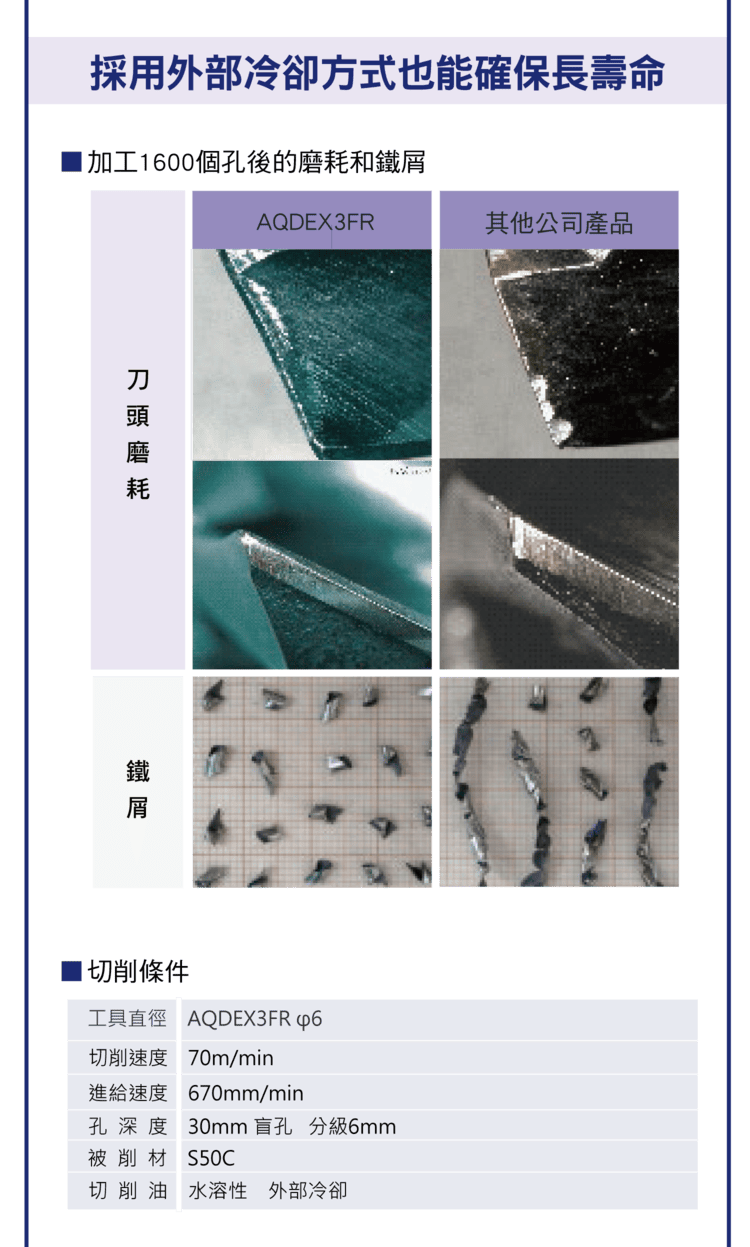
The three-flute design splits chips well and evacuates smoothly, reducing clogging and improving wall quality. It suits hard-material, precision-hole and high-speed production work, paired with a rigid CNC machining center.
FAQ
Q: How does a 3-flute drill differ from a 2-flute?
Three edges distribute cutting force for higher feed capability and steadier walls, with markedly better roundness and life than a 2-flute; it needs a rigid machine and stable evacuation.
Q: Can it machine 60HRC hard material?
Yes (manufacturer example). It can machine SKD11 at ~60HRC while holding diameter accuracy and stable life, with a suitable coating, conditions and cooling.
Q: How high can the feed go?
Because force is distributed, feed capability is high (mfr. example up to ~1500 mm/min); set actual values by material, diameter and machine rigidity via calculation.
Q: Where does the 3-flute drill fit best?
Hard-material, high-precision and high-speed production holes — e.g. molds and parts needing high roundness; pair with a rigid CNC machine and stable internal coolant.
For the full reading guides on this topic, see Chip Control: A Complete Reading Guide and Hole Accuracy: A Complete Reading Guide.
This article is part of Drill Bits: The Complete Guide - Start From Depth-to-Diameter, Then Pick the Drill and Set the Conditions; that guide shows how the whole topic fits together.
Published: 2026-03-24 | Last updated: 2026-10-05









